
Digital health is a HUGE topic. It can refer to:
- health records being digital rather than paper-based
- administrative interactions that occur online, such as booking, cancelling or re-scheduling appointments
- health care delivered digitally rather than face to face (for example, via a video call)
Electronic Medical Record (EMR) Program
WA Health is getting a statewide Electronic Medical Record. This is a HUGE investment, and a transformative opportunity to re-shape how we deliver health services.
EMR and Consumer Involvement
- In 2021, Health Consumers’ Council was commissioned by the WA Department of Health to co-design a Consumer Charter for an Electronic Medical Record. It was informed through Kitchen Table Discussions across our vast state, and created by a EMR Consumer Charter Reference Group.
- Following the development of the Consumer Charter, there was a pause in work until 2023, while waiting for the Business Case to be approved by WA Goverment.
- In 2023, HCC re-established an EMR Consumer Reference Group, starting with many of the people who had worked on the Charter, and this EMR Reference Group has continued to meet in regularly.
- From January 2024, Health Consumers’ Council Digital Health Lead (Pip Brennan) has been co-located with the EMR Program a day a week to embed the consumer voice.
- From October 2025, WA Health appointed a Director Consumer Engagement (Bec Johnson) who works full-time with the project to coordinate the consumer involvement as the EMR Program develops
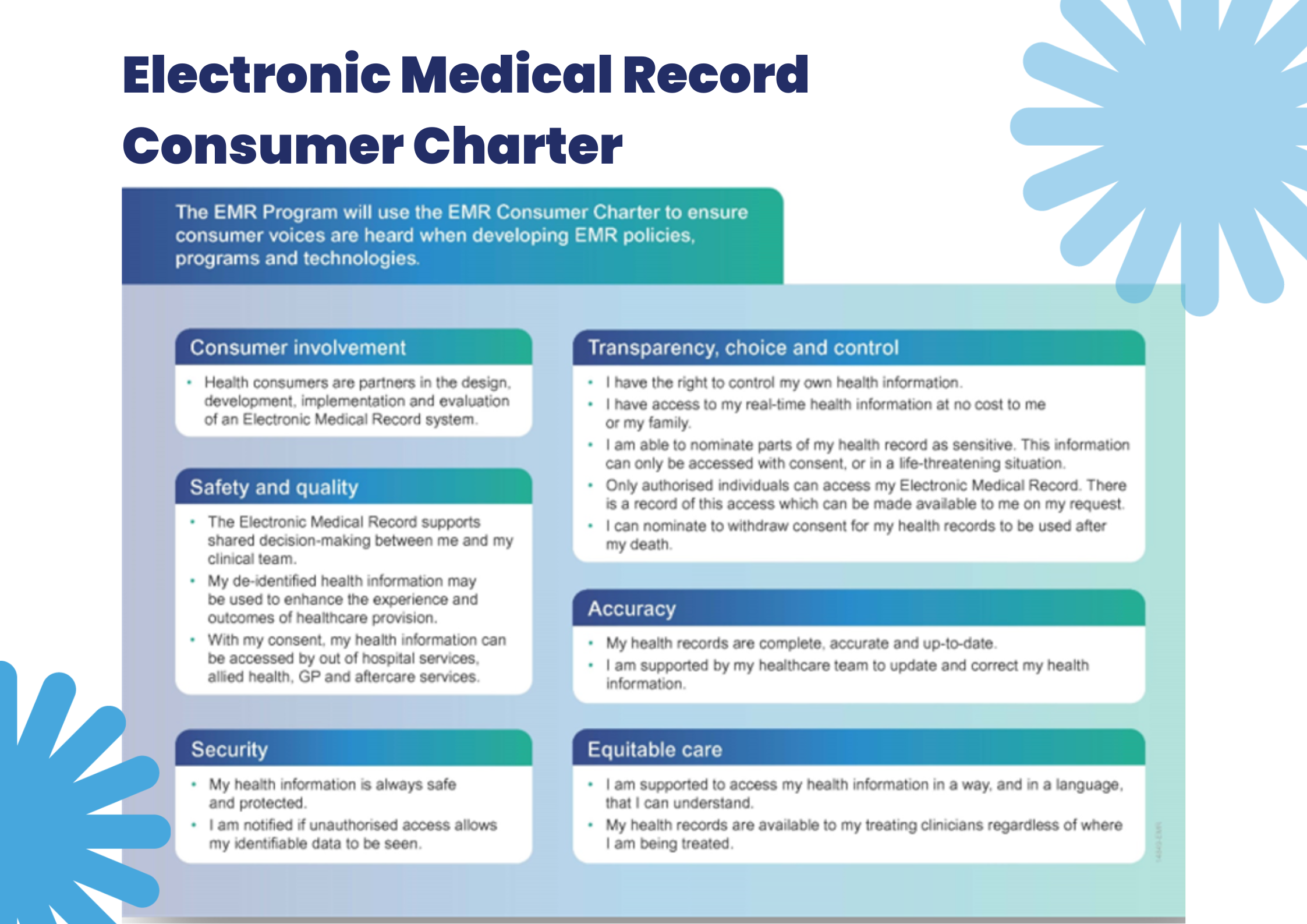
EMR Consumer Charter
Consumer involvement
- Health consumers are partners in the design, development, implementation and evaluation of an Electronic Medical Record System
Accuracy
- My health records are complete, accurate and up-to-date.
- I am supported by my healthcare team to update and correct my health information.
Security
- My health information is always safe and protected.
- I am notified if unauthorised access allows my identifiable data to be seen.
Transparency, choice and control
- I have the right to control my own health information.
- I have access to my real-time health information at no cost to me or my family.
- I am able to nominate parts of my health record as sensitive. This information can only be accessed with consent, or in a life-threatening situation.
- Only authorised individuals can access my Electronic Medical Record. There is a record of this access which can be made available to me on my request.
Safety and quality
- The Electronic Medical Record supports shared decision-making between me and my clinical team.
- My de-identified health information may be used to enhance the experience and outcomes of healthcare provision.
- With my consent, my health information can be accessed by out of hospital services, allied health, GP and aftercare services. Equitable care
- I am supported to access my health information in a way, and in a language, that I can understand.
- My health records are available to my treating clinicians regardless of where I am being treated.
Want to stay in touch?
If you’d like you’d like to receive updates about this work, including opportunities for input, you can register to join our Electronic Medical Record Consumer Updates or email info@hconc.org.au
Summary of key consumer issues
Webinar Links
The EMR Consumer Reference Group identified key areas of learning. We developed the following webinars on key topics which you can watch on replay.
- Patient Portal – this is the part of an EMR that we will use – how can we help shape this to ensure it works well for consumers. Click on this Patient Portal link to read a summary of our presentation about what a patient portal is, what we need to think about for WA’s EMR patient portal and watch the whole replay.
- Interoperability – a fancy word for having your health information follow you from GP, hospital, residential aged care etc. In March of 2024 we interviewed Harry Iles-Mann (Consumer Leader and Digital Health Expert) and Peter Sprivulis (Chief Clinical Information Officer, WA DoH) with the topic “Can an EMR stitch WA’s health system together? Australia is undertaking a significant amount of work in this space, and we as consumers are keeping a close eye on how this may benefit us in WA to keep this topic at the top of the list. The statewide EMR is focusing on the work within WA hospital walls, and we are doing what we can to keep the focus on how this will connect with private hospitals, GPs, aged care facilities and others. Click here to read our blog summarising the issue, where you can find the webinar replay, a summary and a webinar transcript.
- Data Security and Trust with an EMR
This is a huge topic, and we tackled this by speaking to Keith Donohoe (Consumer Advocate) and Robyn Gillies (Chief Medical Information Officer, EMR Royal Melbourne). We spoke about what data is captured in an EMR and why, how this information is managed and accessed, and what safeguards are often put in place to protect information from ‘bad agents’. You can watch the webinar replay here. - Data Use – who gets to use our data? How can we ensure our data is used appropriately and that it helps improve services? Our Consumer Charter expresses that we do want our data to be used to help improve health care for ourselves and others, but consent and transparency is important. At one of our meetings, we spoke to Giles Nunnis from WA Primary Health Alliance and Merilee Needham from South Metro Health on the topic of data in our hospitals and GP services. Unfortunately the video didn’t work, but you can read a summary here or read the full transcript here.
- Patient Reported Outcome Measures or PROMS offer a real opportunity to drive patient centred care because they are an opportunity for us communicate how we are feeling as a whole person, how our quality of life is faring as we access health care services. We interviewed Dr Aron Chakera (SCGH Physician, Renal Specialist, Fellow of the RACP) and Dr Christine Georges (Senior Research Fellow, Professor of Surgery at Cabrini Health) to dig into the topic of how PROMs can be developed and implemented. Hint – having them as part of an EMR hugely improves their completion rate and therefore their potential. You can watch the replay here or read the transcript here.
- Standardisation – or rather “harmonisation” of the forms, which reflect the guidelines embedded in an EMR are the “guard rails” within an EMR help keep us safe – but how might we contribute to these? We spoke with EMR Program member Sarah Pearson on this topic – you can watch the replay here or read the transcript here.
- Implementation of an EMR – road bumps and opportunities – what do consumers need to think about? Health Care Consumers ACT staff members shared their experiences and insights on what they learned in relation to their EMR – the DHR as it is known in ACT, and we are keeping them in mind as we move forward in WA to implement ours. A summary of key learnings is available here.
Digital Health Deliberation Series
We ran a series of Health Deliberations:
Health Literacy where Professor Danielle Muscat presented (see her slides here) and we discussed and deliberated. See the summary of our discussions here.
Frequently Asked Questions
Do we have an Electronic Medical Record in WA?
WA does not yet have an Electronic Medical Record, but in May 2024 it was announced in the Budget that WA has received three years’ funding to develop a tender to procure one. We are the last state or territory to do so, which means we are learning from other states.
- This is a statewide Electronic Medical Record for all WA Health public hospitals right across our vast state
- It is a huge undertaking, and the first step has been to create a digital medical record for every hospital or health service
- As at December 2025, a vendor is being chosen
- The actual Electronic Medical Record will be available from about 2027-2028. The following video was produced in 2021 and explains the rollout plan for the staged rollout of WA’s Electronic Medical Record.
What is the difference between My Health Record and an Electronic Medical Record?
While they might sound similar, your My Health Record is different to an Electronic Medical Record.
My Health Record was put in place Australia-wide in 2019, with a record created for every Australia unless they opted out. My Health Record encompasses all aspects of your health care, from the GP to hospital.
An Electronic Medical Record usually refers to your health information within the walls of a hospital, or group of hospitals. It contains information relevant to your hospital admission, but doesn’t necessarily encompass your whole health history.
Do I have a My Health Record?
A My Health Record was created for every Australian, unless you specifically opted-out of having one. If you don’t remember opting out, or you don’t know if you have a My Health Record, you probably do.
My Health Record holds all your key health information, such as immunisations, test results and imaging reports, medication information, and hospital summaries. It can be accessed by your healthcare providers at any time, including in an emergency.
You can find out more about My Health Record here.
If you don’t know if you have a My Health Record, or you’ve never looked at your My Health Record before, we recommend you take a look at what information is included. You can find out how to set up your My Health Record here.
Additional resources
- “Digital health – we have come so far, but still so much to do” – Leanne Wells, former CEO of Consumers Health Frum of Australia, 2022 blog post
- Healthy WA – Digital Medical Record
- Healthy WA – Electronic prescriptions for medication
- Electronic prescriptions FAQ
[Last updated 01/24]