Author: HCC

Consumer voices driving health – informing the preventative health agenda

WA is the first state to have a Minister for Preventative Health, the Hon Sabine Winton. Late last year, Health Consumers’ Council WA was invited to be part of a number of roundtables gathering input to inform the development of WA’s first preventative health strategy.

There were six roundable discussions and HCCWA were invited to attend four:

  • Mental health and wellbeing in the early years
  • Immunisation
  • Health promotion
  • Cancer screening and genomics

The other two were:

  • Sexual health
  • How government departments work together on this agenda

A number of other consumer and community organisations attended some of the sessions including Alcohol and Other Drug Consumer and Community Coalition, WA Association for Mental Health and Aboriginal Health Council WA.

HCCWA’s input to these discussions was based on the deep and broad understanding of health consumer interests which comes from our daily interactions with patients,  families and carers, people with lived experience and community members. In general our input was:

  • It’s critical to address the social determinants of health – particularly poverty.
  • A focus on the first 1,000 days and healthy families is essential – we highlighted the need to have a concerted focus on preventing and addressing early childhood trauma
  • A lot of prevention takes place outside the “health system”; Government needs to be joined up in its approach, and move to being more community-centred, and less
    “service-centred”
  • There is a need to invest in more community-driven/community-led health promotion activities at a grassroots level
  • Unsurprisingly we called for much more involvement of a wide range of consumers, carers, families and people with lived experience in all scoping, planning, delivery and evaluation of all preventative health initiatives
  • Targeted work should be done to include the voices of people who may not engage in traditional “consultations”, including people experiencing homelessness, people with intellectual disability, and people where English is not their first language
  • The value of peer-led approaches across all areas of health and mental health – including in health promotion activities within and outside clinical settings.

The Minister sat in the room for the duration of each session and I had a clear sense she’d listened deeply and took the feedback on board. She also made reference to a public facing consultation process – we’ve flagged with her office that we’d like to work with them to ensure wide and deep engagement.

We’ll circulate more information about the public consultation when we get it.

Clare Mullen, Executive Director

Employment Opportunity | Systemic Advocacy Engagement Lead

Part-time to Dec 2026 with possible extension

Can you help us build a social movement in health?

Are you passionate about improving equity and participation in health? Do you love all types of data – including first person stories, other qualitative information and quantitative data – and are skilled at weaving these together to craft compelling cases for change that prompt action? Then this might be your perfect role.

Systemic Advocacy Engagement Lead, part-time (4 days/week), fixed term to December 2026 with the possibility of extension

At Health Consumers’ Council, we believe in people power. Through our engagement and partnerships work, we are building a social movement in health – where the people who use health and healthcare services, and the people who work in them, can work together to identify priorities for improvement and make positive and lasting change.

Health Consumers’ Council WA

Health Consumers’ Council WA (HCCWA) is an independent community-based organisation which was established in 1994, representing the consumer’s voice in health policy, planning, research, and service delivery. We stand for equitable, person-centred, quality healthcare and improved health outcomes and experiences for everyone in Western Australia.

About the role

This role reports to the Executive Director. You will work with people across the HCCWA team who work on Aboriginal engagement, cultural diversity engagement, consumer representation and consultation, and individual advocacy.

This role is 0.8 FTE (4 days or 22.5 hours/week) based in our offices in Mount Lawley with the possibility of working from home for up to 50% of the time.

The role is initially offered to the end of December 2026, with the possibility of extension subject to funding.

The role offers

  • The opportunity to ensure diverse consumer perspectives are represented at the highest levels of decision making in health
  • The opportunity to work on a wide range of projects and with people from a wide range of backgrounds
  • The opportunity to be part of a consumer-first organisation with a focus on improving health equity and championing health rights
  • A friendly and supportive team that’s making a tangible difference in the community
  • A competitive not-for-profit annual base salary – Level 6 Social Community Home care and Disability Award $55.72/hour + super
  • Salary packaging up to $15,900 per annum
  • Flexible working with the opportunity to work from home up to 50% of the time when settled in to the role

About you

  • You’re looking for a role where you can apply your strong analysis and writing skills to advance social justice
  • You’re interested in the health system and care about people’s experiences of it
  • You’re comfortable advocating for diverse consumer perspectives to senior decision makers – and just as happy to roll your sleeves up and tidy up after an event along with your colleagues

What you’ll be doing

This position synthesises consumer insights and other literature and evidence to write submissions to public consultations and respond to opportunities to promote HCC’s systemic advocacy agenda as they arise. You will gather insights from health consumers, carers, community members and people with lived experience to inform and create submissions and engaging informative content that is distributed across a number of platforms including social media, email, web and online and hard copy publications and materials. You will also participate in a number of high level committees across WA Health representing diverse consumer views.

A typical week might see you:

  • Hosting a focus group with consumers on a specific topic to inform HCC’s submission to a national consultation
  • Preparing a submission to a Parliamentary enquiry
  • Attending a number of Project Control Group meetings for high profile systemwide reform programs ensuring that diverse consumer perspectives are represented and understood
  • Collecting and reviewing a wide range of information – including first person stories, government policies and publications, social media content, data relating to HCC’s individual advocacy and engagement activities – and using this to produce reports using everyday language, for consumers and community members
  • Updating the HCC website to inform our members and others about our systemic advocacy activities
  • Staying across current issues relating to health and social care, ensuring timely and evidence-based position papers and information is available as needed
  • Meeting with counterparts in other health consumer advocacy groups to collaborate for maximum impact

See the job description for a full outline of responsibilities for the role.

What you’ll need to succeed in this role

Essential 

  1. 3+ years’ experience in a similar role
  2. Well-developed analytical skills including the ability to work with and analyse quantitative and qualitative data and present these in a format that is accessible to non-expert audiences
  3. Excellent English literacy, writing, editing and proofing skills, able to succinctly and quickly synthesise and present a wide range of information on systemic advocacy issues for a range of audiences including formal policy submissions
  4. Ability to quickly synthesise information from a range of sources into accessible engaging content for a range of media including but not limited to social media, media releases, blogs, briefings and articles
  5. Knowledge of the Australian health and health system context including the levers for change
  6. A belief in the importance of the role of health consumers as partners in the planning, design, monitoring and evaluation of health services
  7. Able to confidently and effectively express a diverse range of consumer perspectives in a range of settings including in meetings with senior decision makers, public forums and in written form
  8. Able to use a range of software programs including (but not limited to) WordPress, Canva (or other graphic design program), Survey Monkey, Mailchimp, Zoom and Microsoft Office (or the ability to quickly become proficient in these)
  9. Experience in organising meetings, workshops or events to gather feedback and insights from consumers and other stakeholders
  10. Collaborative working style with an ability and willingness to muck in with other team activities as required
  11. The ability to work autonomously and within deadlines, including managing a number of projects at the same time
  12. Proactive, reliable and flexible attitude and comfortable working in a fast-paced adaptive environment

 Desirable

  1. Strong networks in political circles
  2. Experience in campaigning on social issues

But if you have other skills and experience that you think makes you a great fit for this role, please tell about those too!

Diversity and inclusion

At Health Consumers’ Council we know that strength comes from diverse perspectives being at the table. We particularly encourage applications from Aboriginal and Torres Strait Islander people, people from culturally diverse backgrounds and identities, and people with disability.

To apply for the position

Send a cover letter of no more than two pages addressing the selection criteria in the job description, along with a current resume outlining your work experience, skills and any relevant education or training to jobs@hconc.org.au. Applications that do not address the criteria may not be considered.

  • The closing date for applications is 8am on Thursday 29 January 2026

But, we will be assessing applications as they come in and reserve the right to appoint before this deadline, so if this is your dream job, submit your application promptly

If you require any adjustments to submit your application or wish to have a confidential discussion about the role, please contact Clare Mullen, Executive Director on (08) 9221 3422 or email ceo@hconc.org.au

Job: Executive Assistant, part-time, to Dec 2026 with possible extension

Love organising? Eagle-eyed proof-reader? Like to be at the centre of the action?

We are passionate about the power of health consumer and lived experience voices to improve health outcomes and experiences for everyone in WA. We’re looking for someone who shares our vision to join our small but mighty team.

Executive Assistant, part-time, fixed term (to December 2026 with the possibility of extension)

We are seeking a highly organised Executive Assistant who loves people and being in a fast-paced environment with lots of variety. This is a pivotal role in an agile and growing organisation and helps ensure our Executive operations run smoothly and effectively.

The role is available for 25 hours/week to be worked across Monday – Friday.

The role offers:

  • A high degree of variety – working with the Executive Director on a wide range of activities and liaising with diverse community members and staff at all levels in the health and social care system
  • The opportunity to be part of a consumer-first organisation with a focus on improving health equity and championing health rights
  • A welcoming and inclusive workplace where everyone is encouraged to bring all of themselves to work
  • The opportunity to implement and streamline administrative processes to help us make the most of the limited funding we receive
  • A competitive not-for-profit annual base salary with salary packaging – Level 3.1 Social Community Home care and Disability Award $38.65/hour + super
  • Salary packaging up to $15,900 per annum

About you:

  • You’re looking for a role where you can apply your executive assistance and administration skills to do work that you care about
  • You’re highly organised and enjoy working in an agile and responsive environment
  • You’re interested in the health system and care about people’s experiences of it
  • You’re happy to muck in and enjoy working on a range of different projects and with different teams simultaneously

Position overview

This position provides expert administrative and governance support to the Executive Director and the HCC Board. This includes diary and travel management, secretariat support for Board committees, policy development and co-ordination, general office administration, and covering reception as required.  We’re looking for someone who will be proactive and work collaboratively with colleagues to support our work which has the consumer experience and voice at its heart.

A typical week might see you doing a range of tasks:

  • Coordinating the Executive Director’s busy diary in liaison with senior stakeholders across the WA health system
  • Organising the Executive Director’s email inbox ensuring that priority emails are identified and actioned
  • Following up on actions as directed by the Executive Director and senior staff
  • Assisting with planning and delivering a range of events, workshops and activities by organising attendee lists, logistics and catering and consumer payments and enquiries
  • Drafting, coordinating and proof-reading papers for upcoming Board meetings
  • Attending workshops and events when required to – this may include occasional after hours working
  • Greeting visitors to our offices, responding to our reception phone calls, and responding to emails through our main inbox
  • Managing the training room and equipment register
  • Monitoring and updating organisational policies, procedures and registers
  • Scheduling meetings, preparing agendas and recording minutes
  • Managing stakeholder contact details through our Customer Relationship Management (CRM) system
  • General office admin including organising travel and accommodation
  • Generating simple reports and analysis from existing systems including data entry

See the job description for a full outline of responsibilities for the role.

Selection criteria

Essential

  1. A minimum of 2 years’ experience in a similar Executive Assistant role with a deep understanding of the requirements for attention to detail and confidentiality
  2. Well-developed interpersonal and verbal skills, with a demonstrated understanding of the sensitivity and empathy needed when communicating with vulnerable community members and senior stakeholders
  3. Well-developed written communication skills, with the ability to write clearly and concisely for internal and external use
  4. Excellent organisational skills, with high attention to detail and the ability to manage and prioritise deadlines and own workload with limited supervision
  5. Demonstrated ability to use initiative and solve problems within own area of responsibility
  6. Be adept, or be able to quickly become adept in, a range of office software programs including Microsoft Office 365 Suite, project management software, and accounting software

 Desirable

  1. A demonstrated interest in the aims and purpose of HCC, for example, experience as a health consumer representative or volunteering in a similar advocacy organisation
  2. Experience working in community services and not for profit sector
  3. Ability to develop and maintain productive relationships with diverse internal and external stakeholders, and navigate difficult conversations when required


To apply for the position

Read the job description and send a cover letter of no more than two pages addressing the selection criteria, along with a current resume outlining your work experience, skills and any relevant education or training to jobs@hconc.org.au.

Please submit your application no later than 8am on Tuesday 27 January. 

However, note that applications will be considered as received and we reserve the right to progress recruitment before the closing date – so get your application in early.

Applications that do not address the criteria may not be considered.

If you require any adjustments to submit your application or wish to have a confidential discussion about the role, please contact Clare Mullen, Executive Director on (08) 9221 3422

Health Consumers’ Council WA calls for urgent action to address GP access and affordability in WA

MEDIA RELEASE
12 January 2026

Health Consumers’ Council WA calls for urgent action to address GP access and affordability in WA

The latest Cleanbill Blue Report reveals a mixed picture for Western Australians seeking GP care. While the national rate of fully bulk billing clinics has doubled to 40.2%, Western Australia lags far behind at just 19.8%, the second-lowest rate in the country. At the same time, out-of-pocket costs for those not bulk billed have risen to an average of $46.63, up nearly 10% from last year.

Health Consumers’ Council WA Executive Director Clare Mullen said these figures highlight a growing equity gap in primary care access across the state.

“Western Australians deserve timely, affordable healthcare, yet these findings show that too many people are still facing significant barriers. Bulk billing remains the exception rather than the norm in WA, and rising costs risk pushing care out of reach for those who need it most.”

The report also notes a national trend of GP clinic closures and consolidations, raising concerns about future availability of services in regional and remote WA.

“Consumers tell us every day about the stress and hardship caused by limited access to GPs. We need urgent, coordinated action to ensure that incentives translate into real improvements for WA communities—not just on paper.”

Health Consumers’ Council WA is calling for:

  • Greater transparency on GP pricing and availability.
  • Targeted support for clinics in WA to adopt bulk billing practices.
  • Consumer voices at the centre of policy decisions to ensure reforms meet community needs.

As an independent organisation advocating for health equity, HCCWA will continue to amplify consumer experiences and push for solutions that make healthcare accessible for all Western Australians.

ENDS

Media enquiries: 0488 701 839 | info@hconc.org.au

Bronwyn Ife  |  Systemic Advocacy and Engagement Lead

Clare Mullen | Executive Director

Position filled: Executive Assistant role

employment opportunity for executive assistant

This position has been filled. 

We do sometimes need to take people on at short notice. If you are interested in working with us in a future role, please send a short resume and covering letter to us at jobs@hconc.org.au.

The types of roles we have available from time to time:

  • Project officer/manager
  • Advocacy – individual and systemic
  • Stakeholder engagement
  • Administration


Dental issues, quality and cost – update on advocacy Oct 2025

This year many of us have been shocked by news reports of consumers having paid up front for extensive and costly dental treatment (often implants) and then before the work is completed their practitioner has stopped practicing, died or been deregistered, leaving consumers out of pocket, in pain and with nowhere to turn.

Making this more devastating, a number of consumers have withdrawn a substantial sum of money from their superannuation to afford the up-front cost for treatment. With the treatment being left unfinished they are left high and dry, and out of pocket.

What we heard

When these issues came to our attention – raised by consumers directly to our individual advocacy service, and through the media coverage in The Sunday Times – we looked into what had gone wrong and we found:

  • High costs of dental treatment meaning people need to request access to their Super to help cover the cost
  • Practitioners requiring payment upfront but those payments not always being protected or returned to consumers if practitioners are unable to complete the work
  • The system that’s supposed to protect consumers having a number of gaps:
    • Predatory advertising of costly dental treatment and encouragement to access Super without financial advice being promoted via social media with highly emotive imagery
    • Limitations of information being provided to consumers to enable them to make truly informed consent and being clear about the future impact of accessing Super to pay for treatment
    • The request for Compassionate Release of Super being signed off by the same health practitioner who will be benefit financially from that request. In many cases, this may not be a cause for concern. However, it allows for unscrupulous practitioners to encourage the transfer of funds from  someone’s future financial security, to their own income with little/few checks and balances to ensure fully informed consent.
  • Quality issues – people paying for expensive treatment and then learning their treatment was not of the expected standard
  • Practitioners with a history of concerning practice being able to continue to practice – and information not being available to consumers about past history

What we’ve done so far

It’s clear that the regulation and protection of consumer rights in the area of dental treatment is ripe for reform. Some of the gaps in protection for consumers will take a long time to resolve.

Having collected information about people’s experiences and identified the gaps in consumer protection, we’ve reached out to a number of the agencies that can play a role in addressing these. These include:

  • The Australian Health Practitioner Regulation Agency (AHPRA) and the Australian Dental Board
  • The WA Chief Dental Officer
  • The WA branch of the Australian Dental Association
  • The WA Commissioner for Consumer Protection
  • CHOICE, the national consumer advocacy group

We also reached out through our networks to find out about other consumer concerns on this area. Using that feedback, we’ve contributed to a number of media articles and raised consumer concerns regularly and consistently, as well as speaking up on consumer perspectives at this year’s Dental Board conference. We are making these points:

  • people making the decision to access Super to pay for dental treatment need to be provided with clear information about what they are paying – $10,000 today may actually be worth a lot more if it had been left to accumulate interest in your Super fund
  • if someone is paying up front for treatment, those funds should be held in a trust account – similar to when you pay a deposit for a rental property – that can’t be accessed by the health professional until the work has been completed
  • that regulators – like Ahpra – need to put the interests of consumers front and centre when designing and applying systems of regulation. And acknowledge that financial harm is a risk to consumers, and that regulation systems need to protect against that alongside health harm.

About compassionate release of super

The early release of superannuation – known as Compassionate Release of Super – is meant to only be used if other funding options such as savings or a loan are not available. It’s a last resort mechanism that’s in place to enable people to pay for  essential treatment that cannot be paid for any other way to:

  • treat a life-threatening illness or injury
  • alleviate acute or chronic pain
  • alleviate acute or chronic mental illness.

We are not arguing that the ability to access superannuation for compassionate reasons should cease. We are calling for some tighter checks and scrutiny to ensure that the release is only available when the treatment does meet the above criteria. And that consumers understand the full implications of accessing their funds this way.

The data that the Australian Tax Office provides is alarming.  A majority of superannuation released for compassionate grounds is being spent on medical care, with $1 billion released for medical treatment in 2023-24.

The largest category for medical release of superannuation is dentistry, with $526 million of the above $1 billion being released to pay for dental treatment. This has increased from $66 million in 2018-19, a nearly 700% increase in six years.

Many practices include references to accessing superannuation on their websites when they are referring to payment options. Some others mention accessing superannuation on the front page of their website and some even include it in their online advertising that is pushed as sponsored posts on social media and other websites. We have also seen the emergence of businesses who can complete your superannuation paperwork for you and help you access your super. These are not medical practices but rather an agency who charges patients to help them complete a fairly simple form, and can refer people to their “partner” practitioners if they are having a hard time getting a dentist to sign off on the release of superannuation.

We hope that the ATO can use their data to identify and track practitioners who are the recipients of a larger than usual proportion of superannuation releases and take appropriate actions to ensure that any unusual charging practices are closely scrutinised.

If you have concerns about the financial practices of a health practitioner, you can submit a notification to Ahpra at https://www.ahpra.gov.au/Notifications/Concerned-about-a-health-practitioner.aspx

Registration of practitioners who have a history of disciplinary issues

It became clear that one of the practitioners who had attracted media attention had previously been deregistered in another country. We have raised this with AHPRA as it was unclear to us how this practitioner came to be registered in Australia. While we were unable to obtain specific detail about an individual dentist we did have extensive discussions on this topic and are hopeful that AHPRA will in the future be approaching such registrations in a different way.

Where to next?

Sadly, many of the patients who have been left out of pocket with unfinished work by David Hurst are still stranded. We are aware that a class action has commenced and we hope that this process is helpful for those consumers.

We will be continuing our advocacy with the agencies outlined above to advocate for long-term systemic change. We will continue to share updates through our e-news.

If you have any comments on any of this, please reach out to us at info@hconc.org.au


Dental costs in WA. Consumer FAQ

Updated October 2025. Health Consumers’ Council WA.

Why are we talking about dental costs

Some people in WA paid large sums upfront for dental work. When a dentist stopped practising or was deregistered, the work was left unfinished. Patients lost money and often had health impacts.

Why do people use their superannuation for dental

Dental care is expensive. Many cannot afford it. Some dentists and third party services promote using superannuation as a payment option.

What is the risk

  • If treatment is not finished, your money may be lost.
  • Upfront payments are rarely protected.
  • Some dentists continue working despite past problems.
  • Advertising can be misleading about cost and outcomes.

How much superannuation is being used

In 2023 to 2024 Australians accessed 1 billion dollars through compassionate release of superannuation. Dentistry accounted for 526 million dollars, up from 66 million dollars in 2018 to 2019.

What should I do if I am considering dental work

  • Ask for a written cost estimate with item codes and timeframes.
  • Avoid paying the full cost upfront. Request staged payments.
  • Check the dentist’s registration on AHPRA and the Dental Board.
  • Be cautious of advertising that pushes superannuation access.
  • Contact HCCWA if you are unsure of your rights.

What is HCCWA doing

  • Collecting consumer stories and evidence.
  • Raising issues with AHPRA, the Dental Board, WA Chief Dental Officer, ADA WA, and Consumer Protection WA.
  • Partnering with consumer groups.
  • Pushing for protection of upfront payments and clearer disclosures.

Need advice

Contact Health Consumers’ Council WA. Visit hconc.org.au or call 08 9221 3422.

Your voice at the table: HCCWA’s recent ministerial meetings

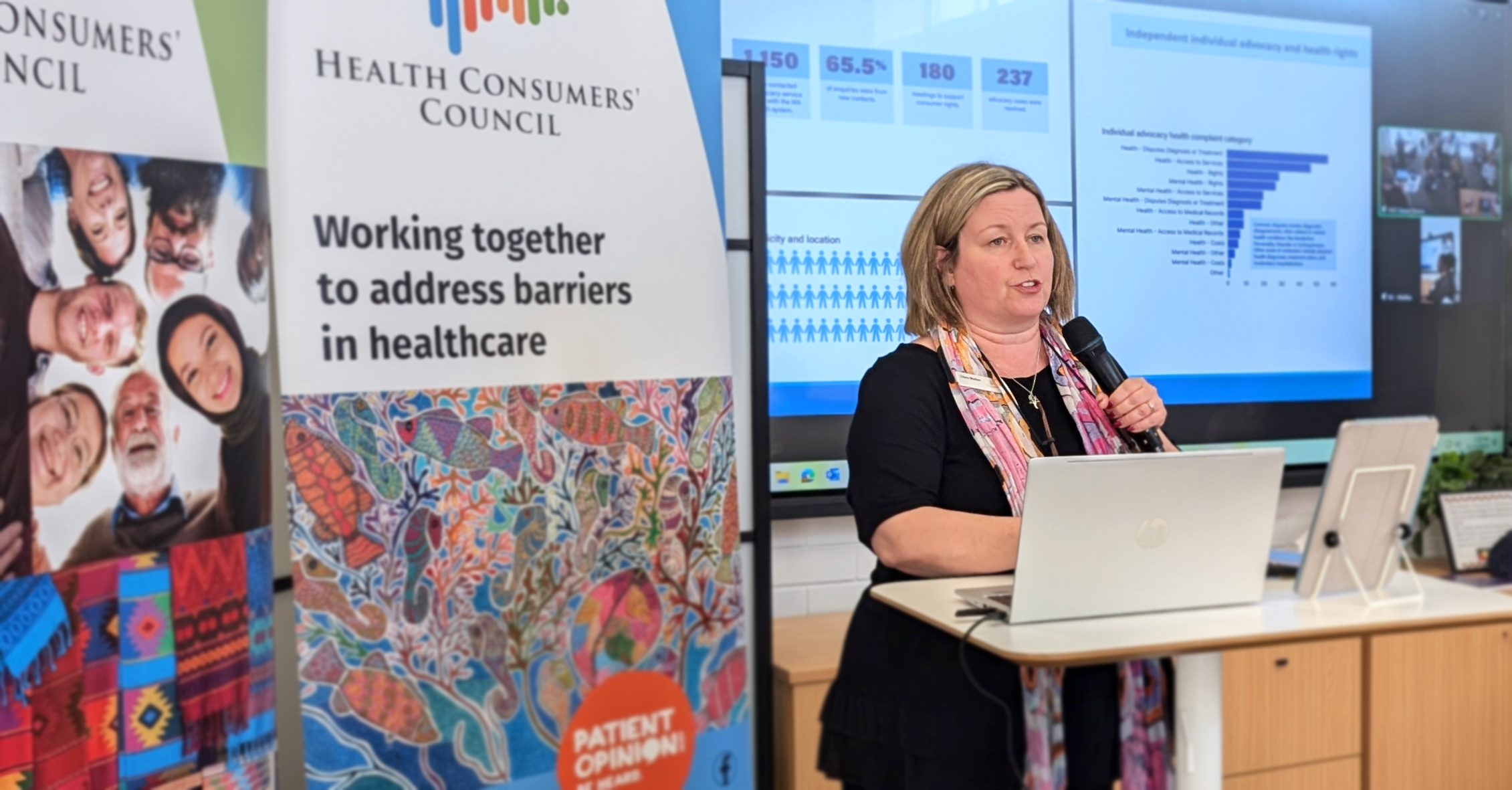
Clare Mullen speaks about the Healthcare Consumers' Council

Building strong partnerships with WA’s new Ministerial team

Over the past few weeks, we have been busy meeting with the new ministerial team and their advisers. These meetings have been a great opportunity to share the experiences and priorities of health consumers across Western Australia. We’re pleased to report that the response from ministers and their teams has been very positive and encouraging.

Why these conversations matter
In all our discussions, Ministers and their advisers were genuinely interested in hearing about the diverse experiences of health consumers — the people who use health services every day. It’s clear that while many lobby groups approach government, our unique focus on the lived experiences of health consumers stands out as vital and valued.

Key highlights from our meetings

  • Making healthcare fair
    In our discussions with all the ministers and their teams, we discussed how consumers deserve healthcare that is fair for all. This includes

    • access to independent advocacy support to reduce harm and level the playing field if things go wrong
    • particular efforts to ensure that the concerns and interests of Aboriginal people, people from multicultural backgrounds, and people with intellectual disability are heard and not dismissed in healthcare settings
    • addressing the financial barriers to healthcare like expensive hospital parking fees.


  • Preventative health and system sustainability
    In our discussions with Minister Hammat – Minister for Health and Mental Health – and with Minister Winton’s team (Minister for Preventative Health) we talked about how health consumers and community members would like to see the commitment to increased investment in preventative health delivered on, noting it is a priority highlighted in the Sustainable Health Review. We also shared how critical it is for consumers to be involved at every level of decision-making, particularly as our health system evolves and faces workforce challenges. We recognised the strong work happening in some parts of WA health services to ensure consumer perspectives are understood from Board to bedside – and that there are more opportunities to build on these strong foundations.
  • Addressing the social determinants of health and weight stigma
    Our meeting with Minister Winton’s team reaffirmed their strong understanding of the social determinants of health and their commitment to preventive strategies.  We also commended Minister Carey for his action on increasing access to social housing. We shared updates from the WELL Collaborative (Weight Education, Lifestyle Leadership) — a partnership focused on improving health outcomes and experiences for people impacted by overweight and obesity that HCC has been involved in since 2018.
  • Consumer leadership in major projects
    With Minister Carey – Minister for Health Infrastructure, a new portfolio – we discussed the success of having consumer leadership embedded in the Women and Babies Hospital project. This approach ensures that consumer perspectives are integrated early and meaningfully in major developments. We encouraged that this approach be considered for all major infrastructure activities. We heard that work is underway to streamline and standardise consultation processes on these activities and we will continue to advocate for consumer representatives at every stage – including before ideas are generated, as well as being consulted on outcomes.
  • Health Research and Consumer Involvement
    With Minister Dawson’s office, we advocated for continued consumer involvement in medical research planning, decision-making, and the communication of research outcomes. We discussed how bringing researchers, practitioners, and consumers together can accelerate the translation of research into the real-world applications that consumers are keen see.
  • Aged Care and Community Models
    In our conversation with Minister McGurk – Minister for Aged Care and Women – we emphasised the need for strong support for older people — whether staying well at home or transitioning to aged care. We also discussed the value of community connector models, which help people navigate complex systems. The Minister had a good knowledge of these as she’d been involved in helping to establish a similar model aimed at supporting children in out of home care access essential healthcare.

Looking ahead
These meetings were a great opportunity for us to ensure that the new ministerial team and their advisers understand the importance of health consumer perspectives and how they can help to cut through the vested interests that exist in healthcare. It’s clear that WA’s new ministerial team values the voices of health consumers and is keen to hear about the real-world experiences of those accessing – or trying to access – care.

We look forward to building on these strong foundations to ensure that consumer perspectives remain central in shaping health policies and services.

Clare Mullen, Executive Director

Health services are under pressure around the world – here’s how you can help in WA

Right now, health services are under pressure around the world. In this LinkedIn post an ED doctor in the UK shares his perspectives on why people might be experiencing long waits in Emergency Departments.

Need healthcare that can’t wait?

If you’re seeking healthcare which is unplanned but is not an emergency or life-threatening – and it can’t wait until you can get an appointment with a GP – there are a few options that don’t require you to sit for a long time in an Emergency Department:

  • Call HealthDirect or visit the website for advice and information 24/7 – this service has been significantly improved in recent years and includes the option to discuss your symptoms with a registered nurse.


  • Visit an Urgent Care Centre
    • There are two types of Urgent Care Centres in WA
      • Medicare Urgent Care Centres are free at the point of care – you can find your nearest online at https://www.health.gov.au/find-a-medicare-ucc or by calling HealthDirect on 1800 022 222
        • You may be able to walk-in, or need to make an appointment – check with the centre closest to you
      • Other urgent care centres – such as those provided by St John Health – provide urgent care without an appointment with a fee to be paid.
        • You will need to pay up-front but Medicare Card holders will get a Medicare rebate.
        • The up-front costs can range from $168 Monday to Friday to $310 on public holidays
        • The out of pocket costs (after the rebate) range from approx $125 Monday to Friday to $175 on public holidays
        • You can find your nearest online at https://www.health.gov.au/find-a-medicare-ucc or by calling HealthDirect on 1800 022 222


  • Emergency or life-threatening illnesses or injuries require immediate medical attention by an emergency department or hospital. For example, things like chest pain, breathing difficulties, severe burns, poisoning, loss of feeling, and seizures.

If you do need to attend an Emergency Department, you can get an idea of how long you might be waiting from the WA Health website showing up to date wait times at https://www.health.wa.gov.au/reports-and-publications/emergency-department-activity/data?report=ed_activity_now

Other ways you can play your part in reducing the need for hospital care


  • Maintain good health hygiene habits
    • if you’re unwell, reduce the chance of infecting others by staying home, wearing a mask if out in public, and wash your hands regularly
      • and in particular, take action to reduce the chance of infecting older people in your community or family
    • pay attention to air quality in homes and buildings

HCC’s advocacy in this area

At HCCWA we are actively advocating for the interests of health consumers including patients, carers and family members in relation to ensure affordable access to healthcare across primary, community and hospital settings. This includes providing input on the WA Government’s work in relation to virtual care, care for older people, and emergency access.


Executive Director update May 2025: the critical need for consumer voices

Navigating change: reflections on planning, learning, and the critical need for consumer voices

By Clare Mullen, Executive Director

May is a pivotal month in our calendar year at Health Consumers’ Council. It’s the time where we finalise our plans for the next financial year (which starts in July), which means also finalising our budgets. It’s always a challenge to match our ambition for the WA community and the health consumer community with the limited resources that we have available.

We have been fortunate in the last 12 months to have received some additional funding—small amounts of short-term additional funding from the Health Department and the Mental Health Commission. But our last opportunity for any significant change in our funding was in 2014 when the health system environment – and the scale of the issues faced by health consumers – were very different.

Despite these constraints, we’re excited about what we have planned for next year. We’re very much focused on building the data and the evidence that we need to make a strong case as we hope to negotiate future funding and demonstrate the impact of the work that we are doing. We’re also looking forward to rolling out the self-advocacy workshops and resources we’ve been developing over the last few months – and thanks to those of you who worked with us on those.

Conference season: learning and sharing insights

May is also a busy time because there are lots of conferences that take place around now. I was fortunate to have been invited to put forward consumer interests in several important forums.

Primary Health Alliance Conference, Melbourne

First up, I attended the Primary Health Alliance Conference in Melbourne, where there were many conversations about how to make primary care more accessible and affordable to more people in the community. And in particular, how to enable more people to be able to access multidisciplinary care in a GP practice. I came away from that event thinking about our role in helping to build consumer and community understanding of some of the funding reforms that are needed. I’m looking forward to seeing what comes next with that.

Australian Centre For Value Based Healthcare Congress

Next, I had the chance to facilitate a panel discussion at the Australian Centre For Value Based Healthcare Conference, where we heard from one example of a co-design project that one of the consumer participants described as the best co-design project she had ever been involved with!

We also heard from New South Wales Health, where I learned about some of the data they’ve collected through their patient reported experience measures (PREMs) and patient reported outcome measures (PROMs). This has demonstrated the link that if you get the experience right for people, that can impact positively on the outcomes for people, which also impacts positively on the cost of care. This is really the essence of value-based healthcare: improving experiences, improving outcomes, and improving value for money.

You can read about some of the NSW work – including the link between dissatisfaction with food and health outcomes – here: https://www.bhi.nsw.gov.au/About_BHI/Blog/growing-evidence-on-the-link-between-patients-experiences-and-outcomes
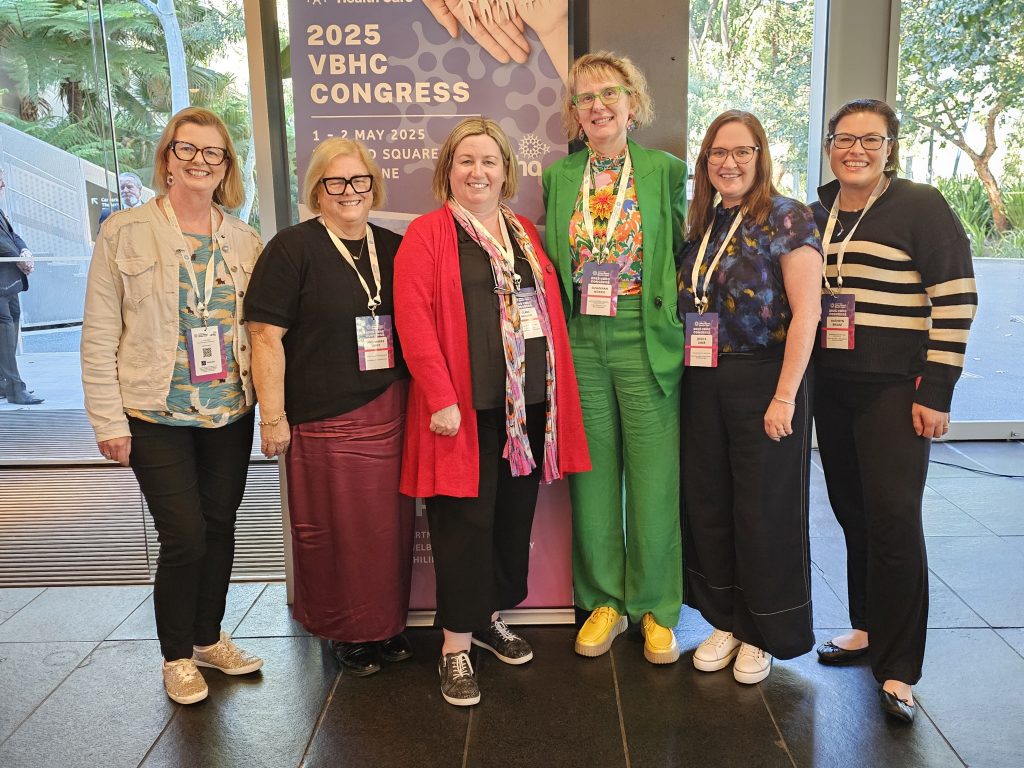
A group shot of 5 women in front of a pull up banner

L-R: Alison Coughlan Health Consumers Centre Vic; Anne-Marie Liddy, Chair, Health Consumers Qld; Clare Mullen, HCCWA; Susannah Morris, Consumer Leader from WA; Jessica Lamb and Kathryn Briant from Health Care Consumers Association ACT

It was also a great opportunity to connect with other consumer advocates and leaders including colleagues from Victoria, Queensland and the ACT.

At Health Consumers’ Council, we’ll be doing more work on value-based healthcare because it’s a really important concept for people who are involved as consumer representatives  – particularly those at executive level and above. It’s one of the ways that we can use the work that’s being done on PROMs and PREMs in Western Australia to drive better experiences and better outcomes.

Thank you to the Australian Centre for Value-Based Healthcare for funding my travel and accommodation to enable me to participate in this and the primary care event.

Ageing Australia Conference

This week, I was invited to be part of a panel at the Ageing Australia Conference in Perth. Many of you will know that the aged care sector is going through significant reform with the implementation of the new Aged Care Act, with elements of that coming into play from 1st July 2025.

The new Aged Care Act is being billed as a rights-based act and so I highlighted the importance of making sure that, in a rights-based context, attention is paid to addressing the power imbalance that can exist between service providers and the people who use their services. This includes issues of equity and making sure that in the hurry to implement things by a certain timeframe, the needs of people who may not come from the dominant paradigm are also considered. I also highlighted the importance of independent advocacy and information from organisations who have the interest of consumers, residents, and clients at heart, including our partners at Advocare and COTA WA.

You can read more about the panel discussion in this LinkedIn post: https://www.linkedin.com/posts/ageingaustralia_the-transition-to-the-new-aged-care-act-panel-activity-7332769192443580416-Hvrl

National Safety and Quality Health Service Standards – towards the next edition

The first edition of the National Safety and Quality Health Service Standards was launched with the second edition coming in 2021. To inform the third edition the Australian Commission on Safety and Quality in Health Care hosted a meeting with the state/territory and national consumer peak organisations this month. It was a wide ranging discussion covering the whole spectrum of issues consumers face. In particular, I raised the issue of strengthening the standards to address racism in healthcare, as well as ensuring that the standards account for people’s experience as they transfer between different elements of the system.
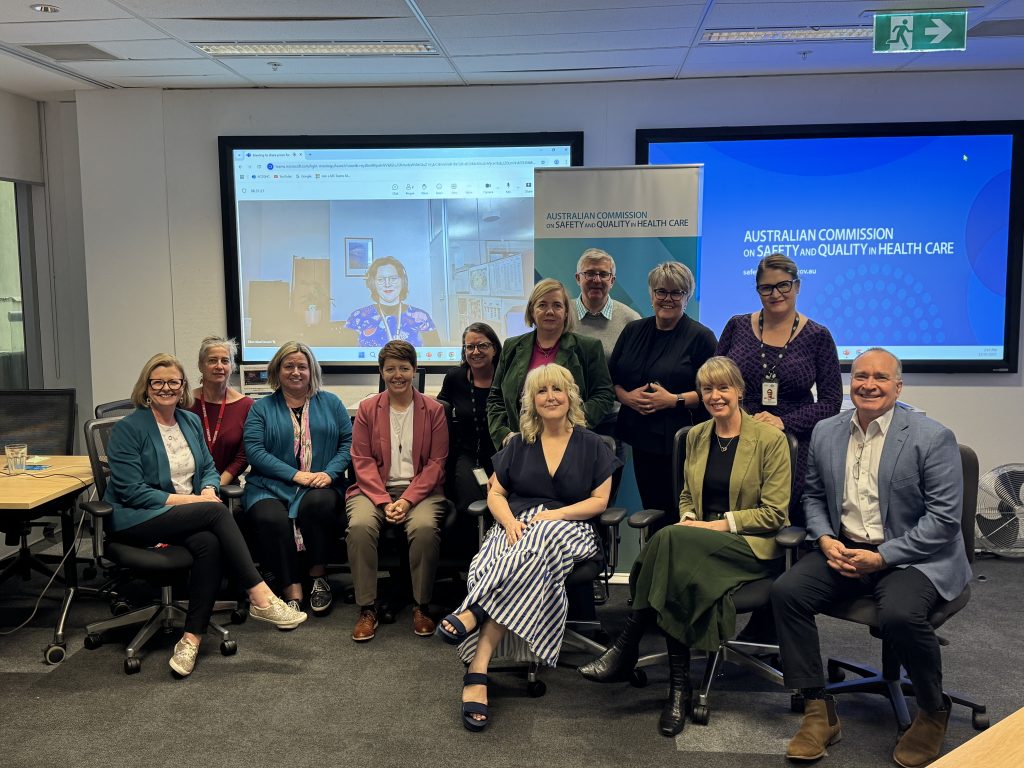
A group image with 12 people in the room and one person on the screen.

L-R: Alison Coughlan, Vic Health Consumers Centre; Kate Gorman, Health Care Consumers Assn ACT; Clare Mullen, HCCWA; on screen Ellen MacDonald, Health Consumers Tasmania; Anna Flynn, Director Partnering with Consumers, ACSQHC; Naomi Poole, Naomi Poole, Executive Director Strategy and Innovation, ACSQHC; Elizabeth Deveny, CHF; seated Broni Smith, Program Manager, Partnering with Consumers, ACSQHC; Anthony Brown, Health Consumers NSW; Anna Thornton, Chief Nursing Officer, ACSQHC; Gillian Giles, Director Clinical Governance, ACSQHC; Joanne Taylor, Program Manager Comprehensive Care; Keith Tracey-Patte, Health Consumers Queensland


A system in transformation

There are changes happening in primary care, in hospital care, and in private care. At the same time, as I’ve said there is significant change happening in the disability sector as well as the aged care sector.

There are many wonderful people working in health services, in aged care and in disability services, and many of them very much have the interest of consumers in mind. But no one experiences the system as a whole other than the consumers who are trying to navigate the complexity of those various systems and how they interact – or don’t!

Never has it been more important that there are confident, connected, informed consumer representatives who are able and feel supported to speak up for the rights of consumers, carers, community members, and people with lived experience, in every room where ideas are being discussed, and decisions are being made that impact on the experiences and outcomes that people will have.

A Call to Action

If you have been thinking about whether or not you might want to draw on your lived experience or become involved as a consumer representative, I urge you to think about it now. Now is the time.

It is imperative that we have strong, confident people in the community who are coming from an informed and supportive consumer movement —where people draw on their own experience and can also put forward a broad consumer perspective. We need to be in every room where discussions are happening.

Systemic advocacy: protecting consumer rights

Consumer rights in dental care

This month has also been very busy on the systemic advocacy front. Some of you have seen the news items from The West Australian about consumers who have been left out of pocket and without dental care: https://thewest.com.au/news/health/patients-of-perth-dental-rooms-dentist-david-hurst-left-in-financial-limbo-and-pain-after-practice-collapses-c-18454547

Unfortunately, what the stories have highlighted is that there are many gaps in the system that is supposed to protect us as we access dental care. Many people are facing aggressive marketing tactics from dental companies who are encouraging people to access their superannuation in order to have dental treatment. It’s not clear whether or not people understand all of the implications of that, both for their future financial security but also for the day-to-day reality—for example, having to pay tax on super accessed early.

I will be meeting with WA’s Chief Dental Officer and the head of the Australian Dental Board next week to discuss this, and we’ll be putting forward our concerns to make sure that the loopholes that seem to be undermine the rights that patients and consumers have are closed. We want to ensure that consumers can be making informed choices in the confidence that the system that is there to protect them is working as it should.

We have a survey for people who might want to share their stories, and you can find that here: https://forms.office.com/r/WttmCBkJUd

Hospital Parking: A Barrier to Care

On another front, we had the opportunity to take part in an ABC Life Matters conversation this month talking about the impact of the high cost of parking at some public hospitals. We heard about the economic argument that there is evidence showing that if family and friends are able to spend time with their loved ones while in hospital, this can help the healing process and in some cases help people get home sooner.

In Western Australia, we put a call out to our networks to understand the impact of hospital parking costs, and we know that today, right now, there are people taking out payday loans in order to access essential healthcare, including attending emergency departments.

There have been many attempts in the past to raise the issue of parking costs, and to date, those have been largely unsuccessful. There are some concessions that are available, and you can see what we have been able to find out about those on our website. But by and large, the cost of hospital parking is still a barrier to care for many people.

The reason that we are taking up this issue again is that having spent a state election period hearing about how we are the state with the strongest economy in Australia we think that the stark contrast between that and the reality of people trying to access healthcare is really quite stark.

We’ve raised this already with the new health ministerial team, and we also reiterated it in our budget paper that we submitted to the ministers last week. Again, we have a survey inviting people to share information about their parking experiences. We won’t share any details that identify anyone, but as we know, lived experience stories can change minds and hearts. So please, if you have a story to share, please do—here’s the link: https://forms.office.com/r/NFq9WhFcKM

Advocacy in Action: Meeting Growing Community Need

Finally, we have been very busy in both our engagement team and our individual advocacy team. What we identified is that in January to March 2025, compared to January to March 2024, our individual advocacy team saw an increase in the number of priority cases that far exceeded 500 percent—more than a five-fold increase in the number of priority cases.

Every case is important, but for example, if you are in hospital right now and reaching out to an independent advocate might be able to help you in that particular situation, then we will do our best to support that person as quickly as possible.

As Health Consumers’ Council is the only state-based consumer organisation in Australia that provides independent individual health advocacy across the whole range of health issues—mental health, physical health, primary care, hospital care, private healthcare, and public healthcare (the only area that we don’t cover is involuntary mental health)—this increase is significant.

What is curious to me is why health advocacy is so poorly resourced compared to advocacy in the disability sector and advocacy in the aged care sector. Advocacy is much needed in any sector where public services, just by the way they exist, are difficult for people to navigate. You need people who understand those systems to walk alongside you and support you as you stand up for and defend your rights and seek redress when things have gone wrong.

A big piece of our advocacy is continuing to advocate for more access for the community to independent health advocacy across all areas of health.

Engagement and Innovation

In our engagement team, we have had a whole range of events take place this month. We gathered together consumer representatives from across the healthcare system to understand how Care Opinion is being used in their health service and what opportunities they saw as consumer reps for using it differently. We have a few ideas that have emerged from that, so watch this space. We’ll be hosting another conversation with that same group alongside the staff who work on Care Opinion later in the year.

This is thanks to a small amount of funding that we got from the Health Department to progress work in relation to Sustainable Health Review Recommendation 4, which relates to the objective of expanding the use of Care Opinion.

The other exciting news is that we are making progress to support the Health Department as they implement their safety and quality strategy. One of the strands in that work is looking at consumer leadership, and so we are initiating that work by hearing from consumers about their experience of consumer leadership. What does it mean to you? What can make it work really well, and what can get in the way of it? Again, we have a survey for that: https://forms.office.com/r/gjNuHJuNUy

Looking forward

If you’re still reading, then you’ll know it’s been a busy time. There are lots of opportunities for people to influence change in the system. If you have ideas for areas that we’re not across, we are a small team, but we will add it to the list of things and do what we can to support you in the community to make change for the good of health consumers, families, carers, and people with lived experience in the community.

Thank you to those of you who go above and beyond, who speak up, who draw on your own lived experience and your knowledge of the healthcare system to advocate for positive change. Never has it been more needed for us to have strong independent consumer partners to work alongside those change agents in the health system to bring about a transformed health and medical care system for the WA community.


Highlighting consumer interests with the new WA ministerial team

Clare Mullen Executive Director Health COnsumers' Council WA

At Health Consumers’ Council (HCC), we believe that meaningful change in our health system requires active consumer involvement at every level of decision-making. Following the recent ministerial appointments, we’ve reached out to the new health leadership team to highlight key priorities identified by health consumers across Western Australia.

Our key advocacy priorities

Through our engagement with the WA health consumer community and our consumer lens on the health reform landscape, we’ve highlighted several critical issues:

Consumer involvement in decision-making

Across all our ministerial communications, we’ve emphasised the need to strengthen requirements for WA Health services to meaningfully involve consumers, families, and people with lived experience at every level of decision-making. We’ve highlighted the successful Consumer Lead roles within the Women’s and Babies Hospital project as a minimum standard for future projects of similar scale.

Healthcare affordability and equity

We’ve raised serious concerns about healthcare affordability, with evidence showing some community members are missing essential healthcare due to cost concerns, with some people resorting to taking out payday loans to access necessary care.

Aboriginal healthcare equity

We’ve drawn attention to Australia’s widest gap in hospital procedure rates between Aboriginal and non-Aboriginal patients occurring right here in WA. We’re advocating for increased access to advocacy services for Aboriginal patients to strengthen their voices in healthcare settings.

Reducing avoidable harm

We’ve proposed practical steps to improve healthcare safety:

  • Mandating access to independent advocates for consumers and families involved in Severity Assessment Code Category 1 Clinical Incident Investigations
  • Embedding Care Opinion across the health system as a feedback and quality improvement mechanism

Preventative health investment

We’ve emphasised the potential of community-led health initiatives, highlighting the Compassionate Communities model in WA’s South West that achieved a remarkable 63% reduction in hospital admissions. We’re advocating for accelerated rollout of similar community-led approaches.

Medical Research and Citizen Science

We highlighted opportunities to strengthen consumer involvement in shaping research priorities. We’ve proposed investment in citizen science initiatives for health and health promotion, building on WA’s reputation as a leader in consumer involvement in research.

Aged care priorities

We’ve highlighted issues around:

  • Ensuring sufficient aged care capacity so people receive the right care in the right place
  • Taking action to eliminate stigma and discrimination in aged care services
  • Protecting the sexual safety and dignity of people with dementia

Prison Health Services

With Minister Papalia (Emergency Services, Corrective Services), we’ve reiterated the Sustainable Health Review Panel’s support for transferring custodial health services from the Department of Justice to the WA Health system to facilitate more integrated physical and mental healthcare.

Looking forward

These letters mark the beginning of what we anticipate will be a constructive dialogue with the new ministerial team. We’ve requested meetings with each minister to discuss these priorities in more detail and explore collaborative approaches to addressing them.

As is clear from the range of issues we’ve raised, the opportunities to improve health outcomes and experiences for everyone in WA are many and far-reaching. We welcome the expansion of the Ministerial team as recognition of the importance and scale of this work.

As ever, we welcome your thoughts and experiences on these issues. Please continue share your healthcare stories with us, as they strengthen our advocacy work and help identify emerging issues affecting health consumers across WA.

Clare Mullen, Executive Director