


Everyone deserves honest, respectful communication when something goes wrong during healthcare.
By Health Consumers’ Council WA
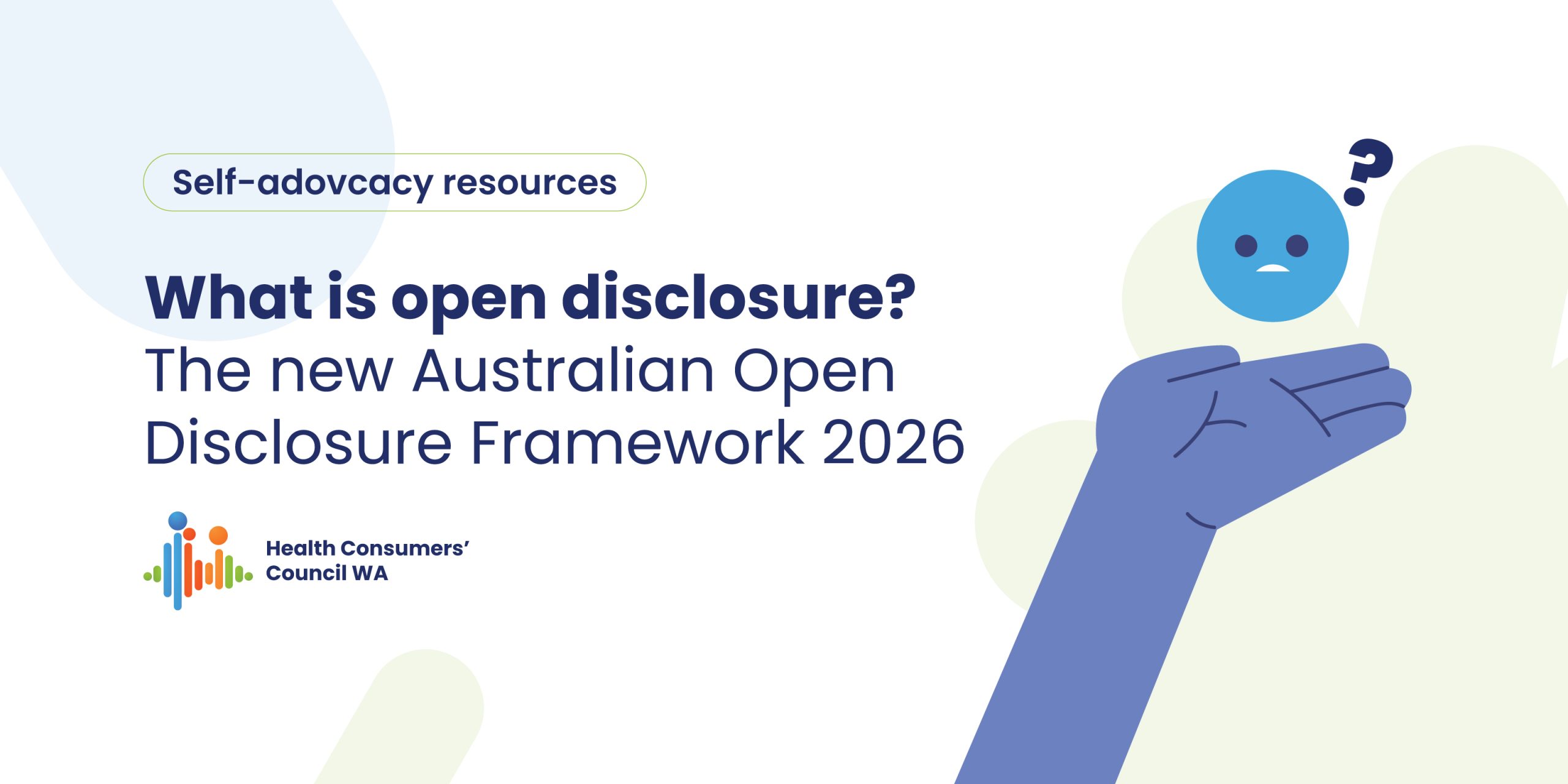
The Australian Commission on Safety and Quality in Health Care released the updated Australian Open Disclosure Framework in June 2026. It replaces the 2014 framework and aims to support more consistent, person centred communication when a patient experiences harm or potential harm during their care.
For Health Consumers’ Council WA (HCCWA), this reflects what health consumers have consistently told us through our advocacy work. People often remember less about the clinical details of an incident than how they were treated afterwards. Being listened to, receiving a genuine apology where appropriate, and understanding what happens next can make a significant difference.
Key takeaways
- Open disclosure is about honest, respectful communication when a patient experiences harm or potential harm during healthcare.
- Australia’s updated Open Disclosure Framework places greater emphasis on person centred care, cultural safety and ongoing communication with patients and families.
- Good open disclosure includes listening to the patient’s experience, explaining what happened, offering a genuine apology where appropriate, and discussing what happens next.
- If something goes wrong during your healthcare, you should expect clear communication, opportunities to ask questions, and ongoing updates as more information becomes available.
- HCCWA supports safer, more compassionate healthcare by advocating for consumers and working with health services to strengthen open disclosure practices.
What is open disclosure?
Open disclosure is the process of having honest, timely and respectful conversations with patients, families and carers when something goes wrong during healthcare.
It involves:
- explaining what is known about what happened
- acknowledging the impact of the event
- offering an apology where appropriate
- listening to the person’s experience and concerns
- discussing what will happen next, including any investigations or ongoing care.
Open disclosure is based on the principle that people have a right to be informed about their healthcare. It supports safer care, helps maintain trust and encourages learning when things do not go as planned.
When should open disclosure happen?
Open disclosure should be considered whenever a patient experiences harm, or potential harm, during healthcare.
Harm is not limited to physical injury. The updated framework recognises that people may also experience psychological, emotional or social harm. Importantly, individuals may experience harm differently from how a health service defines or understands it.
This reinforces the importance of listening first, rather than assuming everyone shares the same perspective.
What has changed in the 2026 framework?
Open disclosure has been part of Australian healthcare for many years, but the updated framework places greater emphasis on:
- person centred communication
- cultural safety
- restorative approaches that support healing and learning
- recognising different experiences of harm
- building trust through ongoing communication, rather than treating open disclosure as a single event.
The framework encourages health services to see open disclosure as more than a process to complete. It describes it as an opportunity to build respectful relationships with patients, families and carers, even during difficult circumstances.
Why this matters for consumers in Western Australia
At HCCWA, we regularly hear from people who have experienced harm during healthcare.
Through both our advocacy work and our open disclosure training with health services, we know these conversations can be challenging for everyone involved. Many clinicians may only participate in a small number of serious open disclosure conversations during their careers.
Our experience is that what matters most is not having the perfect words. It is listening carefully, responding honestly and creating space for people to ask questions, express concerns and be heard.
Open disclosure is not a one way conversation. While it involves sharing information, it is equally about understanding the patient’s experience.
People who are distressed may not remember every detail they are told. They are far more likely to remember whether they felt respected, listened to and treated with compassion.
A genuine apology can play an important role in rebuilding trust. It should be sincere, communicated in plain language and accompanied by meaningful follow up.
Trust is rarely rebuilt in a single meeting. It develops over time through ongoing communication, transparency and action.
Cultural safety must be part of the conversation
The updated framework recognises that open disclosure must be culturally safe for Aboriginal and Torres Strait Islander peoples.
It acknowledges that racism, discrimination and power imbalances can influence how people experience healthcare and whether they feel safe speaking openly.
Importantly, cultural safety is determined by the person, family or community receiving care, not by the health service.
This means services need to consider who should be involved in conversations, how information is shared and whether people feel respected, supported and safe throughout the process.
From HCCWA’s experience delivering open disclosure training, cultural safety cannot be added at the end. It needs to be considered from the beginning and embedded throughout every stage of open disclosure.
Putting these principles into practice
The updated framework provides clear principles. The challenge is putting those principles into everyday practice.
Through our work with health services, HCCWA focuses on practical skills that support meaningful open disclosure, including:
- preparing for conversations
- identifying who should be involved
- communicating honestly without speculation
- creating opportunities for patients and families to share their experience
- providing clear follow up and updates as new information becomes available.
These practical actions often determine whether people feel genuinely supported or simply informed.
What should consumers expect after a healthcare incident?
If something goes wrong during your healthcare, you can reasonably expect:
- honest and timely communication
- an explanation of what is known
- an opportunity to ask questions
- respectful treatment throughout the process
- ongoing updates if more information becomes available
- information about the next steps in your care.
If you feel your concerns have not been heard, you can ask for further discussions or seek support from an independent organisation such as HCCWA.
The Australian Charter of Healthcare Rights also outlines your rights to access, safety, respect, partnership, information, privacy and the opportunity to provide feedback about your care.
What if open disclosure does not happen?
Not every healthcare incident is managed well.
If you believe open disclosure has not occurred, or you feel you have not received honest communication after an adverse event, you can:
- ask whether an open disclosure process has been considered
- request another meeting
- bring a family member, friend or advocate to support you
- write down your questions beforehand
- ask for information in writing where appropriate
- seek independent advice or advocacy if you need support navigating the process.
What this means for consumer representatives and advocates
The updated framework strengthens the role of consumer representatives and advocates in improving healthcare.
It provides a stronger foundation for asking whether open disclosure is being done well. This includes whether communication is timely, whether people feel listened to and whether health services follow through on their commitments.
For consumer representatives, the framework is another practical tool that can help keep the focus on people’s experiences and support improvements across the health system.
How HCCWA supports open disclosure
HCCWA has worked with health services across Western Australia to deliver open disclosure training that combines practical communication skills with the perspectives of health consumers.
Our training helps clinicians build confidence in having honest conversations after adverse events and supports organisations to strengthen their open disclosure practices.
If your organisation is looking to improve its approach to open disclosure, HCCWA can work with your service to deliver practical, consumer informed training tailored to your setting.
To learn more, contact HCCWA at tania.harris@hconc.org.au.
HCCWA advocates can also help consumers feel supported during an open disclosure process. For more information see our information for consumers: https://www.hconc.org.au/individual-advocacy/open-disclosure-when-things-go-wrong-in-healthcare/
Frequently asked questions
Is open disclosure an admission of legal liability?
No. Open disclosure is about communicating openly and respectfully after something has gone wrong. Having an open disclosure conversation does not, by itself, determine legal liability.
Can I ask for open disclosure?
Yes. If you believe you have experienced harm during healthcare and open disclosure has not been offered, you can ask the health service whether an open disclosure process is appropriate.
Can I bring someone with me?
Yes. You can ask a family member, friend, carer or advocate to attend an open disclosure meeting with you for support.
Does open disclosure replace making a complaint?
No. Open disclosure and complaints are different processes. You can still make a complaint if you are unhappy with your care or with how an incident has been managed.
Learn more
Read the Australian Open Disclosure Framework on the Australian Commission on Safety and Quality in Health Care website.
You can also learn more about HCCWA’s advocacy services, consumer representation opportunities and training programs through our website.