Category: News

World immunisation week: are you up to date with your vaccinations? 

With colder weather approaching, a local measles outbreak that hasn’t yet gone away and COVID always on our minds, World Immunisation Week is a good time to check what vaccinations you might be needing. 

The World Health Organisation recognises World Immunisation Week to highlight the collective action needed to protect people against diseases. The theme for 2025 is “Immunisation for All is Humanly Possible” and celebrates that over the last 50 years, essential vaccines have saved at least 154 million lives, which is 6 lives a minute, every day, for five decades.  

It’s a good time to remember that vaccines aren’t just about saving lives of other people in other places, they save lives right here in our communities too. 

You might have read about the “quad-demic” experienced in the US over their winter, where there were higher than usual numbers of COVID, flu, RSV and norovirus circulating at the same time, leading to consumers being pretty unwell and a hospital system under considerable pressure. A reduction in the rate of flu vaccines and vaccine hesitancy around COVID vaccines has some experts concerned that we may see a similar experience in Australia this winter.  

The Department of Health issues a Virus Watch each week, and if you are interested in infectious diseases and how many of them are in our community at any given time, it is an interesting read. This year, Virus Watch has shown us that the flu is around in higher numbers than it usually is at this time of year, so it might be worth chatting to your doctor about the best time to schedule your annual flu shot.  

COVID vaccines are still available, with variant-specific vaccines being rolled out frequently. The best advice recommends:  

Adults over 18 WITHOUT immunocompromise who have NOT previously received a COVID vaccine.  Single primary dose 
Adults over 18 WITH immunocompromise who have NOT previously received a COVID vaccine Two primary doses 
Adults over 75 Recommended further doses every 6 months 
Adults 65-74 WITHOUT immunocompromise Recommended further doses every 12 months 
Adults 18-74 WITH immunocompromise  Recommended further doses every 12 months 
Adults 18-74 WITHOUT immunocompromise Can consider further doses every 12 months 

 You can get your COVID vaccine from pharmacies, but talk to your doctor about whether a COVID booster would be a good idea for you. 

The WA measles outbreak is well documented in the press, but for adults it can be unclear if you have received a measles vaccination, and how many you have received. The current recommendations are that measles vaccines should be given to  

  • children over 12 months of age
  • adolescents and adults born during or since 1966 who have not received 2 doses of measles-containing vaccine, particularly
  • healthcare workers
  • childhood educators and carers
  • people who work in long-term care facilities
  • people who work in correctional facilities
  • travellers 

For those born before 1966 it is widely assumed that they would have encountered measles naturally as a child and are therefore likely to have natural immunity.  

If you are unsure whether you have had measles or whether you have had two vaccines and are concerned about your immunity, blood testing can clarify your immune status. Talk to your GP.


Bronwyn Ife  |  Systemic Advocacy and Engagement Lead
For media enquiries: 0488 701 839

Federal Election 2025: Why Australia’s Health Future Depends on Your Vote

The Federal Election 2025 is fast approaching, and for Australians, we have been keeping an eye on the announcements from the major parties to see what they are saying about health – this is an important opportunity for healthcare system consumers like you and me to use our vote to shape the future of our healthcare system to make a stronger, fairer, and more accessible system for everyone.

Healthcare issues in the 2025 federal election are front and center. From bulk billing cuts to aged care reforms, Australians are asking critical questions:

  • How will Medicare evolve after the election?

  • Will rural and regional Australians finally gain better healthcare access?

  • What commitments will political parties make toward mental health funding and health equity?

Health election promises need to be about more than spending money on hospitals, although that is always welcome and necessary. It is important to look at investments in health in a way that makes a difference to people’s lives, even if they are not currently a patient in a hospital, because we all use the health system.  

At Health Consumers’ Council we want to see increased investment in primary care, increased investment in preventative health measures, a continued focus on improving the efficiency and capacity of  the hospital system and improved access to health care in the community. Women’s health has also been a priority this election, so we’re tracking that too.  

At the Health Consumers’ Council, we believe that a healthy society is the foundation of a thriving community. That’s why we’re urging everyone to look at the 2025 federal election through a health lens. We’ve had a look at what the major parties have said about each of our priority areas and we’ve summarised them for you, to help you decide what is important for you in health when you are going to vote:

Our Priority Labor Liberal/National Greens 
Increased investment in Primary Care 
  • $7.9 Billion in bulk billing incentives  
  •  Supporting training for 400 additional GP places so 2000 GPs enter training each year 
  •  Salary incentives for junior doctors to be GPs  
  •  400 nursing and midwifery scholarships 
  •  1800 MEDICARE telehealth service
  • $9 billion to strengthen medicare 
  • Grow the GP workforce through new incentive payments, entitlements and training support 
  • $195 billion to cover dental treatment under medicare 
  •  $21.5 billion to triple bulk billing incentives 
  •  $31.7 billion for 1000 new healthcare clinics where you can see a GP, dentist, nurse, Psychologist at no cost 
  •  $900 million in grants to encourage more GPs 
  •  Include free autism and ADHD diagnosis in medicare 
  •  Expand Chronic Disease Management Plan to remove service caps and increasing rebates
Increased focus on preventative health 
  • $1 billion mental health services  – includes 31 new and upgraded Medicare mental health services, 58 new, upgraded and expanded headspace services, 20 youth specialist care centres, 1200 training places for mental health professionals 
  •  $32 million men’s health program to break stigma around seeking help 
  •  8 new Perinatal mental health centres
  • Restore the number of Medicare-subsidised mental health sessions from 10 to 20
  • Support Australians to access suicide prevention services. 
  • Investing in medical research
  • Free mental health care by including mental health in medicare 
  • $400 million in grants to community mental health organisations to expand programs 
  • $180 million to create and implement and align a National Suicide Prevention Act 
  • $15 million to train mental health practitioners in gender affirmation, anti discrimination and cultural responsiveness 
  • $180 million for FAS-D diagnosis and treatment 
  • Pill testing and $786.2 million for 11 new safe injecting rooms  
  • $1.2 billion in resourcing the alcohol and other drug treatment sector
Access to care in the community 
  • Support regional health worker attraction, recruitment and retention initiatives
  • Continue support for the timely access to medicines through community pharmacies
  • Support regional health worker attraction, recruitment and retention initiatives
  • Continue support for the timely access to medicines through community pharmacies
  • $2 million to review telehealth capacity  
  • $750 million to Aboriginal Controlled Community Health Organisations for advancing Closing the Gap initiatives 
  • $2 million for a review into making Medicare and PBS available to imprisoned people
Women’s health 
  • Larger rebates for long acting reversible contraceptives 
  • Additional oral contraceptive pills on the PBS 
  • Menopause hormones added to PBS 
  • 11 new endometriosis and pelvic pain clinics  
  • Additional endometriosis treatments added to PBS
  • New endometriosis and pelvic pain clinics 
  • Specialist cancer nurses to support Australians with Ovarian Cancer
  • Deliver training for health professionals to address endometriosis, menopause and peri-menopause
  • Ensuring cheaper medicines and targeted healthcare for women.

Many of our allies in the health consumer and social services sector have published what they are seeking in the election, and we’ve summarised some of these here for you. 

Carers WA

  • Cost of living support for carers – increase Carer allowance by 15% and a one off boost of $300 to the Carer Supplement
  • Superannuation for carers
  • Expand the Young Carer Bursary
  • Expand the Carer Inclusive Workplace Initiative
  • Carer Recognition  – training professionals to identify and support carers from the beginning 

Consumers Health Forum

  • Increase Medicare bulk-billing incentives to encourage more practitioners to bulk bill, particularly in areas with low rates of bulk-billing and socio-economic disadvantage
  • Reform the Medicare Safety Net to ensure it is more effective in reducing costs
  • Introduce a system to ensure automatic application of Pharmaceutical Benefits Scheme Safety Net pricing
  • Work towards universal affordable dental care and implement the next 10-year National Oral Health Plan
  • Support longer and more flexible specialist referrals, so consumers don’t have to keep going back to their GP
  • Allow other healthcare providers to refer patients to specialists where appropriate 

Australian Men’s Health forum

  • Fund Men’s health
  • Act on Male Suicide
  • Improve Boys Education
  • Support Aussie Dads 

Australian Women’s Health alliance

  • Affirm abortion as essential healthcare
  • ensuring the Medicare Benefits Schedule includes appropriate remuneration for healthcare providers to deliver affordable care
  • supporting workforce capacity building by working with medical and professional colleges providing sexual, reproductive and maternal healthcare training
  • ensuring public hospitals provide abortion care as part of standard, comprehensive reproductive health services
  • working with state and territory governments to implement all 36 recommendations from the Senate Inquiry into universal access to reproductive healthcare. 

Council on the Aging

  • Fund dental care for seniors
  • Review and increase rental assistance payments for seniors
  • Energy bill relief for pensioners
  • Affordable basic internet plans for seniors
  • Expand the lower-income super tax offset scheme (LISTO) to ensure those earning between $37,000 and $45,00 are included
  • Create innovative programs to help older women find affordable housing and improve their financial knowledge
  • Create a national plan that improves outcomes for an Ageing Australia and tackles ageism
  • Require businesses to accept cash payments and prohibit debit card fees
  • Create a peer-led training and support service for victims of online fraud and scams
  • Provide elder abuse prevention and support services – including for older women experiencing family violence
  • Ensure people requiring aged care services in their home don’t have to wait longer than 30 days for the support they need
  • Test a program that provides medical care at home to help older people avoid hospital stays 

Bronwyn Ife  |  Systemic Advocacy and Engagement Lead
For media enquiries: 0488 701 839

Highlighting consumer interests with the new WA ministerial team

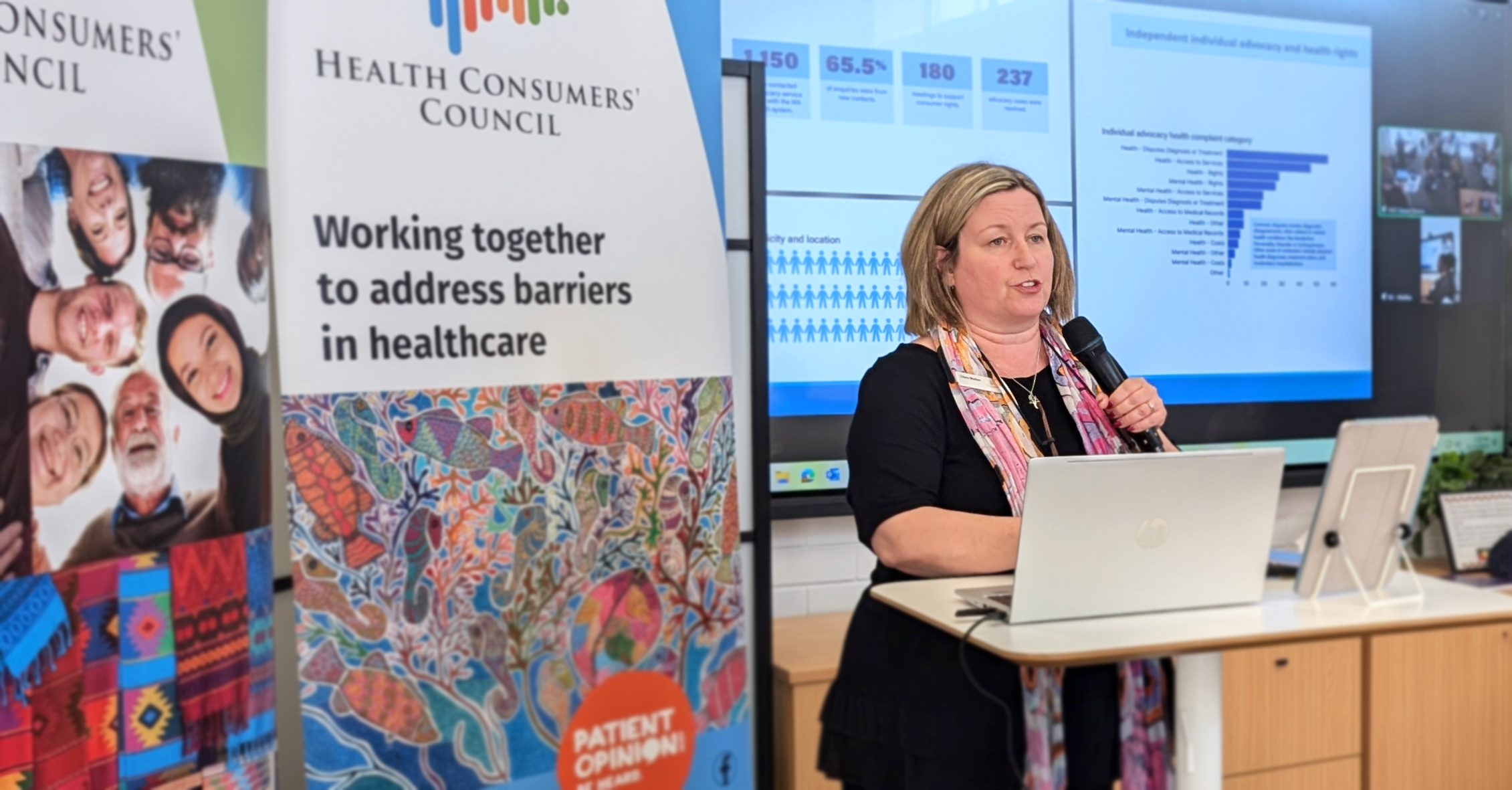
Clare Mullen Executive Director Health COnsumers' Council WA

At Health Consumers’ Council (HCC), we believe that meaningful change in our health system requires active consumer involvement at every level of decision-making. Following the recent ministerial appointments, we’ve reached out to the new health leadership team to highlight key priorities identified by health consumers across Western Australia.

Our key advocacy priorities

Through our engagement with the WA health consumer community and our consumer lens on the health reform landscape, we’ve highlighted several critical issues:

Consumer involvement in decision-making

Across all our ministerial communications, we’ve emphasised the need to strengthen requirements for WA Health services to meaningfully involve consumers, families, and people with lived experience at every level of decision-making. We’ve highlighted the successful Consumer Lead roles within the Women’s and Babies Hospital project as a minimum standard for future projects of similar scale.

Healthcare affordability and equity

We’ve raised serious concerns about healthcare affordability, with evidence showing some community members are missing essential healthcare due to cost concerns, with some people resorting to taking out payday loans to access necessary care.

Aboriginal healthcare equity

We’ve drawn attention to Australia’s widest gap in hospital procedure rates between Aboriginal and non-Aboriginal patients occurring right here in WA. We’re advocating for increased access to advocacy services for Aboriginal patients to strengthen their voices in healthcare settings.

Reducing avoidable harm

We’ve proposed practical steps to improve healthcare safety:

  • Mandating access to independent advocates for consumers and families involved in Severity Assessment Code Category 1 Clinical Incident Investigations
  • Embedding Care Opinion across the health system as a feedback and quality improvement mechanism

Preventative health investment

We’ve emphasised the potential of community-led health initiatives, highlighting the Compassionate Communities model in WA’s South West that achieved a remarkable 63% reduction in hospital admissions. We’re advocating for accelerated rollout of similar community-led approaches.

Medical Research and Citizen Science

We highlighted opportunities to strengthen consumer involvement in shaping research priorities. We’ve proposed investment in citizen science initiatives for health and health promotion, building on WA’s reputation as a leader in consumer involvement in research.

Aged care priorities

We’ve highlighted issues around:

  • Ensuring sufficient aged care capacity so people receive the right care in the right place
  • Taking action to eliminate stigma and discrimination in aged care services
  • Protecting the sexual safety and dignity of people with dementia

Prison Health Services

With Minister Papalia (Emergency Services, Corrective Services), we’ve reiterated the Sustainable Health Review Panel’s support for transferring custodial health services from the Department of Justice to the WA Health system to facilitate more integrated physical and mental healthcare.

Looking forward

These letters mark the beginning of what we anticipate will be a constructive dialogue with the new ministerial team. We’ve requested meetings with each minister to discuss these priorities in more detail and explore collaborative approaches to addressing them.

As is clear from the range of issues we’ve raised, the opportunities to improve health outcomes and experiences for everyone in WA are many and far-reaching. We welcome the expansion of the Ministerial team as recognition of the importance and scale of this work.

As ever, we welcome your thoughts and experiences on these issues. Please continue share your healthcare stories with us, as they strengthen our advocacy work and help identify emerging issues affecting health consumers across WA.

Clare Mullen, Executive Director

Health Budget – a win for women’s health

With the federal election called for 3 May, we’ll be tracking health promises made by all of the parties and letting you know what that means for WA healthcare system consumers.  

The federal government released their 2024-25 budget on Tuesday 25 March. Health is always a topic to watch at budget time and we’ve had a look at what was included in the 2025-26 budget.  

Women’s health was a big winner in the budget and we are really pleased to see women’s health being highlighted – an area that has been ignored or only spoken about obliquely for generations. There is a $792 million package for increased rebates and more bulk billing to increase safe access to long acting reversible contraceptives. A greater number of oral contraceptives have been added to the Pharmaceutical Benefits Scheme, making these medications cheaper for people who need them. Pharmaceutical Benefits Scheme listings for hormonal treatments for menopause, medicare rebates for menopause health assessments and menopause training for GPs are all welcome initiatives, as is increased funding for endometriosis treatment and support, making it easier for people to receive the health care that they need.  

The nearly $8 billion spend on Medicare has been covered in many places, but this is aimed at increasing bulk billing rates across the country by increasing incentives for GPs to bulk bill. The goal is for 90% of GP visits to be bulk billed by 2030. The incentives are greater in rural and remote areas, which is a good outcome for services outside of metro areas.  

There is also funding to open 50 new Medicare Urgent Care clinics across the country. There are currently 87 of these clinics, alongside some other Urgent Care clinics run by private providers. A recent review into the Medicare Urgent Care clinics has found that while the cost to the government of care at Medicare Urgent Care Clinics is higher than standard GP appointments, and that the communication from the Urgent Care Clinics back to the patient’s usual GP could be better, the waiting times in Urgent Care Clinics are considerably shorter than those in hospital emergency departments and they give patients greater choice when looking for care, particularly after hours. 

The Pharmaceutical Benefits Scheme co payment is being reduced from $31.60 to $25 which is an important saving for people who regularly need medications. 

Bronwyn Ife  |  Systemic Advocacy and Engagement Lead
For media enquiries: 0488 701 839

Harmony Day is a missed opportunity

International Day for the Elimination of Racial Discrimination

It’s also, Harmony Day

21 March 2025 is International Day for the Elimination of Racial Discrimination it’s also Harmony Day 2025 in Australia.

International Day for the Elimination of Racial Discrimination (IDERD) is recognised all around the world, except here in Australia where in the 1990s the Howard government chose to create an event called Harmony Day instead.

Harmony Day celebrates multiculturalism in Australia, which is a good thing.

But in doing so in place of addressing racial discrimination, it hides the history behind the International Day for the Elimination of Racial Discrimination and discourages us from discussing the hard work required to tackle racism in Australia.

Here at Health Consumers’ Council we are committed to calling out and tackling racism in the health system. In 2019 we successfully advocated for the inclusion of racial discrimination as a category that’s measured in the WA health complaints system – along with other forms of discrimination such as ableism and ageism.  

We’re working on a project this year to highlight racism in health care by examining the issues that arise in our individual advocacy cases to see what patterns are emerging. We also use our strong relationships with health system leaders to elevate the voices of people who experience racial discrimination to the highest levels of decision making in health.  

If you have experienced or witnessed racism in WA healthcare settings you can call it out

  • Make a complaint to the health service concerned – draw attention to the fact that you believe the discrimination was based on race
  • Hospitals: https://www.hconc.org.au/individual-advocacy/how-to-make-a-complaint/
  • GPs: https://www.hconc.org.au/individual-advocacy/4-how-to-make-a-complaint-to-a-gp-or-clinic/
  • Call It Out is a simple and secure way for people to report incidents of racism and discrimination towards First Nations Peoples in any setting: https://callitout.com.au/

Bronwyn Ife  |  Systemic Advocacy and Engagement Lead
For media enquiries: 0488 701 839

Long Covid Awareness Week 10 to 15 March 2025

Long Covid Awareness Week 

 “Long COVID is like being taken hostage in your own body, it is not just a lingering cold, it is a profound disruption to normal life. People need hope and action. Until you experience this kind of  thing you cannot fathom the amount of resilience and mental fortitude you must have to survive.”  – a consumer who lives with Long COVID 

10-15 March 2025 is Long Covid Awareness week.

Since 2020, HCCWA has advocated for the needs and interests of health consumers in relation to COVID, both in relation to information, and to healthcare. While the acute period of COVID has passed, data suggests that between 5 and 20% of Australians experienced ongoing symptoms more than three months after a diagnosis of COVID. Some of these people had experienced fairly mild symptoms when they initially had COVID, but the ongoing symptoms can become debilitating and are often poorly understood among practitioners. One survey of people in WA who were experiencing Long COVID symptoms found that around 17% of people who were working full time before their COVID diagnosis had been unable to return to full time work 90 days after their initial infections, because of the complications of Long COVID and Long COVID recovery.

Consumers have shared their journeys with us. Some of them feel that their doctors don’t believe them, or don’t believe that Long COVID is the cause of their ongoing symptoms. They also report that doctors don’t seem to be well-informed on Long COVID symptoms, Long COVID treatment, and management.

There were Long COVID clinics and Long COVID support services in Western Australia in place for a short-time, however, many Long COVID Clinics have closed. The closures were poorly managed, with patients not being informed of the closure and appointments being cancelled without alternative avenues of care being offered. The East Metropolitan Health Service Post COVID-19 clinic remains open, but it is only available to patients who reside in the East Metro catchment area or those from the Kimberley, Pilbara and Wheatbelt.  

We’re interested to know – what questions or concerns do you have about COVID or Long COVID and Long COVID community resources in Western Australia? 

Share your feedback with us via this short survey and we will share the responses with the Department of Health. 

If this topic is of interest to you, Emerge Australia is undertaking lots of advocacy work on Long COVID.

Follow them here – Emerge Australia Inc  

Bronwyn Ife  |  Systemic Advocacy and Engagement Lead
Published on March 10, 2025  |  For media enquiries: 0488 701 839


References 

Tindle, Robert. Long covid Sufferers can take heart, Australian Journal of General Practice Vol 53, No 4, April 2024 

Woldegiorgis M, Cadby G, Ngeh S, Korda R, Armstrong P, Maticevic J, Kniwght P, Jardine A, Bloomfield L, Effler P. Long Covid in a highly vaccinated but largely unexposed Australian population following the 2022 SARS coV-2 Omicron wave: A cross sectional study. Medical Journal of Australia. March 2024 

Long covid Australia, a review of the literature. Australian Institute of Health and Welfare, 16 December 2022 https://www.aihw.gov.au/reports/covid-19/long-covid-in-australia-a-review-of-the-literature/summary) 

Costantino, V, Grafton Q, Kompas T, Chu L, Honeyman D, Notaras A, Macintyre CR; The public health and economic burden of long covid in Australia 2022-23: A modelling study, Medical Journal of Australia, August 2024 


Consumers in the media

As WA’s peak body for health consumers, we are often approached for comment by news outlets. Here’s a snapshot of some recent coverage:

State election – let’s look through a health lens

** UPDATED 24/02/2025**

With a state election looming, we have been keeping an eye on the announcements from both major parties to see what they are saying about health. 

At Health Consumers’ Council we are keen to see new policies and programs within the health system to help improve the experience of consumers and patient outcomes. While big spending on infrastructure is always welcome and necessary, we are also really interested in ideas that will change and improve the way people interact with the health system every day. 

We want to see increased investment in primary care, increased investment in preventative health measures, a continued focus on improving the efficiency and capacity of  the hospital system and improved access to health care in the community. 

We’ve had a look at what the major parties have said about each of our priority areas and we’ve summarised them for you, so you can decide what is important for you in health when you are going to vote. 

Our Priorities WA Labor Party WA Liberal Party 
Increased investment in primary care 
  • $8.2 million “GP Ask” program allowing GPs to communicate directly with WA Health Specialists on behalf of patients reducing the need for ED visits and referrals  
  • $14 million for women’s health centres 
  • GPs to be able to diagnose and prescribe medicines for ADHD 


  • $26.4 million for GP training incentives 
  • $1 million for GP community residency program 
  • $5 million GP upskilling for ADHD co prescribing 


Increased investment in preventative measures 
  • $39.5 million for public access to treatment at Ngala’s residential parents service 
  • $6 million to help develop more community housing 
  • $3.1 million housing first program in Bunbury 
  • $10.4 million expand Homeless Engagement Assessment Response Team 
  • $38.6 million family and domestic violence package includes increasing capacity of refuges in Geraldton, reforms to restraining orders act 
  • $850 000 for Australian Breatfeeding Association breastfeeding education classes, training and local parent groups 
  • $4 million to support development, implementation of mental health and suicide prevention programs in the workplace 


  • $36.3 million universal access to residential parents service at Ngala 
  • $40 million suicide prevention programs  
  • $40 million mental health prevention strategies 
  • $6 million to kids help line 


Improved efficiency and capacity of hospital system 
  • $3.3 billion to improve health infrastructure – redevelopments at Bunbury, Geraldton and Peel 
  • $104 million in improvements to Royal Perth Hospital  
  • $100 million for Midland Health campus ED  
  • $36.3 million for WA Virtual Emergency Department 
  • $2.5 million Womens’ reproductive health day procedure centre  
  • Build Womens and Babies hospital in Murdoch 
  • $50 million to expand Ronald McDonald House, $25 million for Cancer Council WA Lodge Accommodation services  
  • $5 million for adult eating disorder services  
  • $60 for improvements to Albany Hospital 


  • $275 million to provide 500 additional transitional care beds 
  • $13 million for high residential rehab beds for compulsory drug rehabilitation 
  • $100 million in four years Elective surgery guarantee  – everyone will get surgery within clinical timeframes – by getting it at no cost in the private system if cannot be accommodated in public system  
  • $20 000 payment to study and work as a nurse in WA – adding 2000 nurses to the workforce 
  • $33.5 million for eating disorder services  
  • $73.2 million to expand St John Urgent Care clinics 
  • $18 million for 60 000 episodes of care at St John Urgent Care  
  • $10 million training for high demand specialists 
  • Build Womens and Babies hospital in Nedlands 
  • $80 million to rebuild Royal Perth Hospital 
  • Two new wards at Joondalup Health Campus 
Improved access to health care in the community  
  • $26 million for youth mental health in the regions including $13.8 million for an Acute Care and Response team in Bunbury and $12.2 million to access virtual infant and child mental health services  
  • $9.9 million to transition a Kalgoorlie mental health program into a public subacute mental health facility 
  • $30.4 million health outcomes in Kimberley, including new clinic at Broome Regional Aboriginal Medical Service, a Derby Wellness centre with focus on drug and alcohol services, mental health support FDV services and aged care, detox facility in Broome and double renal dialysis capacity at Fitzroy Crossing. 
  • $12.4 million for a rebab centre in the Great Southern 
  • $16.3 million regional paramedics in Peel and South West 
  • PATS fuel rebate increase from 26c per km to 40c per km and expanded number of eligible services for PATS  – physio, speech, OT and dental  
  • $140 million aged care including loans for providers to deliver more beds and a program of Integrated Older Adult Care Hubs, Dementia Action Plan and an Aged Care Facility for Aboriginal people in Queens Park.  
  • $7.5 million for improved RFDS Services in the Mid West  
  • $21 million radiation oncology services in Geraldton  
  • $2 million renal dialysis unit in Geraldton  
  • $10.4 million for improved diabetes care 


  • $24 million Chemo in the Home program  
  • $19 million for five regional mobile dental units 
  • PATS increase to .40c per km (same) nightly allowance $150 per night 
  • $10 million on career paramedics in regions  
  • $25 million radiation oncology in Geraldton 
  • Build Tom Price Hospital  
  • $5.5 million for outpatient and ambulatory care services at Kalamunda hospital  
  • $3 million to expand dispensing of hospital only medications to community pharmacies  
  • $60 million for free post discharge GP visits 


Find out more:
WA Labour
WA Liberals
WA Greens
WA Nationals

They vote for you

Bronwyn Ife  |  Systemic Advocacy and Engagement Lead
Published on Feb 17, 2025  |  For media enquiries: 0488 701 839

Health consumers and two elections…

Clare Mullen speaking with HCCWA members

Why the 2025 elections matter for healthcare policy, and how patients and consumers can influence change.

The Impact of the WA State Election 2025 and Federal Election on Healthcare

You might have noticed we’re in the run up to two elections. The WA State election on Saturday 8 March 2025, and the Federal election at some point in the next few months. Not only that, but the Productivity Commission and Cleanbill both published reports this month about healthcare in Australia pointing out what is very clear to anyone trying to access healthcare – there’s a lot of pressure on the hospital system and good luck trying to find a bulk billed GP appointment. And so the airwaves are alive with announcements and soundbites calling for action. And many of these will talk about the need for more hospital beds and hospital infrastructure.

Policy Priorities for Better Healthcare in WA and Australia

Here’s what we’d like to see from a patient and health consumer point of view:

  • increased investment in primary care across the state
    • the Cleanbill report found there are fewer than 40 GP clinics in WA where someone who’s not on a concession card can be bulk-billed – with the cost of living pressures being experienced by many people we know this means people are thinking twice about accessing care
    • the increase in urgent cares is great, but it’s not the same as good primary care
  • urgently increase the investment in preventative health measures
  • a continued focus on improving the efficiency and capacity of the hospital system
    • while retaining a focus on delivering compassionate person-centred care
  • improving access to healthcare in the community
    • one of the reasons for long waits in the Emergency Department is because there are people in hospital who are well enough to leave hospital, but not well enough to return home – we need more access to more community-based options, for example people looking for residential aged care
    • one study into a Compassionate Communities Community Connector model in WA’s South West found that the model led to a 63% reduction in hospital admissions – imagine if we were able to roll this kind of approach out across the state?

You can hear me talking about some of these points with Nadia Mitsopoulis on ABC Perth Mornings this month at this link. The whole item is from 4m45s and our comment is from 16m25s until 20m45s.

Long-term solutions: addressing the root causes of healthcare challenges

Change is not a quick fix

Despite what you’ll read in the coming weeks, there are no quick fixes to the current pressures. WA is not alone in facing these pressures on our healthcare system. And these pressures haven’t come out of nowhere.

The very powerful commercial interests of the food, alcohol and entertainment sectors have created a world over the last five decades where we are increasingly and strongly nudged towards unhealthy behaviours such as eating high levels of ultra-processed foods; spending increased time on electronic devices, including social media; and prioritising paid work over social and community connections.

Add to this the recovery from the turbulence of the COVID pandemic, and healthcare systems around the world are facing similar challenges.

The role of vested interests in shaping healthcare policies

Patient and consumer voices can cut through vested interests

There are many vested interests in the healthcare space. Powerful clinical groups and commercial interests are able to spend significant sums of money putting forward the interests of their members and stakeholders.

And in Australia, we have three levels of government who all have a role in health and healthcare. And unfortunately, getting different parts of government to work well together has never been easy.

Why consumer advocacy is essential for better healthcare policies

Only consumer advocates have the interests of patients, consumers and the community as their sole focus

It has never been more important that there are strong, informed, and connected patient, consumer and community voices in every discussion informing decisions about health and healthcare.

By Clare Mullen, Executive Director

Why we choose to keep our office open on the Australia Day public holiday

Clare and Tania at a the Perth march for a voice to parliment

A simple act of empathy, support, and perspective

Australia Day holds varied meanings for Australians. However, for many Aboriginal and Torres Strait Islander peoples, it symbolises colonisation, loss, and intergenerational trauma. At Health Consumers’ Council (HCC), we believe it is vital to acknowledge this history, understand its impact, and support First Nations peoples not just on January 26 but every day.

Standing in solidarity with Aboriginal communities

As advocates for all healthcare consumers in Western Australia, we recognise the importance of listening to, and amplifying, the voices of Aboriginal peoples. For many, January 26 is a day of mourning and reflection, highlighting ongoing challenges such as significant health disparities.

On the Australia day public holiday (27 January) our office will be open

At HCC, choosing to give staff the opportunity to work on the Australia Day public holiday is an act of solidarity. This is something we have done for a couple of years now and it has been welcomed by staff. We believe there is much to celebrate about Australia, but we recognise the colonial history of the current date, and so don’t see it as a day for celebration. Our team members have the option to work on this day and take another day off instead, or to take the day off if that’s their preference.

Encouraging dialogue, empathy, and micro-activism

By sharing our decision to work on Australia Day we hope to spark reflection and conversation within organisations and communities. By reconsidering the significance of January 26, we aim to promote inclusion, equity, and a deeper understanding of its impact on Aboriginal and Torres Strait Islander peoples.

This is one of the steps we take to acknowledge the truth of our nation’s history and to play our part in fostering a more inclusive future.

This reflects our broader commitment to addressing health inequities and standing with Aboriginal communities as they continue their work to address the harm of colonisation that is still experienced by many people today.

We also work throughout the year to address health inequities experienced by other groups and you can find out more about that work on our website.

Acknowledging some key dates in Australia’s history

  • 65,000+ years ago: First peoples from Southeast Asia arrived in Australia, forming the world’s oldest continuous civilization.
  • 1606: Dutch explorers became the first Europeans to land in Australia.
  • 1788: Captain Arthur Phillip raised the British flag at what he named as Sydney Cove on January 26.
  • 1818: NSW celebrated January 26 as a public holiday to mark the 30th anniversary of the Sydney Cove landing.
  • 1901: The six colonies united to form the Commonwealth of Australia.
  • 1938: Aboriginal protests on January 26 highlighted the trauma of colonisation, calling it “A Day of Mourning.”
  • 1988: Protests during the Bicentenary included 40,000 people marching for land rights and against dispossession.
  • 1994: January 26 was officially declared a public holiday across all states and territories.

Consider joining us for our workshop Acknowledging Country.

Acknowledging Country

An Acknowledgement of Country is an important start to most meetings and professional gatherings and is an opportunity to express your and your organisations respect for Aboriginal people, Country and Culture.

This workshop is designed to help you start to think about what an Acknowledgement of Country means, the difference between and Acknowledgement and a Welcome to Country, when you should be doing an Acknowledgement and how to personalise and make your own Acknowledgement meaningful and respectful.

You will leave the workshop with some tangible tools to develop your Acknowledgement, have the opportunity to ask questions, to develop your own personalised Acknowledgement and some tips for delivering it with confidence and respect.

All profits from these workshops go directly to supporting Aboriginal health consumers in WA in various ways including but not limited to, funding training opportunities for Aboriginal health consumers and occasionally Aboriginal workers, funding Aboriginal consumer payments to ensure Aboriginal perspectives are heard where they may not be. Please contact Tania to discuss this further.

See more workshops we offer below, or register for our next Acknowledging Country workshop now.