


Category: Systemic advocacy

Health consumers and two elections…

Clare Mullen speaking with HCCWA members

Why the 2025 elections matter for healthcare policy, and how patients and consumers can influence change.

The Impact of the WA State Election 2025 and Federal Election on Healthcare

You might have noticed we’re in the run up to two elections. The WA State election on Saturday 8 March 2025, and the Federal election at some point in the next few months. Not only that, but the Productivity Commission and Cleanbill both published reports this month about healthcare in Australia pointing out what is very clear to anyone trying to access healthcare – there’s a lot of pressure on the hospital system and good luck trying to find a bulk billed GP appointment. And so the airwaves are alive with announcements and soundbites calling for action. And many of these will talk about the need for more hospital beds and hospital infrastructure.

Policy Priorities for Better Healthcare in WA and Australia

Here’s what we’d like to see from a patient and health consumer point of view:

  • increased investment in primary care across the state
    • the Cleanbill report found there are fewer than 40 GP clinics in WA where someone who’s not on a concession card can be bulk-billed – with the cost of living pressures being experienced by many people we know this means people are thinking twice about accessing care
    • the increase in urgent cares is great, but it’s not the same as good primary care
  • urgently increase the investment in preventative health measures
  • a continued focus on improving the efficiency and capacity of the hospital system
    • while retaining a focus on delivering compassionate person-centred care
  • improving access to healthcare in the community
    • one of the reasons for long waits in the Emergency Department is because there are people in hospital who are well enough to leave hospital, but not well enough to return home – we need more access to more community-based options, for example people looking for residential aged care
    • one study into a Compassionate Communities Community Connector model in WA’s South West found that the model led to a 63% reduction in hospital admissions – imagine if we were able to roll this kind of approach out across the state?

You can hear me talking about some of these points with Nadia Mitsopoulis on ABC Perth Mornings this month at this link. The whole item is from 4m45s and our comment is from 16m25s until 20m45s.

Long-term solutions: addressing the root causes of healthcare challenges

Change is not a quick fix

Despite what you’ll read in the coming weeks, there are no quick fixes to the current pressures. WA is not alone in facing these pressures on our healthcare system. And these pressures haven’t come out of nowhere.

The very powerful commercial interests of the food, alcohol and entertainment sectors have created a world over the last five decades where we are increasingly and strongly nudged towards unhealthy behaviours such as eating high levels of ultra-processed foods; spending increased time on electronic devices, including social media; and prioritising paid work over social and community connections.

Add to this the recovery from the turbulence of the COVID pandemic, and healthcare systems around the world are facing similar challenges.

The role of vested interests in shaping healthcare policies

Patient and consumer voices can cut through vested interests

There are many vested interests in the healthcare space. Powerful clinical groups and commercial interests are able to spend significant sums of money putting forward the interests of their members and stakeholders.

And in Australia, we have three levels of government who all have a role in health and healthcare. And unfortunately, getting different parts of government to work well together has never been easy.

Why consumer advocacy is essential for better healthcare policies

Only consumer advocates have the interests of patients, consumers and the community as their sole focus

It has never been more important that there are strong, informed, and connected patient, consumer and community voices in every discussion informing decisions about health and healthcare.

By Clare Mullen, Executive Director
Women’s and Newborns Hospital relocation – HCC advocating for consumer voices

In April 2023 the WA Minister for Health made a surprise announcement that the new Women’s and Newborns Hospital – previously planned to be on the QEII site alongside Sir Charles Gairdner Hospital – would be located in Murdoch, alongside the Fiona Stanley Hospital.

Despite being contacted at that time by a senior WA Health member to reassure us that there would be significant consumer involvement as this work unfolded, we then didn’t hear anything until we followed up in June. At that time it became clear that there had been no consumer input to this new decision. And none since the announcement in April.

We’ve since been in discussion with a group of consumers who have been very involved in early consultations who raised a number of concerns. We have raised these with the Minister for Health and senior WA Health staff. We also held a consumer event on 20 July to gather more views and raise people’s awareness of what we know.

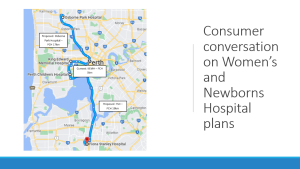
This is the presentation we went through at that event

Image of a slide from a presentation. On left of the slide is a map of the Perth metro area with the journey between Osborne Park, KEMH, and Fiona Stanley Hospital outlined. The title is "Consumer conversation on the Women's and Newborns Hospital Plans"

230720 HCC Women’s Hospital update


We had a rich discussion at that event which has been fed back to the project team:

  • There are significant concerns about the apparent complete absence of any consumer involvement or input to inform this decision – it’s very disappointing that clinical engagement is well underway but there has been no engagement with consumers so far.
    • People were also concerned that it has not been possible to find out what clinical input there was to inform this decision. The conclusion being reached is that there wasn’t any. This is very concerning to consumers as it doesn’t give confidence that clinical concerns.
  • Significant concerns that the proposed position will mean significant infrastructure reforms to enable the gold standard of tri-location of maternity, neonates and adult services.
    • The options raised at the meeting included moving PCH to the FSH campus and upgrading OPH to ensure it has the additional clinical services necessary for high quality maternity care (and avoiding repeating the issues at KEMH being an isolated maternity hospital)
    • It wasn’t clear in our discussion how this work would be less disruptive than the original plan
  • The lack of consumer involvement in decisions about priorities for services to be located at QEII
    • We heard that there are plans to site a new UWA Medical School on the QEII campus as well as the planned Comprehensive Cancer Centre.
    • There was a sense that while these are obviously important, the rationale for prioritising their position on the QEII campus over enable tri-location of services was not clear.
  • The lack of information about the plan for the 40 or so babies needing surgery within hours of birth.
  • Concerns about the risks to infant and parent mental health – and the associated long-term impact of early childhood trauma – for families needing access to neonate surgery

Separate to the meeting, we also received one consumer comment that they were supportive of improved access by public transport to the FSH site, particularly for people with disabilities.

Overall, there was general recognition that there is no immediately obvious “easy” solution to this issue. There was considerable frustration that it hasn’t been considered important to have consumer perspectives involved to help to identify the issues and be part of the solution generation.

The hospital project team are keen to seek broad consumer input. HCC will be facilitating a small group discussion in early September to explore what real engagement with consumers going forward could look like. Later there will be another discussion with consumers to discuss the implications of the planned move to this new location.

If you would like to be kept informed about this work, contact Jasmina Brankovich, HCC’s Policy and Systemic Advocacy Lead at jasmina.brankovich@hconc.org.au

Clare Mullen, August 2023

Advocating for consumer perspectives through committees

One of the ways Health Consumers’ Council advocates at a systemwide level for consumer perspectives in health is by participating in a range of committees – these are some of the committees staff were involved in between January and June 2023. If you’d like more information about any of these, please reach out to info@hconc.org.au

  • Clinical Governance Advisory Committee – Prison Health
  • Clinical Senate and Clinical Senate Executive
  • Curtin School of Allied Health Advisory Board
  • Electronic Medical Record Clinical Leadership Group
  • Emergency Access Reform Project Control Group
  • EMHS Weight Management Clinic Project Reference Group
  • Enrolled Nurses Industry Advisory Committee
  • Family and Domestic Violence Committee
  • First Responders Forum
  • Health Networks Leads Forum
  • Healthy Habits Reference Group
  • HIV Case Management Advisory Panel
  • IGR: Mental Health Governance Review
  • My Baby WA Steering Committee
  • Obesity Collective Leaders Forum (national)
  • Outpatient Reform Steering Committee
  • Safety and Quality Strategy Executive Working Group
  • SHR 4 Co-Leads
  • SHR 4 Steering Committee
  • SHR Partnership Group
  • SHR Program Board meeting
  • SHR Rec 4 Partnership Suite Working Group
  • State Health Operations Centre Steering Committee
  • State Peak Consumer Organisation Forum
  • WA Aged Care Collaboration Group
  • WA State Oral Health Advisory Committee
  • WACOSS Peaks Forum
  • WELL Co Clinical Advisory Committee
  • WELL Co Steering Committee

Updated by Clare Mullen, August 2023