




It’s November 2026 as I write this, and it’s likely what I write may be out of date by December 2026! The world of Artificial Intelligence (AI) in health and healthcare is changing very quickly. In the last few weeks, we’ve been involved in a few discussions and found a few resources that might be of interest.
Who is driving the use of AI in healthcare? Whose interests are being served?
Last month I attended the Wild Health Summit on: “How AI and New Models of Care are Rapidly Reshaping Our Hospitals”.
Chatting with some of the other consumer leaders there, the question we had was: how do we get the tech companies to focus on the interests of consumers, when the profits lie in focusing on the interests of the impact on clinicians and health services? (Answers on a postcard if you have some!)
Clearly there are some shared interests between consumers, clinicians and health services. But one of the obvious missed opportunities is in the use of AI scribes (see below). These would have been great tools to provide consumers, carers and families with a clear easy-to-understand summary of the discussion and the clinical management plan. But that isn’t their primary purpose, and it’s not clear if this option has been designed into these tools at all.
AI scribes – who’s checking the notes?
We’re hearing from many people that AI scribes are being used in lots of clinical settings. An AI scribe is a software tool that records the audio of your discussion with your clinician, and then writes notes that will be added to your medical record. The notes should be checked by the clinician, and the clinician remains legally responsible for the content of the notes.
Some consumers appreciate these tools. They like the fact their clinician can now actually face them when they’re talking, and isn’t tapping away at a keyboard all the time. Others are concerned about the lack of explicit consent – some people tell us about only being told after the scribe has been “working” that it’s being used, while others are specifically asked, but are concerned how it might affect their care if they don’t give permission.
There have been some media stories where the AI scribe has written down information that is wrong – and consumers have found it challenging to get that information corrected or removed from their medical records.
AI scribes – what do you think?
We’re gathering feedback on what consumers think of AI scribes – take a moment now to share your feedback in this online survey
Be SMART when you’re using AI
We love a good consumer-created resource here at HCCWA.
The guide outlines the SMART approach:
- S – slow down and think before asking health questions to a chatbot
- M – make your questions clear
- A – ask yourself, what am I sharing?
- R – remember to check facts
- T – talk to a real person when you need to
Do not use an AI chatbot in a medical emergency or mental health crisis.
The health chat bot guide from the University of Birmingham was produced by consumers, clinicians and AI experts through an international consensus process to help people use it safely.
Our colleagues at Health Voices Victoria, Health Consumers NSW and Health Consumers Queensland are involved in a range of initiatives looking at AI for health consumers. Check out their work and sign up for updates to stay across how this is developing.
And nudge your clinician to think about how they use AI
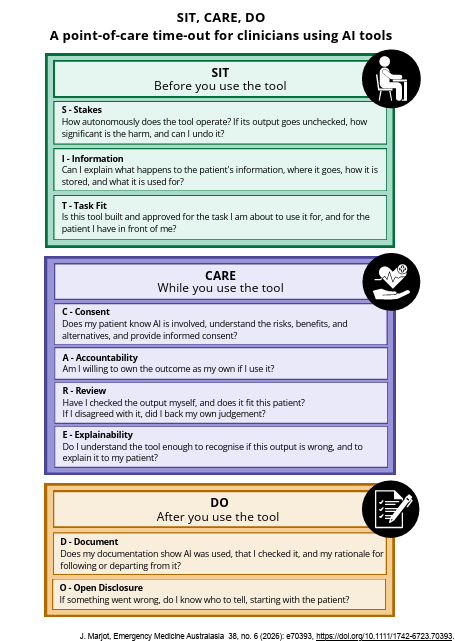
Despite all the effort being directed towards making AI work for clinicians, there still is a lack of quick easy frameworks. We liked this one we saw on LinkedIn developed by an Emergency Department clinician as an easy reference tool.
And what about AI at Health Consumers’ Council WA?
We have adopted a cautious use of AI in our work. As a small charity we are always looking for ways to be more efficient so we can extend our impact as far as possible.
Our staff do not use AI to make decisions and any content that’s been developed with the input of AI is reviewed by a human who is responsible for the content.
What lies ahead?
Like I say, what was accurate when I started writing this, may well have been overtaken in the time I’ve taken to write it (without the use of AI :))
It’s clear that AI has a place in health – as evidenced by the fact that some studies suggest almost half of Australians have consulted it for health advice in the last year (AHI 2026).
The question is – will AI in health be designed with consumer needs at the forefront, even if they don’t deliver a commercial benefit?
Clare Mullen, CEO 20/11/26