What is culturally safe GP care? New research from Aboriginal and Torres Strait Islander consumers
A new paper, “Towards assessment of culturally safe general practitioners: co-designing with Aboriginal and Torres Strait Islander peoples’ perspectives, the Calgary–Cambridge guide and clinical yarning”, published in the Australian Journal of Primary Health on 25 May 2026, puts Aboriginal and Torres Strait Islander consumer voices at the centre of the conversation about cultural safety in general practice.
The research was carried out in Queensland across four sites, including three Aboriginal Medical Services and one mainstream general practice, spanning regional, rural and very remote communities. A total of 131 Aboriginal and Torres Strait Islander people took part through surveys, interviews and group processes. The work was guided by an Aboriginal Community Reference Group to ensure the findings reflected community perspectives.
This research matters because cultural safety is often discussed in policy or training settings, but less often defined by consumers themselves.
What Aboriginal and Torres Strait Islander consumers said matters most
Participants were clear about what they expect from a GP consultation. The priorities people identified were not theoretical; they were grounded in what really helps people feel respected, understood and confident about their care.
The most important attributes were:
knowing how to diagnose and treat disease properly
explaining things clearly, using basic words
greeting people respectfully
not stereotyping Aboriginal people
listening carefully
Other highly ranked elements included recognising what matters to the patient, not interrupting, being polite and respectful, creating a welcoming environment, and providing enough time for the appointment.
These findings show that culturally safe care is not something separate from everyday practice but is built through how care is delivered and whether people feel heard and taken seriously.
What does culturally safe care look like in a GP appointment?
Consumers said they want GPs who get clinical care right, use plain language, listen without interrupting, speak respectfully and as an equal, and avoid assumptions.
Participants also described the importance of privacy, comfort, and having enough time in appointments. Cultural safety also sits in the environment, including how welcoming the service feels, whether privacy is maintained, and whether people feel comfortable in the space.
What consumers want to see change
Consumers are asking for consistent, high-quality clinical care, clear communication, genuine listening, respectful interactions, freedom from stereotyping, and adequate time, privacy and follow-up.
There was also a strong message about consent. Participants wanted control over who is involved in their care and how information is shared, including during consultations, procedures and examinations.
Participants also valued continuity of care. Seeing the same GP over time, not having to repeat their story, and having follow-up on results and referrals all contributed to feeling safe and supported.
Important findings about culture and identity
Participants had mixed views about being asked about Country, Mob or cultural identity. For some, this was helpful. For others, it was intrusive or distressing, particularly where identity had been questioned or where people were disconnected from family or community. The paper recommends allowing these conversations to develop over time, rather than making them a standard opening question.
The research also goes further in challenging routine identification processes in general practice. It highlights that asking people to identify as Aboriginal or Torres Strait Islander in a standard administrative way can create fear of stereotyping, mistrust and disengagement. It points to the need for safer systems, where identity can emerge over time through relationships and where access to supports does not depend on a process that can cause harm.
What this means for general practice
The authors recommend strengthening existing GP consultation approaches by embedding relational practices such as respectful greeting, listening and clear communication, and integrating elements of social yarning into standard practice.
The paper also challenges commonly taught approaches. It shows that practices such as asking about Country, using silence, or trying to find common ground should not be assumed to be culturally safe for everyone. These approaches need to be used carefully and in response to the individual.
Where to next
Suggested future work includes testing the proposed consultation model in real settings and developing tools to assess cultural safety from a consumer perspective. This research was conducted in specific Queensland communities, and further work is needed across different regions and communities.
Why this matters in Western Australia
This paper provides clear direction based on what Aboriginal and Torres Strait Islander consumers have said themselves.
The key message is straightforward, people want care that is clinically sound, clearly explained, respectful, and free from judgement or stereotyping.
For services, this means reviewing how care is delivered and making practical changes that reflect these expectations.
Further reading & reference
Training for healthcare professionals
The insights in this article reflect what Aboriginal and Torres Strait Islander consumers have shared with HCCWA over many years. They also inform the content of our Aboriginal Patient Advocacy Training, where we work with community workers, advocates and health professionals to turn these insights into practical skills. Visit our training and events page to register for our next training session, or contact us to find out more.
ABSTRACT Background. Cultural safety is a key component of quality general practice for Aboriginal and Torres Strait Islander peoples; however, few tools exist to assess this from the patient’s perspective. This study aimed to explore the qualities of a general practitioner (GP) that support culturally safe consultations, as described by Aboriginal and Torres Strait Islander peoples, and to examine how these align with two consultation models: the Calgary–Cambridge Guide and clinical yarning. Methods. A mixed methods approach was used, including a survey, qualitative interviews and a modified nominal group technique (mNGT). Participants were Aboriginal and Torres Strait Islander peoples who had previously engaged with general practice care. Data were both described and analysed thematically. Results. In total, 131 Aboriginal and Torres Strait Islander peoples participated (70 in the survey and interview; 43 in mNGT to validate the findings; and 18 in three separate mNGTs to rate desirable attributes of a GP). Participants identified several qualities underpinning a safe GP consultation. Within the top five attributes in the mNGT were universal skills – clinical competence, avoidance of jargon and attentive listening – alongside welcoming patients with a greeting and avoiding stereotyping. Although there was strong emphasis on respectful, individualised care, preferences varied significantly, highlighting the limitations of a generic approach to consultation skills. Some findings challenged core assumptions regarding clinical yarning and elements of cultural safety training. Conclusion. We propose a refined, integrated consultation model that enhances the Calgary– Cambridge Guide with relational elements of the social yarn, particularly during initiation of the consultation. This integrated model, grounded in Aboriginal and Torres Strait Islander peoples’ perspectives yet familiar to GPs and academics, offers a promising foundation for culturally safe practice and assessment, with potential applicability across other diverse populations.
Keywords: Aboriginal and Torres Strait Islander health, Australia, Calgary–Cambridge guide, clinical yarning, cultural safety, equity, general practice, Indigenous health care.
Health Consumers’ Council WA (HCCWA) is an independent, community-based organisation established in 1994. We exist to ensure that consumer voices are heard, respected and embedded across all levels of the health system.
We work to amplify lived experience in health policy, planning, research and service delivery by:
Supporting individuals to navigate the health system and ensure their health rights are met through individual advocacy
Supporting community members to have their voices heard at every level of decision making in health in partnership with health services and Government
Championing equitable, person-centred, high-quality healthcare for all Western Australians
Our work is grounded in our values of equity, compassion, collaboration, courage, care and integrity.
About you
You are an organised and strategic professional who excels at enhancing the way organisations operate. You combine a forward-thinking, big-picture perspective with hands-on execution, and are deeply committed to meaningful, purpose-led work.
Demonstrated experience in community or consumer engagement, with a strong focus on culturally and linguistically diverse communities and inclusive, equity-centred practice
Skilled in designing and facilitating engagement activities and translating lived experience in clear insights, reports and practical recommendations
Proven ability to build and maintain trusted relationships with communities, stakeholders and partners
Highly organised and collaborative, with strong project management skills and the ability to manage competing priorities and deliver outcomes in a complex environment
About the position
The role leads engagement with multicultural communities to ensure their experiences, perspectives and priorities inform health policy, service design, planning, delivery, evaluation and broader system reform in WA.
This position works across fee-for-service and core-funded engagement projects, leading or contributing to engagement design, facilitation, consultation, training, reporting and relationship development. The role applies trauma-informed, culturally responsive and equity-centred practice to create safe and meaningful opportunities for multicultural consumers, carers and community members to participate.
The role contributes to HCCWA’s understanding of systemic issues, policies and reform priorities relevant to culturally and linguistically diverse health contexts, and helps translate consumer experience into practical insights, reports, advice and recommendations.
The position contributes to the Engagement Team’s purpose to seek out, listen to and elevate the voices of consumers, carers and communities to drive systemic change.
A typical week might see you
Building relationships with multicultural communities, community leaders and partner organisations to strengthen engagement and trust
Planning and facilitating workshops, consultations and listening sessions to capture diverse consumer experiences
Designing inclusive engagement approaches and supporting participation through interpreters, accessible materials and culturally responsive methods
Analysing feedback and lived experience insights and translating them into clear reports, recommendations and advocacy outputs
Coordinating projects, managing timelines and delivering high-quality engagement activities across multiple priorities
Collaborating with internal teams and stakeholders to identify systemic issues and contribute to meaningful health system change
The role offers you
The opportunity to be a part of a workplace that is driven by championing West Aussie consumer health rights
A welcoming, inclusive and supportive workplace, where everyone is encouraged to bring all of themselves
A competitive not-for-profit annual base salary with salary packaging
Flexible working arrangements including the opportunity to work from home occasionally
At Health Consumers’ Council WA we know that strength comes from diverse perspectives being at the table. We particularly encourage applications from Aboriginal and Torres Strait Islander people, people from culturally diverse backgrounds and identities, people with disability and LGBTIQA+ community members.
Selection Criteria
Essential
3+ years’ experience in community engagement, consumer engagement, community development, health promotion, advocacy, social research or a related field, including work with culturally and linguistically diverse communities.
Strong understanding of culturally responsive, inclusive, trauma-informed and equity-centred engagement practice.
Demonstrated ability to build and maintain trusted relationships with multicultural communities, community organisations and other stakeholders.
Strong facilitation skills, including experience facilitating small, medium and large groups in person, online and in hybrid settings.
Experience designing, coordinating and evaluating engagement activities such as consultations, workshops, forums, listening sessions, training or co-design activities.
Experience gathering, analysing and synthesising qualitative data, lived experience insights or community feedback and presenting findings in accessibly ways for difference audiences.
Ability to contribute to systemic advocacy by identifying themes, issues and opportunities for change from consumer and community experiences.
Strong written communication skills, including the ability to prepare reports, summaries, briefings, submissions, presentation or other high-quality written materials.
Ability to manage multiple priorities and projects, meet deadlines and work with a high degree of autonomy.
Collaborative working style with an ability and willingness to support team priorities and contribute to a positive team culture.
Confident using Microsoft Office and confidence using or learning digital systems such as project management, event, email and marketing and CRM platforms.
Desirable
Strong understanding of the WA health system and current issues affecting health consumers.
Existing connections with multicultural communities, bicultural workers, multicultural organisations or relevant networks in WA.
Experience working with interpreters, translated material and/or multilingual health information.
Experience contributing to fee-for-service work, grants, service agreements, proposals or business development.
Experience in co-design, deliberative engagement, training, health literacy or capacity building.
Relevant tertiary qualification or equivalent experience in community development, public health, social work, social policy, health promotion, communications, research or a related discipline.
Interest in digital literacy and ability to identify and pursue opportunities or organisational improvement.
How to apply
Provide a cover letter of no more than two (2) pages addressing the selection criteria points 1, 2, 3 & 6, along with a current resume outlining your work experience, skills and any relevant education or training to Tania Harris, our Engagement & Systemic Advocacy Manager at jobs@hconc.org.au clearly stating which role you’re applying for. Applications that do not address the selection criteria may not be considered.
Applications close Monday, 29 June 2026 at 8am
If you require any adjustments to submit your application or wish to have a confidential discussion about the role, please contact Tania Harris, Engagement and Advocacy Manager on (08) 6109 6709
We are the Health Consumers’ Council WA (HCCWA). We work to make sure that the voices of West Australians are heard and acknowledged in healthcare system matters. We fight for an equitable system that is shaped for the people of WA.
The Engagement Lead – Consumer and Stakeholders role designs, delivers and evaluates high-quality engagement and systemic advocacy initiatives involving consumers, carers and community members.
We exist to ensure that consumers’ rights are upheld in the health system at every level of decision making.
About you
You are a confident and adaptable engagement professional who values equity, inclusion and consumer voice. You enjoy working with diverse communities and bringing people together in safe and meaningful ways.
Experience designing and delivering engagement or co-design activities with consumers or communities.
Strong facilitation skills across in-person, online and hybrid settings.
A good understanding of inclusive, trauma-informed and equity-centred practice
The ability to gather insights from lived experience and present them clearly for difference audiences.
Strong written skills and experience producing reports, summaries and resources.
Solid project management and organisational skills.
Excellent relationship-building skills and a collaborative approach.
Confidence working independently while contributing positively to a small team.
An understanding of the health or community services sector, or experience in advocacy or policy, will be highly regarded.
About the position
This role designs, delivers and evaluates high-quality engagement and systemic advocacy initiative involving consumers, carers and community members.
You will lead inclusive, trauma-informed engagement activities and translate lived experience into clear insights, reports and recommendations that influence health and social care policy, service design and reform.
The role also builds strong partnerships, contributes to organisational capability and leads engagement projects from design through to delivery.
Working across both core-funded and fee-for-free projects, this position plays an important role in strengthening HCCWA’s impact and sustainability.
A typical week might see you
Planning and facilitating a community workshop or consultation (online or in person)
Analysing feedback and turning community insights into a clear, engaging report
Meeting with health or community partners to plan or deliver engagement work
Developing content such as workshop materials, summaries or social media posts
Working with colleagues to identify emerging issues and opportunities for systemic advocacy
Contributing to a proposal or project plan for new engagement work
Supporting and connecting with consumer representatives and community members
Reflecting with the team on what’s working well and where you can improve
The role offers you
The opportunity to be a part of a workplace that is driven by championing West Australian consumer health rights
A welcoming, inclusive and supportive workplace, where everyone is encouraged to bring all of themselves
A competitive not-for-profit annual base salary with salary packaging
Flexible working arrangements including the opportunity to work from home occasionally
At Health Consumers’ Council WA we know that strength comes from diverse perspectives being at the table. We particularly encourage applications from Aboriginal and Torres Strait Islander people, people from culturally diverse backgrounds and identities, people with disability and LGBTIQA+ community members.
Selection Criteria
Essential
3+ years’ experience in planning, delivering and reviewing engagement or co-design activities with communities, consumers or people with lived experience.
Confident facilitating groups of all sizes, in person, online or in hybrid settings.
Demonstrated understanding of inclusive, trauma-informed and equity-centred engagement practice.
Experience collecting and analysing consumer, community and lived experience feedback and presenting clear, easy to understand insights for different audiences.
Strong written communication skills, with the ability to prepare clear, concise and professional reports, summaries and other documents.
Ability to support systemic advocacy by identifying key issues and opportunities for change from the community and consumer experiences.
Demonstrated organisational and project management skills, with the ability to manage timelines, budgets, risks and priorities, and changing client requirements.
Strong relationship-building skills and the ability to work with a wide range of people and organisations.
Able to work independently, use sound judgement and adapt to changing priorities.
A team focused approach, with a willingness to support others and contribute positively to the team.
Confident using Microsoft Office and willing to learn new systems such as project management, AI and CRM tools.
Desirable
Experience working in health, mental health, community services, advocacy, policy, social research or a related field.
Understanding of the WA health system and current issues affecting health consumers.
Experience contributing to fee-for-service work, grants, service agreements, proposals or business development.
Experience in deliberative engagement, community development, health promotion, training or capacity building.
Experience supporting membership, volunteer, consumer representative or community networks.
Interest in digital literacy and ability to identify and pursue opportunities for organisational improvement.
How to apply
Provide a cover letter of no more than two (2) pages addressing the selection criteria points 1, 3, 4 & 6, along with a current resume outlining your work experience, skills and any relevant education or training to Tania Harris, our Engagement & Systemic Advocacy Manager at jobs@hconc.org.au clearly stating which role you’re applying for. Applications that do not address the selection criteria may not be considered.
Applications close Monday 29 June 2026 at 9am
If you require any adjustments to submit your application or wish to have a confidential discussion about the role, please contact Tania Harris, Engagement and Systemic Advocacy Manager on (08) 6109 6709 or (08) 9221 3422
While I never watched a full episode of Game of Thrones, I’m familiar with the ominous warning that “winter is coming…”
If you’re involved in the health system as a consumer or community representative, then you’ll know that health services in the south of the state are battening down the hatches to prepare for the increase in people who get sick at this time of year.
But we know from our discussions with WA community members that people don’t want to get sick if they can help it. Getting sick during winter isn’t inevitable and we know that every time you get a group of health consumers in a room, people sharing their knowledge is powerful.
So while we couldn’t easily get almost 200 people together in a room, we’ve gathered views from 200 of you about how you stay well and if you’re stepping up your efforts as winter approaches. Here’s what you told us…
First up – you care about your health
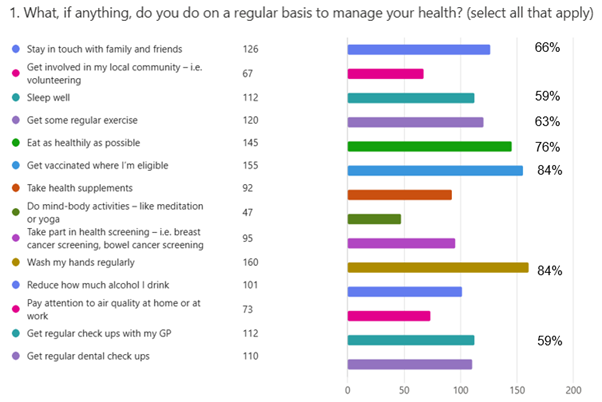
Everyone does something to protect their health usually. With the most selected options being:
Wash hands
Get vaccinated
Eat as healthily as possible
Stay in touch with family and friends
Get some regular exercise
Getting regular check ups with your GP and sleeping well scored highly too.
Next – most of us are doing something extra to prep to avoid winter bugs
More than three quarters of respondents think about taking extra measures – including:
Getting vaccinated
Maintaining strong hygiene like hand-washing and using masks
Avoiding higher-risk environments during peak season
Staying home and keeping your distancewhen unwell
Building overall health and immunity
Paying attention to air quality and ventilation
Most of our respondents plan to get vaccinated if they’re eligible
More than 80% of respondents plan to get vaccinated and know where to go to get it done, with about 7% of respondents unsure. Among the people who say they’re not planning to get vaccinated, about 5 people express concern about the risks of vaccination, with another 7 people commenting on how they’ve experienced cold/flu-like illnesses after previous vaccinations.
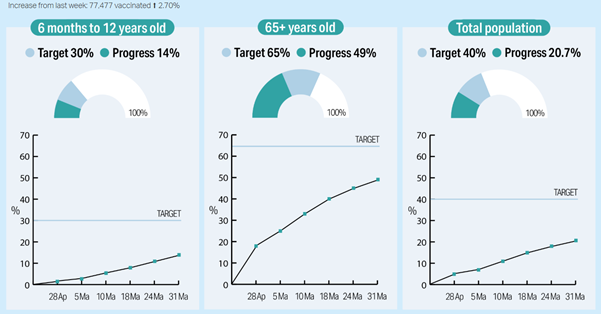
We can all play our part in reaching the community target which gives us all the best chance of staying safe. At the time of writing we’re already over half way towards these targets – but there’s still a way to go. You can check out progress at the WA Health site here: https://access.health.wa.gov.au/immunisation
Finally, we want clear, accessible public health information in places where we already go
People also said they want strong public health messaging and transparency – if you haven’t already, check out the WA Health website which has links to your nearest place to get vaccinated, as well as more information about what to expect.
Survey information
We shared a link to a MS Forms survey between 06/03/26 and 09/06/26. The link was shared with HCCWA networks via email and social media. It was also shared on Reddit in r/Perth. There were 191 respondents. Over three quarters of respondents belong to a group that is known to experience health inequities. Almost a quarter of respondents were between 35-44, and over one tenth of respondents were 75 or over.
Applications close: Monday , 29 June 2026 at 8:00 am
Tentative interview dates: 6 July and 8 July 2026
Not For Profit (NFP)
About us
Health Consumers’ Council WA (HCCWA) is an independent, community-based organisation established in 1994. We exist to ensure that consumer voices are heard, respected and embedded across all levels of the health system.
We work to amplify lived experience in health policy, planning, research and service delivery by:
Supporting individuals to navigate the health system and ensure their health rights are met through individual advocacy
Supporting community members to have their voices heard at every level of decision making in health in partnership with health services and Government
Championing equitable, person-centred, high-quality healthcare for all Western Australians
Our work is grounded in our values of equity, compassion, collaboration, courage, care and integrity.
About you
You are a highly organised and strategic operator who thrives on improving how organisations work. You bring a balance of big-picture thinking and practical implementation, with a strong commitment to purpose-driven work.
You will have:
Experience strengthening systems, processes and organisational effectiveness in a complex environment
Solid understanding of operations in a not-for-profit setting, including finance, HR, digital systems, risk management and governance
Strong judgement, initiative and the ability to manage competing priorities
Excellent communication skills, particularly in developing clear, accessible policies and processes
A collaborative, flexible approach, with a willingness to support others and “muck in” when needed
A genuine commitment to equity, inclusion and the value of consumer voices in health
About the position
The Operations and Impact Manager plays a pivotal role at the centre of HCCWA, ensuring the organisation runs effectively so our teams can focus on high-impact advocacy and engagement.
This role connects strategy, operations and delivery — strengthening systems, processes and governance while supporting day-to-day organisational performance. You will lead improvements across corporate services (HR, finance, IT, systems and facilities), drive continuous improvement, and ensure strong operational foundations that enable meaningful impact.
You will also act as a key member of the Leadership Team, contributing to decision-making, organisational continuity, and deputising for the Executive Director as required.
A typical week might see you
Working with the Executive Director to progress strategic and operational priorities
Leading improvements to internal systems, tools and processes to increase efficiency and impact, including HCCWA’s digital transformation plans
Coordinating finance, HR, IT matters with external providers
Supporting managers with recruitment, onboarding or performance processes
Reviewing and strengthening policies, governance processes and compliance systems
Improving how knowledge and information are structured and shared across the organisation
Troubleshooting operational challenges and identifying practical solutions
Representing HCCWA in meetings or forums and supporting organisational decision-making
The role offers you
The opportunity to be a part of a workplace that is driven by championing West Australian consumer health rights
A welcoming, inclusive and supportive workplace, where everyone is encouraged to bring all of themselves
A competitive not-for-profit annual base salary with salary packaging
Flexible working arrangements including the opportunity to work from home occasionally
At Health Consumers’ Council WA we know that strength comes from diverse perspectives being at the table. We particularly encourage applications from Aboriginal and Torres Strait Islander people, people from culturally diverse backgrounds and identities, people with disability and LGBTIQA+ community members.
Selection Criteria
Essential
Demonstrated experience (5+ years) improving organisational systems, processes and overall effectiveness in a complex environment, including developing practical approaches to organising information, maintaining shared knowledge, supporting effective use of digital tools and platforms, and overseeing strong cybersecurity and data protection practices
Strong understanding of operational management in a small to medium not-for-profit organisation, including practical exposure to finance, HR and organisational governance and risk management with demonstrated ability to interpret financial reports (including P&L and balance sheet) to inform decision making
Proven ability to deliver complex projects and initiatives across teams, including managing competing priorities and driving work through to completion
Excellent written communication skills, including the ability to prepare clear, concise and user-friendly policies, procedures and governance documents
Strong analytical and problem-solving skills, with the ability to remain organised and effective in complex and changing environments
Ability to influence and work collaboratively across teams, supporting others to adopt improved ways of working
Experience in managing or working closely with external service providers (such as HR, IT, finance or similar), ensuring effective and value for money outcomes
High level judgement, initiative and accountability, including the ability to operate autonomously within defined boundaries and escalate appropriately
Demonstrated commitment to outcomes focused service delivery, with the ability to translate organisational priorities into practical action
Flexible and collaborative approach, with a willingness to “muck in” where needed to support delivery and build capability across the organisation
Desirable
A demonstrated interest in the aims and purpose of HCCWA
Experience with CRM systems and knowledge of MS Dynamics
Understanding of governance and compliance requirements in a non-profit setting
Experience supporting organisational growth including income diversification and fee for service delivery
How to apply
Provide a cover letter of no more than two (2) pages addressing the selection criteria points 1, 2, 3 & 7, along with a current resume outlining your work experience, skills and any relevant education or training to Clare Mullen, our Executive Director at jobs@hconc.org.au clearly stating which role you’re applying for. Applications that do not address the selection criteria may not be considered.
Applications close Monday , 29 June 2026 at 8am
Tentative interview dates: 6 July and 8 July 2026
If you require any adjustments to submit your application or wish to have a confidential discussion about the role, please contact Clare Mullen, Executive Director on 0488 7101839
A great time to join HCCWA and play your part in improving health outcomes and strengthening the voice of health consumers in WA.
We have a number of opportunities to join the HCCWA team at the moment. Some of these jobs are open for recruitment now, others will come on board in the coming days. Please share these roles with people in your networks who might be great additions to the HCCWA team.
Work Type: Full-Time/12-month contract with possibility of extension
Level: SCHADS L5
Salary: $50.00-$53.31/hour + Superannuation
Applications close: 8:00 AM AWST, 22nd Jun 2026
Not For Profit (NFP)
ABOUT US
We are the Health Consumers’ Council WA (HCCWA). We work to make sure that the voices of West Australians are heard and acknowledged in healthcare system matters. We fight for an equitable system that is shaped for the people of WA.
This role exists to provide individual advocacy support to health consumers who need assistance navigating issues within the WA health system. Advocates play an important role in upholding consumer rights and ensuring consumers are heard, informed and supported to pursue outcomes that reflect their needs, rights, and goals.
ABOUT THE ROLE
As an Advocate, you will provide individual advocacy to health consumers who seek support to resolve issues within the WA health system. This role is grounded in HCCWA’s consumer-led, pure-advocacy framework and involves working in a strengths-based, non-judgmental way to provide a safe, trauma-informed service.
You will often be the first point of contact for consumers accessing the service, undertaking intake and triage and responding to enquiries by telephone, email and walk-in enquiries. You will manage an individual advocacy caseload, working alongside consumers to identify their needs, rights, priorities and goals, assess barriers and options, and progress advocacy actions in line with agreed priorities.
Using your knowledge of the health system, you will advocate alongside or on behalf of consumers and provide information about rights, responsibilities and available options. You will also liaise with health service providers and other stakeholders, and support referrals where issues fall outside HCCWA’s scope. On occasion, and where appropriate, this may include supporting consumers in meetings or appointments. In addition, you will maintain accurate case notes and contribute to a high standard of professional practice while building positive working relationships with consumers, colleagues and external stakeholders.
ABOUT YOU
Demonstrated experience supporting people to navigate complex systems, address barriers, and work towards outcomes that reflect their needs, rights and goals
Experience undertaking intake and triage, including identifying needs, rights, barriers, urgency, risk, goals and appropriate referral pathways
Knowledge of the WA health system, community services and referral pathways, with the ability to use this knowledge to support people to understand their options and progress their goals
Highly developed communication and interpersonal skills, with the ability to advocate, negotiate, influence, mediate and de-escalate while building positive working relationships with a wide range of people
A strengths-based, non-judgmental and trauma-informed approach, with an understanding of the social determinants of health, systemic barriers and the value of lived experience in navigating the health system
The Role Offers you
The opportunity to be part of a workplace that is driven by championing West Australian consumer health rights
A welcoming, inclusive and supportive workplace, where everyone is encouraged to bring all of themselves
A competitive not-for-profit annual base salary with salary packaging benefits
Flexible working arrangements including the opportunity to work from home occasionally
Diversity and inclusion
At Health Consumers’ Council WA we know that strength comes from diverse perspectives being at the table. We particularly encourage applications from Aboriginal and Torres Strait Islander people, people from culturally diverse backgrounds and identities, people with disability and LGBTIQA+ community members.
Selection Criteria
Essential
Experience undertaking intake and triage, including identifying consumer needs, rights, barriers, urgency, risk, goals and appropriate referral pathways.
Substantial demonstrated experience in a similar advocacy, case-management, or community sector role (or equivalent combination of relevant experience and education) with an understanding of the value of advocacy and the mechanisms for change in the WA health system.
Highly developed communication and interpersonal skills to confidently advocate, negotiate, influence, mediate, and de-escalate with people at all levels while maintaining productive relationships with individuals and organisations.
An understanding of the social determinants of health, systemic barriers and complex trauma when working with people experiencing vulnerability and disadvantage, and the ability to work in a trauma-informed way.
Ability to work autonomously with strong organisational skills to manage competing priorities simultaneously while meeting deadlines.
Demonstrated ability to manage an individual advocacy caseload, including identifying consumer issues and priorities, progressing matters effectively, maintaining accurate records, and reviewing outcomes and follow-up actions.
Good working knowledge of the WA health system, community service organisations and referral pathways
Tertiary qualification in social or behavioural science (e.g., social work, psychology, sociology), or previous advocacy or lived experience in navigating the health system
Desirable
Understanding of policy and legislation within the health and mental health systems.
How to Apply
To submit your application, please click ‘Apply Now‘ by 8 am(AWST) on the closing date.
Provide a cover letter of no more than two (2) pages addressing the selection criteria points 1, 2, 4, & 6, along with a current resume outlining your work experience, skills and any relevant education or training to Sam Arbon, Advocacy Manager at jobs@hconc.org.au using the subject line: Advocates x2 enquiry via EthicalJobs clearly stating which role you’re applying for. Applications that do not address the selection criteria may not be considered.
Appointment is subject to a National Police Clearance, Working With Children Check, and right to work in Australia.
Interview dates will be held on Monday, 29 June and Tuesday, 30 June 2026.
If you require any adjustments to submit your application or would like to have a confidential discussion about the role, please contact Sam Arbon, Advocacy Manager on (08) 9221 3422 (ext 1).
Most people want their healthcare experience to be positive, respectful and centred around their needs.
Sometimes, however, you may leave an appointment, hospital stay or healthcare service feeling confused, concerned or unsure about what happened.
You might feel that your questions were not fully answered. You may not understand a decision about your care. You might feel that something could have been handled differently. Perhaps something has gone wrong.
If this happens, it is important to know that you have options.
Providing feedback is an important part of improving healthcare. It helps healthcare services understand what is working well, what could be improved and where consumers may need additional support.
Just as importantly, giving feedback is one of your healthcare rights.
Start with a conversation
In many cases, concerns can be resolved through clear communication and a conversation with the healthcare service involved.
If your concern relates to a public hospital, you can contact the hospital’s Consumer Liaison Service or Patient Feedback Service.
If your concern relates to a GP clinic, specialist practice or other healthcare provider, you can contact the practice manager.
Sometimes a conversation can clarify misunderstandings, answer questions or help resolve concerns quickly.
When raising a concern, it can help to:
Explain what happened as clearly as possible
Describe how the situation affected you
Ask questions if something is unclear
Explain what outcome you are hoping for
Keep a record of important conversations or correspondence
Knowing your rights and communicating clearly can help you feel more confident when discussing concerns about your healthcare.
What if my concern is not resolved?
Sometimes concerns are not resolved through initial conversations.
If that happens, there are several options available depending on the nature of your concern.
Contact HaDSCO
The Health and Disability Services Complaints Office (HaDSCO) is an independent complaints resolution service in Western Australia.
HaDSCO can help consumers and healthcare providers work towards resolving complaints about health, disability and mental health services.
Share your experience through Care Opinion Australia
Care Opinion Australia provides a public platform where consumers can share their healthcare experiences and feedback.
For many public hospitals, services respond publicly to stories and feedback shared through the platform.
This can be a valuable way to share both positive and negative healthcare experiences and contribute to service improvement.
Concerned about a health practitioner?
If your concern relates to an individual health practitioner, such as a doctor, nurse, psychologist, dentist or other registered health professional, you may be able to raise a concern with the Australian Health Practitioner Regulation Agency (Ahpra).
Ahpra also maintains a public Register of Practitioners, where consumers can check whether a practitioner is registered and whether any conditions have been placed on their registration.
What are my rights as a health consumer?
Every person receiving healthcare has rights.
These include the right to:
Be treated with respect and dignity
Ask questions about your care
Receive information in a way you can understand
Be involved in decisions about your healthcare
Seek a second opinion
Provide feedback about your healthcare experience
Many people worry that their concern is not important enough to raise.
However, feedback plays an important role in improving healthcare services and helping organisations understand the experiences of consumers and carers.
Building confidence through self-advocacy
Self-advocacy means understanding your rights, communicating your needs and actively participating in decisions about your healthcare.
It does not mean being confrontational.
It means asking questions, seeking information, raising concerns when necessary and working collaboratively with healthcare providers to achieve the best possible outcomes.
The more informed and confident you are, the better equipped you are to navigate healthcare services and make decisions about your care.
Need support with self-advocacy?
Health Consumers’ Council WA provides a range of free resources to help consumers understand their rights and navigate the healthcare system with confidence.
Our resources include:
Self-advocacy guides
Factsheets
Letter templates
Workshops and training
Independent Individual Health Advocacy Service (IHAS)
Explore our free self-advocacy resources and learn more about your healthcare rights by visiting our website.
Let’s make healthcare fair for all.
Frequently Asked Questions
Can I complain about a hospital in Western Australia?
Yes. You can start by contacting the hospital’s Consumer Liaison Service or Patient Feedback Service. If your concern is not resolved, you may wish to contact HaDSCO or use other available feedback pathways.
Can I complain about my doctor?
Yes. You can raise concerns directly with the practice, and in some situations you may also be able to raise concerns with Ahpra.
What is HaDSCO?
The Health and Disability Services Complaints Office is an independent Western Australian service that helps resolve complaints about health, disability and mental health services.
What is Ahpra?
The Australian Health Practitioner Regulation Agency regulates registered health practitioners across Australia and manages notifications about practitioners.
Do I have the right to give feedback about my healthcare?
Yes. Providing feedback and raising concerns about your healthcare is one of your healthcare rights.
Where can I get help advocating for myself?
Health Consumers’ Council WA provides free self-advocacy resources, workshops, fact sheets, templates and independent advocacy support through our Individual Health Advocacy Service (IHAS).
Prepared for participants, our consumer community and health system partners
A warm welcome back, and a thank you
These workshops belong to everyone who showed up: those who came in person on a Saturday morning, those who joined online on a Tuesday evening, and those who registered and couldn’t make it this time. Your interest matters, and there will always be a door open for you.
This report is our way of sharing what happened in those rooms and online spaces, and what we heard. It’s written for the people who attended, for our wider consumer community across WA, and for the health system partners and consumer engagement teams who are part of this work with us.
We hope it reflects not just what was covered, but the spirit of how it was covered: honestly, warmly, and grounded in the belief that the experiences of people who use, care for others in, and move through health services are a form of knowledge the system cannot afford to ignore.
“taking the time out of our weekend to come along” – Workshop facilitator, opening the in-person session
What we heard: key themes
Across both sessions, a number of strong themes emerged. These weren’t just talking points; they were things people felt and named from their own lives.
1. Lived experience is a form of knowledge
People who use health services, care for others, navigate aged care, mental health, disability or hospital systems hold knowledge the system cannot get from data alone. This came through clearly in both workshops.
“as consumers moving through it, you then start seeing the gaps”
“our perspectives and experiences are so valuable and give services and systems the information they can’t get anywhere else”
This is one of the core reasons consumer representation matters. Participants told us the most useful parts of the workshop included gaining “in-depth knowledge of health WA,” “understanding the value” of consumer representation, and learning “what consumer reps can expect, skills required, barriers, challenges and benefits.” Together, these responses suggest the workshops helped people see that their experience is not secondary to professional knowledge. It is different knowledge. And it is essential.
2. Consumer representation is contribution, not just a position
Many participants described consumer representation as a way of using their hard-won experience to improve services for others. For some, that came from personal health experiences. For others, it came from watching a parent, child, partner or family member struggle to navigate a system that wasn’t designed with them in mind.
“sharing what I’ve been through to help make the system better for other people”
“have a say and be a voice for people who don’t necessarily have the strength to do that”
People are not coming to consumer representation only because they want a seat at a table. They are coming because they want what they have been through, or what someone they love has been through, to mean something.
“To get to know that consumer representation work can really make consumers’ life easier.”
That comment captures a practical hope that ran through both workshops. Consumer representation is not abstract. It is about improving real people’s real experiences of care.
3. Representation is relational and collective
Consumer representation is not only about telling our own story. Our stories matter; they often bring us into this work. But participants also reflected on how the work asks us to listen, stay curious, seek out other perspectives and hold space for voices that are different from our own.
“Everyone around the table is human, not just the specialists, and your voice is just as important.”
This speaks to both confidence and connection. Consumer representation is not about creating an “us and them” divide. It’s about bringing lived experience into shared spaces, while being honest about power, accountability and the need for change.
4. Diversity is central, not optional
Both workshops gave real attention to diversity. Participants across the two sessions brought a wide range of identities and experiences: carers, people living with chronic illness, people from culturally and linguistically diverse backgrounds, healthcare staff, community members and people new to the work.
“If someone has experienced racism or discrimination in the health system, asking them to sit on a committee can feel impossible.”
This is a powerful reminder. Inviting people is not enough. If people have been harmed, dismissed or treated unfairly by systems, participation needs to be built with care, trust and safety. The workshops consistently encouraged participants to ask: Who has been involved? Who hasn’t? What might we be missing? What do we need to do differently?
5. The work is practical and values-based
Participants valued both the practical and the human dimensions of the workshops. People discussed what consumer representatives can expect, including payment, orientation, preparation time, support from coordinators and respect in meetings. They also discussed skills: listening, asking good questions, being prepared, managing power dynamics, seeking information and sharing experience safely.
“we put names to these numbers”
That comment captures something important. Consumer representatives help ensure that systems don’t lose sight of the people affected by their decisions. Evaluation responses described the most useful elements as the “interactive nature,” the “honest and open and authentic account of the role,” and the practical detail about what the work involves.
6. Tokenism, accountability and closing the loop
Participants were honest about the risk of consumer involvement becoming a tick-box exercise. This included concerns about not being heard, being the only person with a different view, feeling spoken over, having too little preparation time, or being invited into decisions too late to make a real difference.
The workshops were clear: meaningful partnership is not just about inviting people in. It is about creating the conditions for people to contribute well, taking that contribution seriously, and coming back to people with what happened as a result. People want to know: What did you do with what we said? What changed? What couldn’t change, and why? That feedback loop is a form of respect.
7. The work can be meaningful and hard, sometimes at the same time
The workshops were honest about the emotional dimensions of consumer representation. People often come to this work because something difficult or harmful happened to them or to someone they care about. That motivation can be powerful. It can also make the work emotionally demanding.
“Knowing when you can share the raw emotion, and when you can’t, is a really fine balance.”
Participants discussed bureaucracy, slow change, power imbalances, vicarious trauma and the challenge of knowing how to bring personal experience into formal spaces without being asked to carry more than is fair. The training was clear: consumer representative roles are not therapy. People need support, boundaries and care to do this work sustainably over time.
Self-care was framed as a collective as well as an individual responsibility: knowing our limits, debriefing, finding allies, seeking mentoring, choosing the right opportunities, and remembering that this work should also bring something to us.
About these workshops
In March and April 2026, Health Consumers’ Council WA held two Introduction to Consumer Representation workshops. One was an in-person Saturday session; the other was an online Tuesday evening session. Together, they brought people into conversation, people at different stages of their journeys with consumer representation, and from different corners of WA.
These sessions are part of HCCWA’s core training and engagement work. They are designed for people with lived and learned experience, for carers, family members and community members who want to understand what consumer representation can look like, why it matters, and how they might contribute to making health services work better for everyone.
The timing and format of both sessions were deliberate. The Saturday workshop came out of feedback that people needed options outside standard working hours. The Tuesday evening online session recognised that many people are fitting this kind of engagement around employment, caring responsibilities, health needs, study and family life. Accessibility is not an afterthought at HCCWA. It is central to how we think about participation.
Consumer representation is not separate from the communities we’re part of. It’s one way that people who live with and through health systems can bring their knowledge into places where decisions are made, and help those decisions be better.
Who took part
Across the two workshops, 35 people registered. Thirteen people attended: five at the in-person session and eight online. A number of people sent apologies and couldn’t make it on the day.
Importantly, two people who had registered for the in-person Saturday session and were unable to attend came back and joined the online Tuesday evening session instead. Because a second option existed, they were able to find a time that worked for them and still participate. This is exactly why offering different formats matters: not as a logistical convenience, but because the right opportunity at the right time is what makes participation genuinely accessible.
We want to say something directly here: lower attendance than registrations is not a failure, by anyone. It’s a reality of community participation. People register because they want to come. Work, health, caring, transport, unexpected demands: sometimes life gets in the way. This is one of the reasons we follow up with everyone who couldn’t attend and personally invite them to the next available session. Missing one workshop does not mean missing the opportunity. You are always still welcome.
“It really wasn’t until I had to help my elderly mother and uncle navigate aged care and health that I realised how complicated it all is, especially if you don’t have IT skills or English as a first language.” – Workshop participant
This quote captures something we heard throughout both sessions: people often come to consumer representation because they have seen, very personally, how hard systems can be to navigate. And they want that to change for the next person.
A snapshot of who responded to our evaluation
Six people completed anonymous evaluation forms across the two sessions. While this isn’t a full picture of everyone who attended, it gives us a useful snapshot of who provided feedback.
People who responded included:
Consumer representatives and people new to consumer representation
A consumer who is part of a systemic advisory group
A healthcare staff member
A community member
People who identified as carers, people living with chronic health conditions, and people from culturally and linguistically diverse backgrounds
Respondents came from postcodes across metropolitan Perth and regional WA, a reminder that this work matters from Fremantle to the south-west and beyond. For every single one of them, this was their first time attending an HCCWA training or event.
What the workshops covered
The sessions worked through a lot of ground, but always with people at the centre. Topics included:
How the WA health system is structured, and where its connections and gaps tend to be
What we mean when we talk about consumers, carers, family, lived experience and learned experience
What consumer representative roles can actually involve in practice
Partnering with consumers, including Standard 2 of the National Safety and Quality Health Service Standards
What people can expect when they step into a consumer representative role
The skills and qualities that support effective representation
The importance of diversity, and of noticing whose voices are still missing
Honest conversation about the challenges: tokenism, power dynamics, emotional labour and feeling unheard
Self-care, boundaries and sustainability in the work
Where to find further support, training and opportunities through HCCWA and beyond
What made these workshops more than a list of topics, though, was the way they were held. Consumer representation was never framed as a technical task or a formal position only. It was framed as relational, values-based work, grounded in lived experience, shared responsibility and connection to community.
What participants told us
Feedback on the day, and through the evaluation forms, was positive and thoughtful.
Everyone who gave feedback after the workshops said:
The workshop was a good use of their time
The length was just right
They would recommend an HCCWA event to a friend, colleague or network
Their knowledge of the importance of consumer representation improved: four said it had greatly improved, two said it had improved
Most respondents also reported increased interest in getting involved. Four said their interest had greatly increased, one said it had increased, and one said it had stayed the same, which may simply mean they were already keen.
In their own words: what was most useful
“In-depth knowledge of health WA”
“Understanding the value”
“What consumer reps can expect, skills required, barriers, challenges and benefits”
“Interactive nature”
“Honest and open and authentic account of the role”
“To get to know that consumer representation work can really make consumers’ life easier.”
What participants suggested we could do better
When asked what was least useful, most people said nothing, or that all parts were useful. One person noted the health system overview was complex and acknowledged openly that the system itself is complex and convoluted. This is useful feedback: the overview is important, and we can keep working on how we present it clearly.
One participant suggested we explore ways of managing discussion so that each person has a chance to contribute without any one topic taking over. That’s something we will consider for future sessions.
What worked well, and what we’re thinking about next
These workshops did several things well.
They created welcoming spaces where people could bring their experience, questions and uncertainty without needing to already have system knowledge. They affirmed lived and learned experience as valuable knowledge, not a nice addition but something central. They were practical and honest about what consumer representation involves, including the challenges. They supported people to see themselves as capable contributors to change.
The smaller in-person group allowed for deeper conversation and relationship-building. The online evening format broadened access for people who could not attend in person or during the day. Across both formats, participants responded to authenticity: not just being told what consumer representation is but being invited into an honest conversation about what it feels like and what helps.
For future sessions, we are thinking about:
Making the WA health system overview easier to navigate, with clearer visuals and plain-language pathways
Continuing to offer flexible formats, in person and online, on weekends and evenings, so that more people can participate around their lives
Protecting space for genuine discussion while supporting a good session flow
Keeping diversity, equity and missing voices as core content throughout, not a separate topic
Continuing to name emotional labour, boundaries and self-care as genuine parts of the work
In closing
These two workshops were a small, meaningful piece of the work. Thirteen people came together, bringing curiosity, experience and care, and explored what it might look like to contribute to a health system that works better for everyone.
The strongest message across both sessions was consistent: people who use services, care for others and navigate health systems hold knowledge that matters. This knowledge helps services see what is working, what is confusing, what is missing and what needs to change.
“Consumer representatives help put names to these numbers.”
“sharing experience to help make the system better for other people”
Together, those two reflections capture the heart of this work.
Consumer representation is not separate from community. It is grounded in relationships, accountability and shared responsibility. It asks us to bring our own experience, listen for the experiences of others, notice who is missing, and keep working towards systems that better reflect the needs and realities of the people they serve.
For HCCWA, these sessions are part of strengthening the pathways for people to contribute to health system improvement across WA. They are also a model of the kind of engagement we want to see more broadly: accessible, honest, relational, inclusive and grounded in the belief that our experiences can create change.
Thank you to everyone who came, who tried to come, and who continues to believe that their experience belongs in the room.
In March and April, we ran two workshops and brought together thirteen people at different stages of their consumer representation journeys. What they shared was honest, thoughtful and consistent with what we have heard over many years of running this training.
People come to this work because something happened to them or to someone they love, and they want it to mean something changes for the next person. They want to understand the system well enough to push back on it. They want to contribute in a way that is heard and respected, not just invited in and then overlooked.
“our perspectives and experiences are so valuable and give services and systems the information they can’t get anywhere else”
We have put together a full summary of both workshops, including what participants told us about the value of lived experience, the realities of consumer representative roles, the importance of diversity and who is still missing from these spaces, and what makes participation meaningful rather than tokenistic.
Why this matters beyond the training room
Consumer representatives play a specific and important role in systems change. They bring the perspectives of people who use services into the places where decisions are made. They help ensure that what the health system understands about what is working, what is missing and what needs to change is grounded in real life, not just data and projections.
HCCWA’s role is to make sure the people stepping into those roles feel ready: informed, supported and clear that their experience is a form of expertise. That has been our commitment for 34 years and this training is one of the places where that commitment shows up in practice
A training built for the long haul
This is not a one-off workshop or a box to tick before someone is assigned to a committee or a working group or a seat at an executive table. It is a space where people with lived and learned experience of health services can explore what consumer representative work actually involves, think about whether and how they want to contribute, and build confidence to do that well. The content covers the shape of the WA health system and where consumer voices can fit within it. It is honest about the challenges: the risk of tokenism, the emotional weight of bringing personal experience into formal spaces, the patience required when change is slow. And it is grounded, always, in the belief that people who use health services hold knowledge the system cannot get from anywhere else.
It has been delivered face to face, fully online, and now in both formats because we have learned that different options open the door for different people. In 2026, two people who couldn’t make the Saturday in-person session came back and attended the Tuesday evening online session instead. That is what genuine accessibility looks like: not just saying people are welcome, but making sure there is more than one way in.
Over three decades of consumer voices: the training that keeps people ready
Since 1994, Health Consumers’ Council WA has stood alongside people who use health services across WA. Throughout that time, one thread has run consistently through our work: helping people understand that their experience matters, that their voice belongs in the room, and that they have something real to contribute to making the health system better.
Our Introduction to Consumer Representation training is one of the ways we do that. The current iteration of this training goes back to 2019, but this commitment goes back much further. The format has evolved; the purpose has not.
Read the full 2026 workshop summary report or get in touch with us at engagement@hconc.org.au if you are interested in consumer representation opportunities or want to know when our next session is running.