We’re excited to share HCCWA’s new Health Passport — a simple, practical tool designed to make healthcare appointments easier and less stressful for people from non-English speaking backgrounds.
The Health Passport helps people share important information with health services, especially when they are not yet confident reading or writing in English, or when they need communication support such as an Auslan interpreter.
With support from a family member, carer, community worker or service provider, a person can complete the Health Passport before attending a health appointment. Once completed, it gives healthcare staff key information at a glance, helping to reduce the need for people to repeatedly answer questions they may not fully understand or feel confident responding to.
We hope the Health Passport helps people feel more prepared, supported and confident when accessing care — and helps health services provide care that is respectful, inclusive and person-centred.
The Health Passport is now available to download and use. We encourage you to share it with your community, clients, networks and anyone who may find it helpful.
We warmly welcome feedback from both health consumers and healthcare providers as we continue working together to make healthcare more accessible for everyone.
This work also connects closely with HCCWA’s Diversity Dialogues initiative, which brings together consumers, carers, communities, and healthcare organisations to discuss how we can improve healthcare access and experiences for everyone in WA.
Our next Diversity Dialogues session will focus on improving access to care for older people from migrant and refugee backgrounds.
WA Health now has a mandatory policy for how body worn cameras can be used in public health facilities. The policy is intended to support safety during incidents of violence, aggression or threatening behaviour, while protecting people’s privacy, dignity and rights.
Plain language question
Plain language answer
Who can use body worn cameras?
Only Security Officers can use them under this policy.
When can they be turned on?
Only when there is an imminent safety risk involving violent, aggressive or threatening behaviour.
Are they for routine surveillance?
No. They must not be used for general monitoring, intimidation, harassment, discrimination, personal use or staff disputes.
Do people need to be told?
Yes, where practicable. Security Officers should clearly tell people the camera is being activated and that they are being recorded.
When should recording stop?
Recording should stop once the incident is resolved and the immediate safety risk has passed.
How is footage handled?
Footage must be downloaded, securely stored, linked to a security incident report, and accessed or disclosed only under relevant WA Health rules.
What the policy allows
Body worn cameras can only be used by Security Officers when they are responding to incidents involving violent, aggressive or threatening behaviour.
They are one part of a broader workplace violence and aggression response. The cameras may help deter or de-escalate behaviour and may create an objective record of an incident.
They must be used lawfully, ethically and proportionately.
What the policy does not allow
Cameras are not for routine or general surveillance.
They must not be used for personal purposes, staff disputes, intimidation, harassment or discrimination.
They should not be activated simply because a person is distressed, unwell, frustrated or upset unless there is an immediate safety risk involving threatening, violent or aggressive behaviour.
When cameras can be turned on
A camera can only be activated when there is an imminent risk to the safety of workers, patients or visitors.
Imminent risk means there is a credible and immediate threat based on current, clear and objective signs that harm is happening or about to happen.
Where practicable, Security Officers must tell people clearly that the camera is being turned on and that they are being recorded. This may include physical actions, such as pointing to the camera, to support understanding.
Places and situations needing extra care
Cameras should generally not be activated in highly private or sensitive spaces, such as toilets, change rooms, bathrooms, parent rooms, lactation rooms, clinical treatment areas, during medical procedures, or when someone is undressed.
The exception is where there is an imminent safety risk involving threatening, violent or aggressive behaviour.
Security Officers should consider relevant information from clinical staff before activating a camera, including known clinical conditions, substance use, triggers or behavioural history, particularly where recording may escalate the situation.
When recording must stop
Recording should stop once the incident has been resolved, the immediate safety risk has passed, and the Security Officer has been stood down from the incident or risk.
If a patient, carer, guardian, staff member or member of the public asks for recording to stop, the Security Officer must assess whether continued recording is still necessary and lawful.
If recording continues, the person should be told clearly.
Privacy and access to footage
Body worn cameras are treated as listening and optical surveillance devices under WA surveillance law.
Recordings must avoid unlawful recording of private conversations or private activities.
Footage must be downloaded and stored securely at the end of each shift, or as soon as practicable, in an access-controlled system.
Stored footage must be linked to a relevant security incident report. Access, use or disclosure must be managed under relevant WA Health information access, retention, privacy and Aboriginal data governance policies.
How use will be reported and monitored
The policy includes only limited requirements for reporting and monitoring body worn camera use.
When a workplace violence and aggression incident occurs and a camera is activated, the incident report must include the words “BWC activated” so footage can be linked to the incident record.
Footage must be linked to the relevant security incident report and stored in an access-controlled system.
Compliance monitoring focuses on whether Security Officers have completed mandatory body worn camera training.
The System Governance and Reform Unit, on behalf of the System Manager, may ask Health Service Providers for additional information to evaluate compliance and support policy evaluation.
The policy does not clearly set out routine public or consumer-facing reporting on how often cameras are used, where they are used, who is recorded, whether people ask for recording to stop, complaints about camera use, access requests, disclosures of footage, or audit outcomes.
Training and local procedures
Health Service Providers must develop their own procedures that align with the statewide policy.
Security Officers must complete training before wearing or operating a camera.
Training must cover legal requirements, activation and deactivation, access and disclosure, end-of-shift processes, incident reporting, verbal notification, camera positioning and device operation.
Consumer-rights and implementation issues to watch
Whether consumers, carers and visitors are told about camera use in clear, accessible and culturally safe ways.
How staff decide that a safety risk is imminent, and whether that decision is documented consistently.
How the policy is applied for people who are distressed, unwell, intoxicated, experiencing mental health crisis, cognitively impaired, neurodivergent, communicating in a language other than English, or experiencing cultural unsafety.
Whether recording in sensitive clinical or personal spaces is treated as genuinely exceptional.
How people can ask questions, raise concerns, make complaints or request access to information about footage involving them.
Whether local procedures include practical guidance for de-escalation, trauma-informed care, disability access, interpreter use, and culturally safe communication.
Whether local monitoring includes consumer-focused measures, such as number of activations, locations, reasons for activation, requests to stop recording, complaints, access requests, disclosures and equity impacts.
Note
This summary is intended to support discussion. It does not replace the official WA Health policy.
WA Health has introduced a statewide mandatory policy for body worn camera use in public health facilities. The policy is about staff and visitor safety, but it also raises important questions about trust, dignity, communication, privacy and accountability.
WA Health has introduced a new mandatory policy about the use of body worn cameras in public health facilities. The policy is focused on supporting safety during incidents involving violence, aggression or threatening behaviour. It sets out when body worn cameras can be used, who can use them, how people should be told they are being recorded, and how footage should be managed.
Health Consumers’ Council WA was invited to take part in the policy consultation process, alongside clinical, safety and health system representatives. We appreciated the opportunity to bring a consumer perspective into those discussions and to speak to what matters for people, families and communities when they are accessing care.
For us, this conversation was about more than the cameras themselves. It was about trust, dignity, communication, privacy and safety.
We also want to acknowledge why this policy exists. Health care workers, security staff and others working in our health system have the right to be safe at work. No one should experience violence, aggression, threats or abuse while providing care or supporting people in health services.
When staff feel unsafe, this can affect everyone – staff, patients, families, carers and other people nearby. A safer environment supports better care.
From a consumer perspective, supporting staff safety and protecting consumer rights are not opposing goals. Both matter. The important question is how safety measures are used, especially in situations where people may be unwell, frightened, distressed, overwhelmed or in crisis.
This is not completely new
Body worn cameras are already used in a range of public safety and frontline settings across Australia. They have also already been used in some WA health settings.
For example, WA Country Health Service has had a local Body Worn Camera Procedure for security officers working at WACHS health sites and facilities. That procedure was published in May 2025 and covers the use of body worn cameras, associated equipment, and the capture, management, storage, retrieval and release of digital data.
WACHS also has an Electronic Security Systems Policy that includes body worn cameras as part of its broader security arrangements, alongside CCTV, duress alarms and access or identification cards.
So, the new WA Health policy is not simply about introducing a new technology for the first time. What is new is the statewide mandatory policy. This creates a system-wide framework for the lawful, ethical and consistent use of body worn cameras across all WA public health facilities.
We have not found publicly available body worn camera-specific policies for every Health Service Provider. This is one reason a statewide policy matters: it gives services a shared set of minimum requirements, rather than relying only on local arrangements that may differ between services and may not be easy for consumers to find.
What the WA policy says
Under the WA Health policy, body worn cameras can only be used by Security Officers. They are not for routine surveillance. They may be activated only when there is an imminent risk to the safety of staff, patients or visitors because of violent, aggressive or threatening behaviour.
Where practicable, people should be told that recording is starting. This is important because clear communication can help reduce fear, confusion and mistrust, especially for people who may already be distressed or struggling to understand what is happening.
The policy also recognises that extra care is needed in private, sensitive and clinical areas. From a consumer perspective, this is one of the most important parts of implementation. A person’s dignity, privacy and cultural safety still matter, even when a situation is difficult or unsafe.
What happens to the footage?
The policy does not set one simple storage timeframe for body worn camera footage. Instead, footage must be managed in line with WA Health information policies and State Government records rules. In practice, footage linked to a security incident may be kept for longer than routine footage, depending on the type of incident, whether it is needed for investigation, and how the record is classified.
A consumer who wants access to footage involving them will need to contact the relevant hospital or health service and ask about access through Freedom of Information or the appropriate information access process. Access may not be automatic, especially if other people are identifiable in the footage.
Questions consumer representatives can ask
As this policy is put into practice, consumer representatives, Chairs and committee members can play an important role by staying curious and asking practical questions, like:
How will people be told when a body worn camera is being turned on?
How will staff make sure people understand what is happening, especially if they are distressed, unwell, cognitively impaired, culturally unsafe, or communicating in a language other than English?
How often are body worn cameras being activated, and in what kinds of situations?
How will services monitor whether cameras are being used appropriately?
How will consumers, families and carers be able to raise concerns or provide feedback?
How long is footage kept, who can access it, and how are people told about their rights to request access?
How will consumer experience be included in evaluation of the policy?
Keeping people at the centre
HCCWA supports safe health services for everyone – patients, families, carers, staff, volunteers and visitors. We also believe that safety measures must be implemented in ways that protect dignity, trust, cultural safety and compassion.
Many of the situations where body worn cameras may be used will involve people at very difficult moments in their lives. That is why monitoring and evaluation should look beyond compliance and should also consider what body worn camera use means for consumers, including whether people feel respected, informed and safe.
We are sharing this information as part of our commitment to keeping our consumer community informed about policy changes and the work HCCWA is involved in. We hope it supports consumer representatives, Chairs and community leaders to take part confidently in conversations about how this policy is implemented across WA Health.
Positive feedback in healthcare can improve staff wellbeing, strengthen compassionate care, and help health services understand what consumers value most across Western Australia.
Healthcare consumers often speak up when something goes wrong. Complaints, concerns and advocacy are essential for improving safety, access and accountability in the WA health system.
But positive experiences matter too.
Across Perth and regional WA, healthcare workers support people through some of the most stressful and vulnerable moments of their lives. A nurse who takes time to explain a procedure. A receptionist who helps someone navigate appointments. A doctor who listens carefully. An Aboriginal liaison officer who helps a patient feel culturally safe. These moments shape how people experience healthcare.
Health Consumers’ Council WA encourages healthcare consumers in WA to recognise the people who have had a positive impact on their healthcare experience.
What consumers value in good healthcare experiences
At HCCWA, patients, carers, families and and healthcare consumers consistently tell us that good healthcare is about more than clinical treatment alone.
People value:
being and feeling listened to
clear communication
compassion and empathy
cultural safety
dignity and respect
involvement in decisions
feeling safe and supported
continuity of care
kindness during stressful moments
These are central parts of quality healthcare. The Australian Commission on Safety and Quality in Health Care identifies partnering with consumers, person-centred care, communication and respect as essential components of safe and high-quality healthcare.
Why positive feedback matters for healthcare workers
Healthcare workers across Western Australia continue to work under significant pressure. Hospitals, general practices, community health services and aged care providers are managing increasing demand, workforce shortages and rising complexity of care.
Research suggests positive feedback can: • improve morale • reinforce compassionate care behaviours • strengthen workplace culture • reduce emotional exhaustion • help staff feel valued and connected to their work
Healthcare workforce literature suggests that meaningful positive feedback from patients and families can contribute positivley to staff motivation and wellbeing. So, a simple thank you can have a real impact.
Positive feedback also improves the health system
Positive feedback is not ignoring problems in healthcare. Consumers can recognise excellent care while also advocating for system improvement.
At Health Consumers’ Council WA, we view consumer experience as an important part of healthcare system improvement. Positive feedback may help health services better understand what consumers value in care experiences. Consumer experiences help identify:
what is working well
where people feel safe and respected
which approaches build trust
how services can improve consumer experiences across WA
Your stories and feedback on your experiences can help health services understand what good care looks like in practice and what should be replicated more broadly.
Examples of positive healthcare experiences
Positive healthcare experiences can happen in any setting across the WA healthcare system. For example:
an emergency department nurse keeping family members informed during long wait times
a GP taking time to explain treatment options clearly
a hospital staff member helping a patient understand discharge instructions
a mental health worker creating a safe and non-judgemental environment
an interpreter or liaison officer helping a consumer feel culturally understood
a receptionist helping organise urgent follow-up care
These moments matter to patients, carers and all healthcare consumers.
How to share healthcare feedback in WA
If someone has had an impact on your healthcare experience in Western Australia, consider telling them. You can:
Positive feedback helps reinforce the type of healthcare consumers want to see more of. Care that is compassionate, respectful, safe and human.
Frequently asked questions
What is positive feedback in healthcare?
Positive feedback in healthcare is when consumers, carers or families acknowledge healthcare workers or services for providing compassionate, respectful, safe or supportive care.
Why is positive feedback important for healthcare workers?
Positive feedback can improve morale, reinforce good communication and compassionate care practices, and help healthcare workers feel recognised for their work.
Can positive feedback improve healthcare quality?
Yes. Positive feedback helps health services understand which behaviours and practices consumers value most. This can support quality improvement and person-centred care.
How can healthcare consumers in WA share positive feedback?
Consumers in Western Australia can provide feedback directly to healthcare providers, share stories through Care Opinion Australia, or engage with organisations like Health Consumers’ Council WA.
What does Health Consumers’ Council WA do?
Health Consumers’ Council WA is the independent peak body representing health consumers in Western Australia. Established in 1994, HCCWA works to ensure consumer voices are heard and included in health policy, service design, advocacy and system improvement across WA.
This week the WA State Budget was handed down, with the government identifying jobs, health, and housing as key priorities.
Health Consumers’ Council WA attended the annual State Budget lockup and briefing, where the Premier and Treasurer outlined the government’s plans for the year ahead.
Overall, this is a significant budget for health.
There is major investment in health infrastructure, continued funding linked to winter demand, and initiatives focused on helping people stay well, including immunisation measures.
We also welcome investment in the Mental Health Advocacy Service (MHAS), with funding expected to increase by around 30% next year alongside expanded responsibilities. However, there was no reference to funding for other health advocacy services – a missed opportunity to ensure patients are being listened to when it matters most.
At the same time, there are important questions about what this budget will mean for people actually using the health system.
One ongoing concern is the cost of accessing care.
While our public hospitals are free, many people continue to face significant out-of-pocket costs just to attend appointments or support loved ones in hospital. Hospital parking remains a major pressure point for consumers and carers, particularly for people attending regularly or over long periods of time.
We were disappointed to see no cost-of-living relief measures related to hospital parking included in this budget.
Another major issue is outpatient wait times.
Official figures presented in the budget papers indicate that some consumers are continuing to wait beyond recommended clinical timeframes for outpatient appointments:
around 10% of Category 3 outpatient referrals are waiting more than one year
around 20% of Category 1 referrals are waiting beyond recommended timeframes
Category 1 – Urgent: Within 30 days (potential to deteriorate quickly)
Category 2 – Semi-urgent: Within 90 days (causes pain/dysfunction, low risk of rapid deterioration)
Category 3 – Non-urgent: Within 365 days (causes pain/dysfunction, unlikely to deteriorate)
These categories reflect clinical urgency, but lower urgency categories may still involve significant pain, reduced quality of life, or functional impacts for consumers while waiting for care.
While there is some additional funding for outpatient services, the increase in outpatient staffing appears relatively small.
These numbers matter because being referred as a lower category does not mean a condition is unimportant or that people are not suffering while they wait.
As recent media reporting has highlighted, delays can have a significant impact on people’s health, wellbeing, finances, and quality of life.
We will continue to review the budget in detail over the coming days and share further analysis focused on what these investments mean for health consumers across WA.
Video Transcript 1: Clare Mullen fronts the Press outside of Dumas House
Hello, I’m Clare Mullen from Health Consumers’ Council WA.
We’re the peak body for people who use health services, the patients, the families, the carers.
I’ll start by saying it’s obviously a great budget for health and we’re going to be watching and seeing what that means for the people who use healthcare.
So first up, obviously, the significant investment in health infrastructure very welcome as the state grows.
Some questions remain, however, about the experience of people when they’re in those hospitals.
2 fronts. 1 is a great opportunity missed, I think, which is the opportunity to really address cost of living and health infrastructure by, for example, a bold move that could have been done, which would be to make hospital parking free or low cost.
We know that that is a huge impost on people who are using health services everyday.
The second area is that the budget figures say that people who are referred to hospital for outpatients.
At the moment, 10% of people are waiting over a year for their appointment and 20% of people who have been referred for urgent referrals are waiting longer than they should.
And yet the investment in outpatients seems to be very small.
And so for most people, when they use hospitals, it will be outpatients that they use.
So we’d like to perhaps have seen a greater investment there.
And the third area, which we’d love to see more, more and more people are using health services.
That’s why we’re seeing a huge investment.
But unfortunately, all too often we know that when people speak up about their health care, when they’ve got concerns or questions, they go unheard.
And what we know is that that can sometimes have catastrophic consequences.
We would love to have seen an investment in individual advocacy services that can support people’s voices to be heard and to be part of their healthcare journey so that we can avoid people having experiences where, had they been listened to, they would have had a more positive outcome.
So overall a great budget for health and we’re looking forward to seeing how that will translate into an experience for people on the ground.
Is it enough given so much of its long term, is it enough to make a difference this winter?
I would say that it is great to see the investment in the winter strategy and we have been doing a survey of consumers about what they intend to do and it’s really interesting to see that most people do intend to get vaccinated, most people do intend to do take action to stay well.
So I think it is encouraging to have seen the investment in increasing immunisation, in increasing access to other parts of the health services.
But time will tell.
And I think the opportunity that potentially is there is to involve the community in conversations about how to get the message out.
We can all do things as community members to stay well.
And I think that there’s more that can be done to help get that message into community.
Thank you. Thanks.
Video Transcript 2: Clare Mullen, Executive Director
“So I have just left the annual state budget lockup, which is where you hear from the Premier and the Treasurer and then you get locked in a room for a number of hours.
So headlines obviously as had already been trailed, this is a really big budget for health.
The priorities that were being restated are jobs, health and housing.
In terms of great things, obviously a lot of investment in health infrastructure, some known investment again in the winter strategy.
So there’s a bit in there about helping people stay well, immunisation, that sort of thing.
In terms of missed opportunities, there’s no reference in there to cost of living relief around the cost of hospital parking.
So there’s a lot of investment in infrastructure.
But unfortunately, as many of us know, going to the hospital on a regular basis can pretty much have you out of pocket hundreds of dollars.
So we raised that point and we’d hope to see something like that in future years.
Great to see investment in the mental health advocacy service.
So the cost there are going to go up by about 30% next year.
Some of that related to them also taking on new services.
But again a missed opportunity is the rest of WAS individual health advocacy service, no mention of that and so we can only assume that it’s not covered.
Finally, there was some official statistics in there that say that if you’re referred for an outpatient’s appointment at the moment, you can expect 10% of people are waiting over a year for a category 3 and 20% of people are waiting beyond the recommended wait times for the most serious of referrals. That’s the CAT1.
Unfortunately, while there’s a small increase in the budget for outpatients, only a really small increase in outpatient staffing.
So it’ll be really interesting to see what the government’s plans are to make a significant difference to that because as recent media has shown, even if you’re referred for a category three, it doesn’t mean that it’s not serious, it doesn’t mean that it’s not important.
And we really want to see those numbers improve dramatically.
So overall, a good budget for health and the impact on the consumers experiencing the health system, We will wait and see.
Written by Tania Harris Engagement Manager | Aboriginal Engagement Lead | Disability Engagement Lead
This year, Western Australia has introduced something important for families — a free, needle-free flu vaccine for children.
The FluMist program is now available for children aged 2 to 11 years, a quick nasal spray instead of a needle. For many parents and carers and especially for children who are anxious about injections, this is a very welcome option.
FluMist works in the same way as traditional flu vaccines by helping protect children against influenza and its complications. It’s not new internationally, it’s been used safely overseas for many years. 2026 is the first time we’re seeing a state-wide rollout here in WA.
We are currently running a Winter survey to hear the perspectives of the community, and what stands out to me is just how varied people’s experiences and attitudes to vaccination are.
Many people told us they actively plan for winter and see vaccination as part of that:
“Make sure I get the flu vaccination… and encourage my family to do the same.”
“Flu vaccination, take vitamin C supplements… wash hands more regularly.”
But alongside this, we’re hearing about very real barriers that not just about choice, but about access, timing and experience:
“I always plan to and then get too sick… to actually get it.”
“I should probably get a flu injection, but I always put it off and forget.”
“Vaccination clinics outside of ordinary working hours… it’s difficult to find time to take the children when working full time.”
We’re also hearing that for some people, concerns and past experiences are influencing decisions:
“Had a fever/chills after last vaccination and dislike needles.”
“I don’t trust vaccinations… and their side effects.”
At the same time, there’s a strong sense of shared responsibility coming through:
“Even if people reject vaccinations, we all have a duty of care to protect each other from harm.”
For me, this is exactly why initiatives like FluMist matter
They respond directly to what people are telling us by removing one of the most common barriers (needle anxiety), making the process quicker and easier for families.
Children are a key group when it comes to influenza. They are more likely to spread the virus, and even otherwise healthy children can become seriously unwell. Supporting children to get vaccinated helps protect not just them, but the wider community as well.
What families need to know
The FluMist vaccine is free for children aged 2–11 years in WA
It is delivered as a gentle nasal spray — no needles required!
It’s available through GPs, community health clinics, Aboriginal medical services and some pharmacies
It’s designed to make flu vaccination easier, particularly for children who may otherwise miss out If you are supporting families, please let them know about this new initiative.
Informed financial consent means you are told the full cost of your care before you agree to treatment. This includes what Medicare pays, what your insurer pays, and what you pay. Always ask for a written estimate, check all providers, and take time before you agree.
What is informed financial consent?
Informed financial consent means you are given clear information about the cost of your care before you agree to it.
This should include:
the total cost of treatment
what Medicare will cover
what your private health insurance will cover
what you will need to pay yourself
Why this matters
Clear cost information helps you make safe and informed decisions about your care.
What costs should you be told about?
You should be told about all expected costs before treatment, including:
surgeon or specialist fees
anaesthetist fees
assistant surgeon fees
hospital or facility fees
diagnostic tests or imaging
follow up care
Sometimes, more than one provider will bill you separately. You have the right to understand the full picture before you agree.
When should you receive this information?
You should receive cost information before treatment.
This gives you time to:
ask questions
compare options
decide if you want to proceed
However, in emergencies, it may not be possible to provide full cost information in advance.
Financial consent is not the same as clinical consent
You may be asked to sign consent forms. It is important to understand there are two types:
Clinical consent: covers risks, benefits, and treatment options
Financial consent: covers cost
You should receive both.
What questions should you ask before agreeing to care?
Ask these questions:
What is the total cost of this treatment?
How much will I pay out of pocket?
Are there other doctors involved?
Will they charge separately?
What Medicare item numbers apply?
What will my health fund cover?
Can I have this in writing?
What to do before you agree to treatment
Take these steps:
Ask for a written cost estimate
Ask about all providers involved
Contact your private health insurer
Check what Medicare will cover
Take time before you decide
You have the right to pause and ask questions.
What if you receive an unexpected bill?
If you were not clearly informed about costs, you can act:
Contact the provider and ask for an explanation
Check your insurer and Medicare details
Ask for a review or itemised bill
If the issue is not resolved, you can escalate, in Western Australia, you can contact:
Health and Disability Services Complaints Office
Care Opinion Australia
Health Consumers’ Council WA for advocacy support
Key takeaways
Before you agree to care, you should know what it will cost you.
If you do not understand the cost, you cannot give informed financial consent.
Ask questions. Get it in writing. Take your time.
Learn how to advocate for yourself or someone you care for
If you struggle with asking questions of your healthcare practitioner (GP, Dentist, Specialist, Pharmacist ect.) join our next FREE workshop ‘Stronger Voices, Better Care’ in-person or online.
Our team works hard for the people of WA, we’re passionate about making a difference in the lives of West Aussies and working hard to make patients, carers, loved ones – all health consumers – are at the centre of our healthcare system to make healthcare fair.
We’d like you to meet Clare Mullen, Executive Director of HCCWA
How long have you worked at HCCWA
Since September 2018, so seven and a half years now.
What inspired you to work at HCCWA?
I had the chance to work on a project which led to setting up the Health Engagement Network. In the course of that work, I came to the realisation that the next wave of transformation in health and healthcare will be – and needs to be – consumer and community-led. When a job in the Engagement Team was advertised, I applied and was successful.
I’m so grateful that the founders of HCC – both consumer leaders and community members, as well as the politicians and public servants of the day – recognised the need for, and committed to, establishing HCC as an independent voice for the community on all aspects of health and healthcare.
Describe what you do at HCCWA
I’m now privileged to be the Executive Director – in that role I take care of the organisation, making sure we have the resources to do what the community requires of us; I take care of the team, making sure everyone has the conditions and the support they need to do the great work they do with and alongside the community; and I play a part in championing and amplifying consumer perspectives on every aspect of health and healthcare. I also spend time building and nurturing relationships with consumer reps and leaders, as well as the many organisations and stakeholders that we work with to achieve a more compassionate, equitable and safe health system for all.
What do you think about HCCWA and the work we do?
I feel so lucky to work in an organisation where everyone works so hard and passionately every day to deliver better health outcomes and experiences for everyone across WA. I’m also inspired and energised by the efforts of the thousands of people in our community who show up to speak up for consumers on committees, working groups, as well as in clinics and hospitals to make sure that more people have a fairer and safe experience in WA health services.
I love the commitment to improving equity – that is, recognising that some people have a different experience in the health system because they either belong to a particular group, or have particular characteristics. Everyone at HCC is committed to making healthcare fair in WA.
How do you see your work helping to improve outcomes and experiences for everyone in WA?
At HCC we’re all working hard to make sure that consumer perspectives are heard in every room where decisions are made about health or healthcare. Be that in your appointment with a doctor where you’re deciding on a treatment plan, or at a Board meeting deciding on a health service’s budget, or informing statewide policy on safe high quality care.
Ever met anyone famous?
Yes! In one year I met Dr Patch Adams, Germaine Greer, and UK Prime Minister Tony Blair when I was organising a health conference in the UK. I was awestruck 🙂
Quick Read: Healthcare can move quickly. Information can be hard to process in the moment. Speaking up helps us understand our care, make informed decisions, and reduce risk.
When you need care, speaking up matters
Appointments are often short, information can come at us very quickly. It is a common feeling to leave an appointment and realise later there were questions we didn’t ask because we didn’t feel confident in the moment, we don’t want to be seen as being difficult or a bother. But speaking up is one of the most practical ways to protect our health.
Why active participation matters
When we ask questions, we improve our understanding of what is happening, and clear understanding supports informed decision making. This is also known as self-advocacy. Self-advocacy and being active and engaged in our care can be:
asking for the information in plain language, printed out or re-explained
checking what happens next in the sequence of care
raising concerns when something doesn’t feel right
Healthcare works best when we, the ‘healthcare consumers’, and our clinicians share information clearly and make decisions together.
This does not mean the responsibility sits only with us. Health services and clinicians also have a duty to communicate clearly, support informed decisions, and respond to concerns.
What self-advocacy can look like
Self-advocacy does not need to be confrontational, often it’s just simple, direct questions, such as:
What is this test for?
What are my options?
What happens next?
What side effects could this have?
Who do I contact if the symptoms change?
Can what is happening to me be explained another way?
Remember, it is also totally ok to bring a support person to an appointment if you need one. A family member, friend, or carer can help us remember information and ask follow-up questions.
Another practical step to make sure you understand everything is to repeat the information back for clarity. You can say something like:
“I want to check I understand. You are asking me to do X, then Y, then come back in two weeks. Is that correct?”
This is an easy way to reduce confusion and catch any misunderstandings early.
When to speak up and how to prepare
Speaking up can feel difficult, especially when we’re unwell or stressed, however it is important to speak up during an appointment or after an appointment when:
we don’t understand what we have been told
symptoms change or get worse
something does not seem right
we feel pressured to agree to something and we may not feel ready
we feel like we’re not being truly heard
we need an interpreter, support person, or more accessible information
Here are some easy actions for the next conversation with a doctor, physio, pharmacist or other healthcare professional:
Before an appointment write down the top three questions or concerns
During the appointment
ask for plain language if something is unclear ‘explain it like I’m 5’
take notes or bring someone to support you and help understand and remember the conversation
repeat back key information to check our understanding is correct
After an appointment
write down next steps, including tests, referrals, and follow-up dates
If something does not feel right:
raise it clearly and calmly
seek a second opinion if needed
contact a consumer advocacy or support service if you need system navigation
Many of us have had to advocate for ourselves or someone we care for, this is common. We shouldn’t have to do everything alone; health services have responsibilities to ensure you understand what is happening and what your healthcare rights are.
Our voice remains one of the most effective tools in our healthcare. Speaking up helps us stay informed, reduce risk, and take part in decisions about our care.
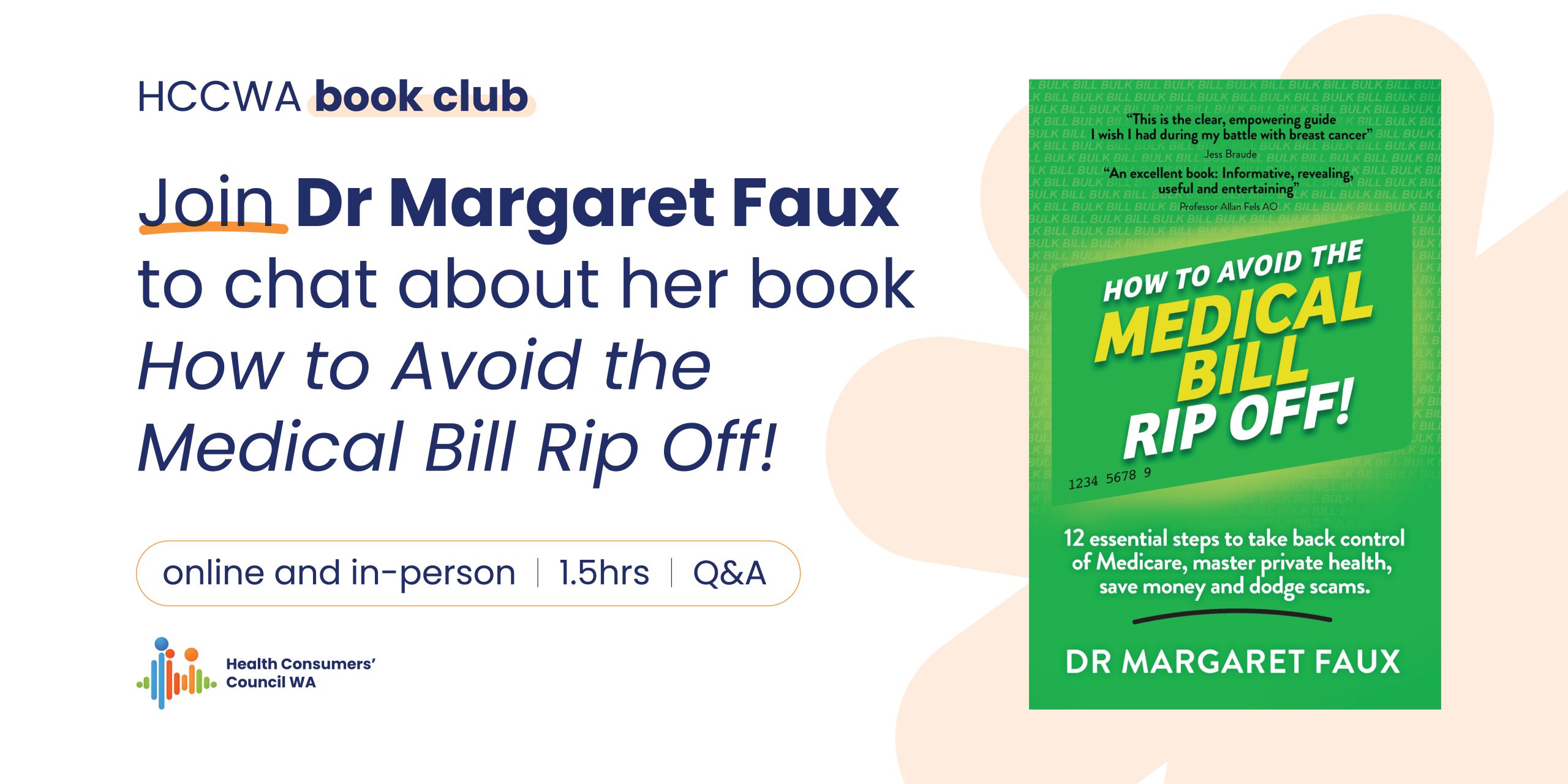
We’re excited to share that we have three special events coming up in April with Dr Margaret Faux, Australia’s leading expert in medical billing and author of the newly released How to Avoid the Medical Bill Rip Off.
Book Club with Dr Margaret Faux – Tuesday 7 April
Join us for a Q&A with Margaret, hear about her new publication, and learn more about the rules and realities of medical billing, Medicare charges, rebates, bulk billing and private specialist fees and more!
Margaret has also generously offered her time to run a workshop for our consumer network!
This session will help consumers and carers increase their confidence in understanding all things medical billing, navigating Medicare, understanding private healthcare costs, and how to identify if Medicare has been billed for services that did not take place.
This is a supportive, practical space to build skills for making informed decisions and asking clearer questions.
Workshop for Staff Supporting Consumers – Wednesday 8 April
To complement our consumer workshop, we’re also hosting a specialised session for staff who support people with questions or concerns about healthcare costs and billing.
Ideal for advocates, community workers and financial counsellors supporting people at risk of being overcharged, confused by fees, or facing unexpected medical bills.
There is a $25 charge to assist with the costs of hosting this event; however, we don’t want cost to be an issue! Please email engagement@hconc.org.au if cost will be a barrier to attending.