Category: HCCWA Blog

Engagement Officer, L4 – full-time

Can you help us build a social movement in health?

At Health Consumers’ Council, we believe in people power. Through our engagement and partnerships work, we are building a social movement in health – where the people who use health and healthcare services, and the people who work in them, can work together to identify priorities for improvement and make positive and lasting change.

We’re looking for a can-do person to join our team and help us extend our reach to more people in the community who use health and social care services, as well as reaching more of the people who work in them.

Health Consumers’ Council WA

The Health Consumers’ Council of WA (HCC) is an independent community-based organisation which was established in 1994, representing the consumer’s voice in health policy, planning, research, and service delivery. We stand for equitable, person-centred, quality healthcare for all West Australians.

Three people sitting at a desk looking towards the front of the room. In the background is an Aboriginal flag and a Torres Strait Islander Flag, and a whiteboard with post-it notes

About the Role

This role is based in the Engagement team and is for an initial period of up to 2 years with the possibility of extension. As well as managing your own projects and activities, you will also provide support to other members of the Engagement team including the Aboriginal Engagement Coordinator, the Cultural Diversity Engagement Coordinator, the Marketing and Communications Coordinator and the Deputy Director.

This is a full-time role based between our offices in Mount Lawley and your home. For the right person, we may consider part-time options, but ideally we’re looking for someone who can be available to work 5 days/week.

What We Offer

  •  A friendly and supportive team that’s making a tangible difference in the community
  • A competitive not-for-profit annual base salary – Level 4 Social Community Home care and Disability Award ($39.26/hour + super)
  • Salary sacrifices up to $15,900 per annum
  • An engaging and flexible working environment
  • The opportunity to work on a wide range of projects and to learn practical skills on the job.

What you’ll be doing

This is a mixed role with lots of variety so you’ll get the chance to work on a range of projects and activities within the Engagement team’s portfolio including:

  • Delivering training and presentations to a range of groups including consumers, carers, community members, people with lived experience and staff working in government, health care and social care
  • Planning, organising and delivering events and workshops – including virtual, face-to-face and hybrid (both virtual and face-to-face)
  • Analysing feedback from events and workshops and creating reports to share this information with a range of stakeholders
  • General engagement project coordination including
  • preparing, monitoring and reporting on project plans
  • liaising with project stakeholders to ensure tasks and deliverables are achieved in line with project plans
  • monitoring and reporting on project budgets
  • responding to enquiries from a wide range of stakeholders about engagement and partnership practices and programs, including providing advice
  • creating and distributing engaging content for a range of platforms including social media, website, email, MS Teams and publications
  • helping to recruit and support volunteers to support HCC’s activities.

What you’ll need to succeed in this role:

  • Excellent literacy and writing skills and strong communication and interpersonal skills
  • Experience in a people-facing role such as customer service or stakeholder engagement and a love of connecting with people
  • Experience in organising meetings, workshops or events
  • Collaborative working style with an ability and willingness to muck in with other team activities as required
  • Be able to work autonomously and within deadlines, including managing a number of projects at the same time
  • Proactive, reliable and flexible attitude and comfortable working in a fast-paced adaptive environment
  • Highly proficient general office IT skills for day to day office activities including the ability to quickly learn to become very comfortable using MS Word, MS Teams and MS Powerpoint – and using MS Excel for organising and sorting data – and comfortable learning new IT skills quickly and with minimal input as required

If you’ve had experience of stakeholder engagement or working with volunteers that would be great. And if you have other skills and experience that you think makes you a great fit for this role, please tell about those too!

Diversity and inclusion

At Health Consumers’ Council we know that strength comes from diverse perspectives being at the table. If you require any adjustments to submit your application, we invite you to get in touch with Clare Mullen via email clare.mullen@hconc.org.au or call reception on 08 9221 3422.

Please read the attached position description for more details – please refer to the criteria in your application.

To apply for this role, please send us an email (to info@hconc.org.au) and a copy of your resume and tell us:

  • What is it about your professional or life experience that makes you a good fit for this role? (Please make it clear how these relate to the tasks and criteria in the position description in your response.)
  • Why do you want this position?
  • How do you see yourself helping Health Consumers’ Council to deliver on our plans?
  • What do you look for in a working environment that can help you thrive?

Next Steps

To be considered for this opportunity please email applications to info@hconc.org.au by no later than 9am on Tuesday 27 September 2022.

Consumer update on Sustainable Health Review workforce recommendations

Sustainable Health Review – update on health workforce issues

The Sustainable Health Review is a wide reaching and ambitious reform program. After an extensive consultation process the Review was published in 2019 and includes 30 recommendations, organised into eight enduring strategies.

Some of the work was paused as the health system responded to the COVID pandemic, but as we move towards living with COVID we’re starting to see action and progress on a number of the recommendations. You can see more about HCC’s involvement in this work at https://www.hconc.org.au/what-we-do/policy-development/sustainable-health-review-consumer-view/

Issues relating to the workforce and culture of the health system were included in the Review, and there are five recommendations that cover these issues.

Find out more about health workforce issues

Health Consumers’ Council hosted a consumer information session to share what we know about work that is happening as part of the Sustainable Health Review on workforce issues.

  • Click here to see the slides from that information session
  • Click here to view the Zoom recording of that information session

Consumers have their say

Health Consumers’ Council hosted two consumer consultations for the Department of Health on one of the recommendations on this topic on 26 July 2022.

Recommendation 26 – Build capability in workforce planning and formally partner with universities, vocational training institutes and professional colleges to shape the skills and curriculum to develop the health and social care workforce of the future.

You can view the post-its that were created as part of these online discussions

Session 1 – focus on regional perspectives

Click the links below to see the dot points for these topics


Session 2 – focus on metro perspectives

Click the links below to see the dot points for these topics


To be added to a mailing list to be kept informed about this work, contact Clare Mullen clare.mullen@hconc.org.au

(Last updated 29/07/22)


Position statement – Roe vs Wade decision in the US

The Health Consumers’ Council of WA unequivocally stands for the rights of all people to access legal, safe, timely and compassionate abortion care as essential healthcare.

Today we join many people and organisations across Australia and add our signature to the Australia position statement on the Roe v Wade decision in the US published by Children by Choice.

We welcome the statement by the WA Minister for Health in support of reproductive rights and equitable access to abortion for women and people with uteruses across Australia. We support the WA safe access zone legislation that protects the rights of people accessing abortions to do so safely and free from harassment or intimidation.

However, we know that accessing free, high quality, comprehensive abortion care in WA can be difficult for some people. Factors including where someone lives, their financial situation, the availability of clear, accessible and culturally appropriate health information, and the availability and affordability of healthcare, can all impact on someone’s ability to access the care they need. We also know from MSI Australia that First Nations’ peoples, trans and gender diverse peoples, members of migrant and refugee communities, people on temporary visas, and people with disabilities can face additional barriers to abortion care that are further impacted by age, economic status, stigma and discrimination.

We will continue to speak up – alongside our partners in WA – for improved, ongoing, timely and affordable access to these vital health services for all.

Health Consumers’ Council WA provides advocacy support to people accessing health services in WA. See https://www.hconc.org.au/individual-advocacy/


Health Services Act – Independent Governance Review

How does the way the WA Health system is managed impact consumers, carers and the community?

The Health Services Act 2016 introduced a new governance structure (how the health system is run and managed) to the WA Health system. The East, North, South, Country and Child and Adolescent Health Services (HSPs) as well as PathWest were created. An Independent Review into that governance structure started in April 2022.

Click here to look at a PowerPoint we put together on the Review Click here to watch the presentation with the slides

Report published

The Report of the Review was tabled in Parliament on 25 October 2022. You can read HCC’s take on the Report after a rapid review at this post https://www.hconc.org.au/rapid-review-of-the-independent-governance-review-with-a-consumer-lived-experience-community-lens/

You can review the report, and the submissions received at https://ww2.health.wa.gov.au/About-us/Department-of-Health/Independent-Governance-Review-of-the-Health-Services-Act-2016

We will continue to review this document in detail. We’re holding a rapid consumer/carer/lived experience leader briefing session on the report on Tuesday 1 November, 12pm – 1.30pm. You can register to attend this session at https://www.eventbrite.com.au/e/independent-governance-review-report-hcc-info-session-tickets-451041014817  

Consumer involvement in the consultation

Members of the Independent Review joined two consultation sessions held online and in person on Wednesday 4th May. At the sessions we focused the feedback sessions on the following:

  • consumer involvement
  • patient experience
  • emergency management
  • prevention and care in the community
Click here to read the report from the consumer workshops with the Review Panel

We also used that to inform our submission.

Click here to read HCC’s submission to the Review

The public consultation closed on 20 May. We know a number of people made their own submissions to the Review. We look forward to being able to share next steps with you as we find out about them.

Relationships and compassion essential for great care

By Clare Mullen, A/Executive Director, 20/03/22

It’s all about relationships…

This week I was part of several conversations in meetings where I found myself saying the same thing:

No matter how good each bit of the system is, they’re only as good as the relationships between the different parts of the system that make up the whole.

In publicly funded services, there is a strong commitment to high quality services. But what is sometimes (even often) missing is an understanding that those services are often only one part of a person’s experience.

I had been reminded about this by a presentation by Fiona McKenzie of Orange Compass in a recent event hosted by the Obesity Collective. (You can watch the video online here)A screenshot of a powerpoint slide showing that relationships that join different elements of a system are important to how that systems functions

One of the challenges of publicly funded services is that there is often a preference for funding activities that a politician might be able to point to at a critical point in the election cycle. The almost hidden work of building and investing in trusted relationships between services doesn’t necessarily fit that criteria. And the more visible work – like networks and forums and other events – can sometimes be misunderstood as not being essential work, because it’s not client-facing. And yet, it’s critical that services are joined up because the person that’s experiencing all those systems ideally lives their life in a joined up way – and will benefit if those services are integrated.

The best thing I’ve read on this is Radical Help by Hilary Cottam – she describes a number of truly innovative ways of designing services with the person at the centre.

Radical is the word. And if we are to get truly person-centred services, we will need leaders to step up and take some radical action.

Compassion begets compassion

This week I also had the chance to listen in to a presentation by Erin Cotter-Smith – about the importance of recognising and addressing the impact of vicarious trauma on people who witness other people’s trauma. She shared some of her own experiences and created space for care givers to learn more about things that might help.

It was a timely reminder about the person on the other end of “person-centred” care.

Healthcare professionals around the world have been under significant pressure with the added burden of responding to COVID-19 for over 2 years. Even here in Western Australia, while we are only now dealing with the reality of living with COVID, we’ve all been on high alert for its arrival at any time.

In WA the Minister for Health’s published survey from August 2021, only 47% of staff across WA Health services agree that “I believe my organisation cares about my health and wellbeing” – to be clear, that’s less than 1 in 2 of the people who work in these services. And only 57% believe they are “given the support [they] need to deliver a high level of service to [their] patients/clients/customers”.

As someone with a strong interest in the care that patients/clients/customers experience, I’m hoping that someone in WA Health is taking real practical action to listen to staff and implement some new approaches that will see those numbers rise significantly.

Putting the public back in public health

By Clare Mullen, A/Executive Director, 07/03/22

World Obesity Day 2022 – everybody needs to act!

World Obesity Day is marked on 4 March each year. The theme this year is “everybody needs to act”.

At Health Consumers’ Council (HCC) we’re acting by taking on the responsibility for hosting the WELL Collaborative (Weight Education and Lifestyle Leadership) – see below.

World Obesity Day is… complicated.

I know some people see it as a day when people in larger bodies are demonised. They utterly reject the term obesity and question the science that’s referred to as showing a link between increased weight and poorer health outcomes.

I have concerns about these too.

But I also know that many people in the community have negative health experiences relating to obesity. Whether that’s concerns about weight related health issues, or the mental health impacts of weight stigma and bias.

And so, through our work at HCC, we put forward the wide range of consumer perspectives that we’ve heard, while also going where there is political will, and some resources – and for now, that is obesity. (See below for more information about how we’re trying to change the conversation through promoting consumer and lived experience voices on this topic…)

I had the chance to take part in a couple of events last week to mark World Obesity Day. There is so much great work happening in this area but I’m particularly excited to see the momentum and recognition building for the need for diverse lived experience voices to be leading this work.

A couple of organisations that are worth following on social media, or subscribing to their mailing lists:

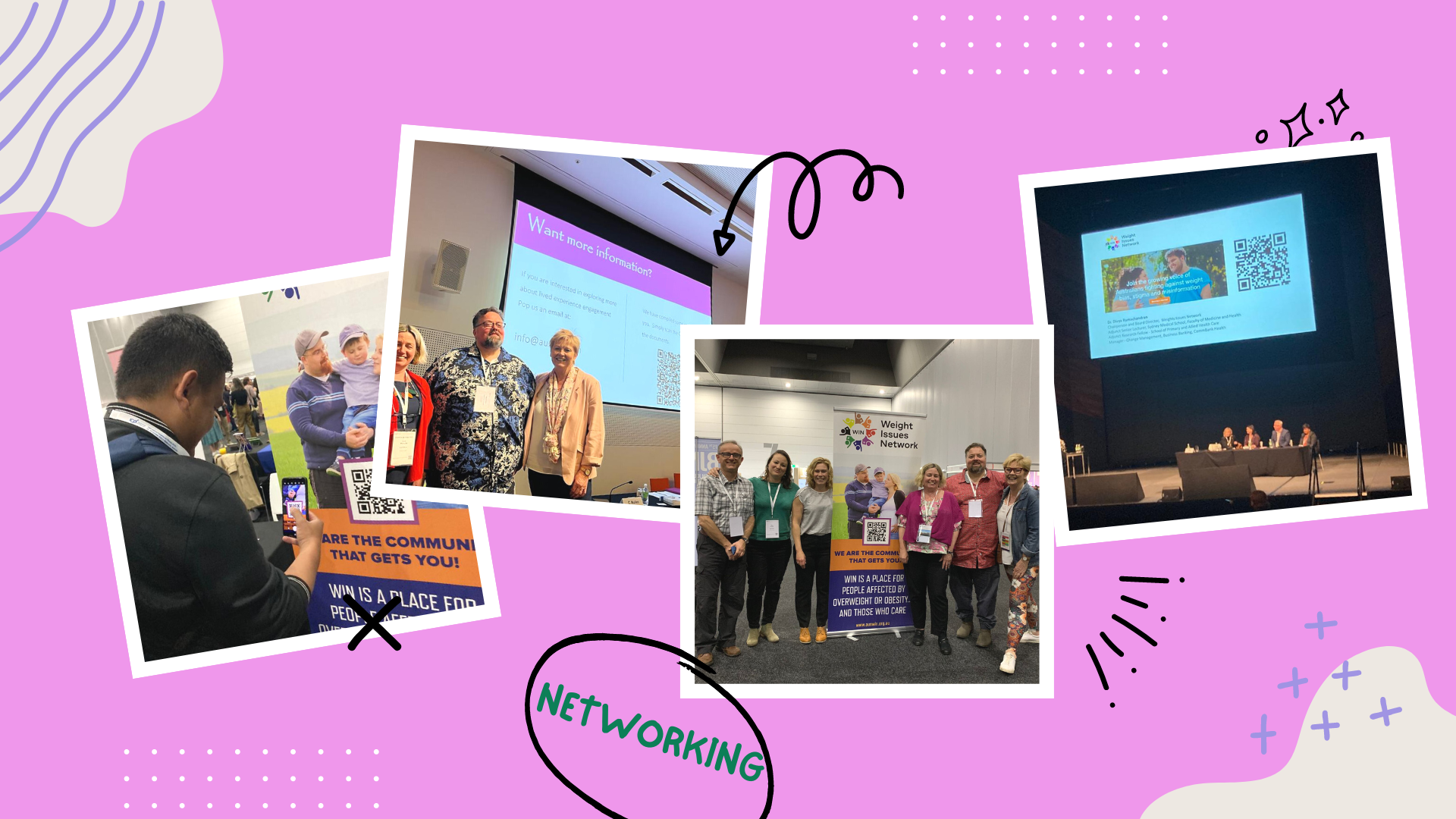
  • Australia: the Weight Issues Network. This is a group led by and for people with lived experience of weight issues. They run regular community conversations where members can learn about various aspects of the science of obesity – as well as advocating for more understanding of the personal aspects – find out more at www.auswin.org.au
  • Europe: the European Coalition for People living with Obesity. This group works collaboratively across Europe to improve the lives of people who are living with and are affected by the chronic disease of obesity through advocacy, policy and education. They run regular “patient lounge” discussions with consumers and researchers – find out more at https://eurobesity.org/

I really believe that only by raising lived experience voices in this space will we see real lasting positive change.

But it can be difficult to raise your head above the parapet in this space as a person with lived experience – particularly for people impacted by severe obesity.

We’ve all been so immersed in the idea that our weight is “our fault” that body shaming and judgement are practically sanctioned by some public health campaigns (grabbable gut anyone?).

And so health services and systems who want to hear more lived experience perspectives have to collectively invest in supporting people to develop their confidence to share their personal experiences in public settings for the greater good, and in creating safe places for those conversations to take place.

We’re lucky in Western Australia that the WA Department of Health and the WA Primary Health Alliance have recognised this and continue to support WA consumers to be heard on this topic.

Putting the public back in public health

I first heard the phrase “Putting the public back in public health” in a WA Department of Health publication, led by Professor Tarun Weeramanthri when he was the Chief Health Officer there.

It has stuck with me since. I think it’s because I see that so many of the elements that impact on our health and wellbeing are factors in the realm of our social worlds, rather than in the realm of our clinical experience.

This idea sharpened considerably for me when I took on HCC’s involvement in what was then called “The Obesity Collaborative – Partners in Change” project. A forward thinking team at the WA Department of Health and the WA Primary Health Alliance gave HCC a small grant to gather consumer insights so that work to address the health impacts of obesity was grounded in the experience of people with lived experience.

That work led to a survey with 750 responses, 25 first-person accounts, and two videos featuring consumers sharing their perspectives – perspectives that were shared at the two Summits on the subject in 2018. (You can see that work here.) That work shaped the development of the WA Healthy Weight Action Plan.

What emerged from all the stories and feedback people shared was:

  • people’s experiences relating to weight and health vary widely. This is backed up by the academic literature which highlights the heterogeneity of people’s experiences of obesity.
  • weight bias and stigma is a huge public health issue that is under-recognised by health professionals and public health teams. Academic evidence suggests that in some cases, the health impact of weight stigma can be more harmful than the health impact related to weight.
  • that many of things that people turned to when seeking to address this issue were non-clinical. One hypothesis for this that diet culture needs us all to feel individually responsible for our weight so that we will buy programs and products that promise the holy grail of long-term weight loss.

Another personal observation for me was the role that our current economic model plays in our health. Whether it’s because there is limited regulation of the food industry (because #profit), or because people living on no/low-incomes are dealing with a whole range of issues including how to make ends meet, or because we are encouraged to believe we should be so committed to our jobs that we’d rather miss a meal than an important meeting – the economic environment has a huge impact on our health and health inequity.

Partnering with consumers – in implementing positive change

The value of lived experience perspectives in the Healthy Weight Action Plan was recognised as essential and another grant from the Department of Health enabled HCC to gather more consumer insights to support the implementation of the Plan. (Again, kudos to the Department of Health for their forward thinking approach. Too often “consumer engagement” stops once the plan is published.)

That grant enabled HCC to gather insights from people with diverse perspectives on the topic including Aboriginal people, people from culturally and linguistically diverse communities, men, young people, and people with disability. It also enabled us to ensure that consumer perspectives shaped the critical activities being implemented as part of the plan. In this way, consumers or consumer perspectives were involved as projects were shaped and developed including:

  • Scoping a new proof of concept program offering virtual support to consumers who were using evidence-based very low calorie diet products
  • Scoping commissioning standards for DoH and WAPHA to use when commissioning services in this area
  • Scoping and refining the collaborative approach to addressing this issue in WA ↓↓

Introducing the WA WELL Collaborative!

The WA WELL Collaborative (WELL = weight education and lifestyle leadership) is the culmination of many hours of work by many teams of people across the community and the health sector.

The WELL Collaborative is a network where everyone with an interest in addressing the health impacts of weight, overweight, and obesity can come together. Whether that’s to find information about existing services, where consumers can be connected with clinicians and researchers who are working on new concepts, or to share challenges and wins about working in this very complex field.

One main way that people can access the network is through our freshly launched website:

You can sign up there to receive regular updates about Collaborative activities. The website is a living site and will be updated regularly.

HCC, WA Department of Health and WA Primary Health Alliance – taking action

I’m delighted to say that HCC has been given a grant by the WA Department of Health and the WA Primary Health Alliance to enable us to continue to ensure that lived experience voices continue to shape and drive this work. Part of our role is to host the backbone function of the WELL Collaborative. In practice this means hosting different networks, organising events, and managing the website.

The first thing I’m really proud of is the name – originally in the Plan this group was going to be the Obesity Collaborative. But since we started talking to consumers, it was clear that the term “obesity” was not one they connected with. It has become widely understood in the community as a pejorative term – and so, unsurprisingly, many consumers aren’t drawn to it. And so when working on a brand and name for the network, we made sure that was clear to the team developing those.

(Note of caution… we know that some consumers are very comfortable with the term and have questioned how other people like them – who are seeking help for the health impacts of obesity – will find their way to the website. We are addressing that through the data we use for search engine optimisation and our communications with other partners.)

The other ways that consumers have shaped this network include the imagery that has been used, and the focus on weight stigma.

Representation matters

We regularly hear from consumers in larger bodies that they are tired of never seeing any positive images when discussing weight and health. They want to see themselves reflected in images that reflect their lives – which are not all doom and gloom. So we connected the website team with a number of the image libraries that have been curated by various groups around the world.

Weight stigma – a major public health issue

A major finding from our work with consumers was the impact that shame, embarrassment and stigma has on people’s health. Whether that’s explicit bias being expressed by health professionals, or implicit in the body language; or it might also be internalised weight stigma – where we’ve been brought up to believe (incorrectly) that we are entirely responsible for our weight and so if we aren’t able to shape our bodies the way we want to, then it is a personal failing. All of these can input on our health – if we don’t receive the correct healthcare advice and treatment because of incorrect assumptions based on our size; if we don’t reach out for treatment because we’re embarrassed our efforts haven’t worked, or if we cope with body shaming by opting for less healthy behaviours.

HCC will be doing a lot more on this topic in the coming months – so watch this space.

But for now, check out this video where consumers talk about their own experiences of weight stigma in health services, and find out what you can do to become aware of any unintentional bias you may hold at www.hconc.org.au/end-weight-stigma

Cosmetic Surgery – Survey closing 1 April

Currently, any medical practitioner in Australia may call themselves a surgeon or cosmetic surgeon, without completing specialist surgical training. Your feedback will help determine if this needs to change. If you have had surgery, particularly a cosmetic surgical procedure, please share your experiences in this anonymous survey.

Click here to complete the survey – it takes about 10 mins – closes 1 April 2022

This is a partnership project with the Health Issues Centre Victoria and the Health Ministers Meeting.


Health consumer stories driving positive change

COVID, consenting to medical research, cancer information, and promoting health

The first few weeks of 2022 have been a busy time in health in WA…

Preparing for and living with COVID

Those weeks have been a time for everyone at Health Consumers’ Council of intense listening to, sharing and advocating for more consumer voices in the planning and preparing the health system’s response to preparing to live with COVID.

In that time we’ve held three discussions with consumer leaders and representatives across WA to hear what was on people’s minds as they were preparing themselves, their families and their communities for living with COVID.

Key messages we heard were that there was a sense of fear in some parts of the community as people navigate the shift from “COVID is to be avoided at all costs” to “we are living with COVID”. We also heard that there was a lack of information for health consumers who have underlying conditions, or who are immunocompromised, and need to make additional preparations. And the third strong message was people’s concerns were not just for their health, but the social implications of COVID. For example, who can people rely on if they’re a carer and they get sick? How do people get access to care if they’re unable to leave the house? What should they be doing to make sure they can get access to the healthcare they need – and stay safe?

And finally, we heard a strong message from health consumers about the opportunity to help people feel more empowered and confident in their ability to prepare.

We’ve shared these concerns with health leaders including the Minister for Health, health service Chief Executives and the teams leading the COVID response at the WA Health Department and the WA Primary Health Alliance.

By the end of last week, we’d seen a couple of significant changes – South Metropolitan Health Service had published information on their websites for people who are immunocompromised, and some patients who are at a higher risk of developing severe disease if they contract COVID are receiving calls from their specialists to help them work out how they can prepare themselves and their families.

We also were able to get information about the new COVID Care At Home program out to over 110 people who registered for a community conversation with Dr Robyn Lawrence from the Health Department, as well as getting into out to the broader community via a mention in Renee Gardiner’s column in The West.

The next focus will be to keep getting the message out into the community – particularly to those groups where mainstream communication methods like websites and news media in English are not widely used.

The other focus will be on encouraging other people in the community to play their part in getting information out to the people who need it and to look out for their neighbours or family members who might value a bit of support. As one consumer who was quoted in the article in The West said “We are all in the same storm but the boats are so different it’s hard to hang out in the tinny with a hole in when others are in their yacht.”

www.hconc.org.au/issues/covid-19

https://www.healthywa.wa.gov.au/Articles/A_E/Coronavirus/Managing-COVID19-at-home-and-in-the-community/WA-COVID-Care-at-Home

And it’s not all about COVID… have your say!

As we finalise our preparations for living with COVID it’s important to remember it’s not the only health issue that’s important for the WA community. There are a couple of key consultations that are looking for consumer input:

  • What are your views about the issue of giving consent to treatment – particularly if you’re incapacitated?
    • The Guardianship and Administration Act Part 9E came into existence on 7 April 2020 “to enable medical research to be carried out in respect of persons who do not have the ability to consent  to it.” While it might seem a bit dry, it could make the difference between someone accessing cutting edge treatment that is part of a research program or not.
    • Find out more and complete the short survey by 25 February at https://www.surveymonkey.com/r/GuardianshipAdmin9E
  • Have you or someone you know had cancer? What information was, or would have been, most helpful?
    • A team of researchers at UWA and WA Department of Health are researching the information needs of people who are diagnosed with cancer. This is part of the WA Cancer Plan implementation. This survey closes on 28 February. Please share it widely
    • https://mdhs-redcap.meddent.uwa.edu.au/fmdhs/surveys/?s=P9RLWRN39K

And finally – towards a healthier WA

This month we also made time to respond to the WA Department of Health’s consultation on the WA Health Promotion Strategic Framework. We called for a stronger focus on health inequities, the recognition of early childhood trauma on our longer term health, and encouraged a bold vision for a healthier WA that the whole community can buy into.

You can read our submission here https://www.hconc.org.au/wp-content/uploads/2022/02/WA_Health-Promo-Strategic-Framework-HCC-response-040222.pdf

Clare Mullen, A/Executive Director
February 2022

Guardianship Act and Medical Research Consultation – what do you think?

The Guardianship and Administration Act Part 9E came into existence on 7 April 2020 “to enable medical research to be carried out in respect of persons who do not have the ability to consent  to it.” (From the Review’s Background Paper – click here to read)
The Review aims to review the operation and effectiveness of this amendment. While this is a complex and potentially dry topic to contend with, this act directly impacts West Australians who could be eligible to be included in health research. The Health Consumers’ Council and the Consumer and Community Involvement Program are therefore collaborating undertake a joint survey to provide a response to the Review. We invite you to respond via this survey and your responses will be included in our joint submission.
It’s important that your voice is heard in a space that has so far been driven by researchers and Government.
Or scan the code below: DEADLINE 25th FEBRUARY
You are also able to provide your own response Send your written submission by email or post (email is preferred) to: legpolicy@justice.wa.gov.au
Mail: Review of Part 9E Guardianship and Administration Act 1990
Strategic Reform Department of Justice
GPO Box F317 PERTH WA 6841
The report on the review will be tabled in Parliament by the Attorney General and may contain references to submissions received during the consultation process, including submitter details or content. If you would like your submission to be anonymous you will need to note this in your submission.
Pip Brennan, HCC A/Deputy Director – pip.brennan@hconc.org.au
Deb Langridge, CCIP Program Director – debra.langridge@uwa.edu.au

Out of Pocket Medical Costs Finder tool

The Federal Department of Health are excited to invite you to attend the upcoming webinar about their initiative to reduce consumers’ out-of-pocket medical costs through the upcoming enhancements to the Medical Costs Finder. This is an existing website where users can discover better cost information for common non-GP medical specialist services across Australia. It is being improved and enhanced through this project.

Date: Tuesday, 17 August 2021
Time: 12:30 PM – 1:30 PM AEST (online) 10.30-11.30 AM AWST
Cost: Free

To RSVP email OOPTransparency@health.gov.au by Friday, 13 August 2021, they will then share the webinar link with you.

Background

The Medical Costs Finder website provides general guidance on the costs of common specialist services by location. It is an initiative to address costs transparency and mitigate ‘bill shock’ from unexpected out-of-pocket medical expenses, by helping consumers better understand the fees associated with services commonly provided by medical specialists earlier in their health journeys.

Currently, the website shows general information on typical costs for common services both in and out of hospital, with 1,100 specialist treatments currently listed. The Federal Department of Health are working to enhance the website so specialists will be able to add their individual fees for common medical procedures and their arrangements with different private health insurers.

The enhancements to the Medical Costs Finder will provide consumers and referring doctors with greater information and choice when deciding on a medical specialist.

The upcoming one-hour webinar will take you through the proposed enhancements to the Medical Costs Finder and allow the opportunity for you to have any questions answered. If you have any questions, please do not hesitate to contact them via email at: OOPTransparency@health.gov.au