
Month: June 2024

Learning from the past, looking to the future – will you join us?

By Clare Mullen, Executive Director

One of the first tasks I was given by our Management Committee when I took on the role of Executive Director just over 12 months ago was to refresh HCC’s strategy. I was also keen to learn from HCC’s proud history as an independent voice for the community since we were established in 1994 as we prepared to mark our anniversary in April 2024.

It was great that these two tasks aligned as I was able to be thinking about our future, while learning about our achievements in the past. We met with and gathered feedback from members, consumer leaders and representatives, health leaders and decision makers across WA health services, fellow advocacy organisations and HCC’s founders and elders.

Some things we heard and learned:

  • Health Consumers’ Council “emerged” from within the WA Department of Health and an earlier iteration – the Health Consumer Network – was chaired by Janet Holmes A Court. Consumer leaders and forward thinking public servants at the time recognised the need for the consumer voice to be independent of government and the public service – and so Health Consumers’ Council was born as an independent not-for-profit organisation
  • Many of the ideas that the team and I kick around today have already been tested in the past
  • WA is a leader both nationally and internationally by having the state peak health consumer body provide individual advocacy service that is free at the point of delivery for the WA community – something that’s not available in any other state or territory and…
    • …there’s much more need for this service that is currently available
  • HCC has a solid reputation with health leaders and decision makers and…
    • …many of our members and people in the health consumer community would like to see us have a more visible presence in the community and be careful to guard our independence
  • There is a pressing need to continue growing the number, capacity and connectedness of WA consumers who are confident, capable and willing to fulfil a range of consumer representative and advocacy roles at a time of significant reforms in health and social care and…
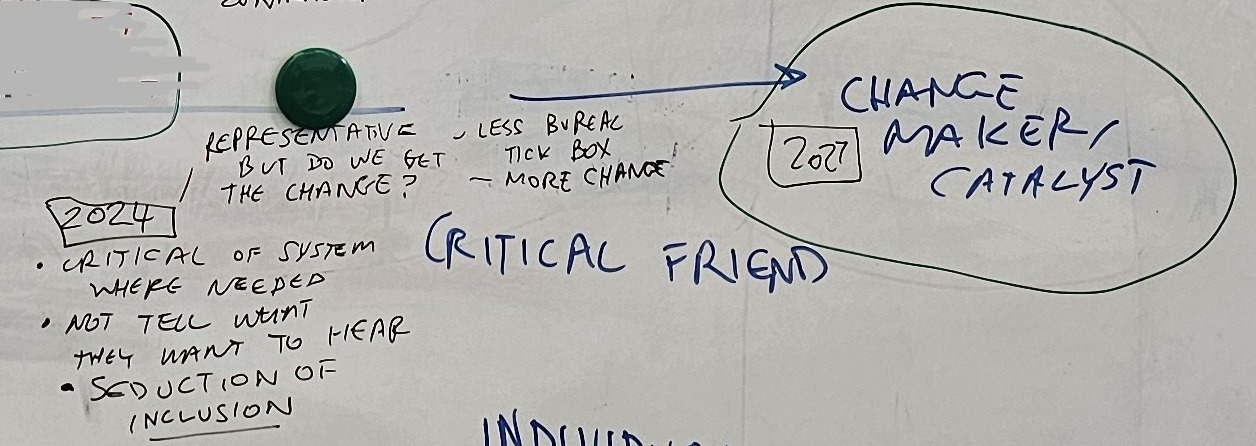
    • …we need to go beyond being a critical friend to being catalysts for change
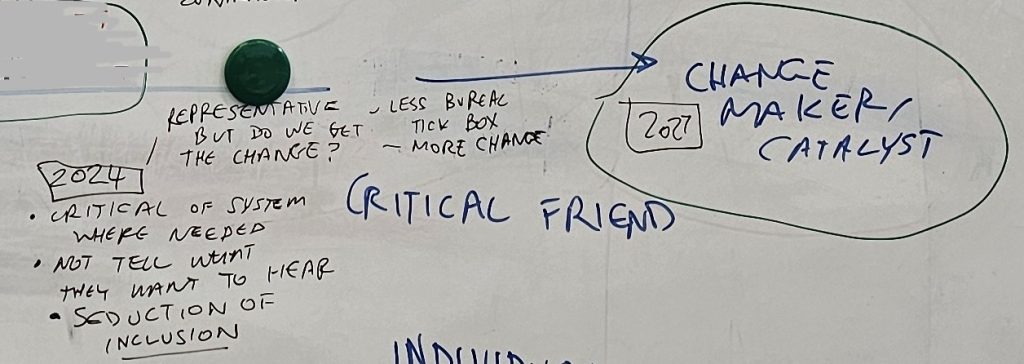
As we were immersed in all this history and feedback, a couple of us had the opportunity to participate in training for advocates, campaigners, activists and changemakers run by Australian Progress. That too was great timing as we’ve been able to apply some of the ideas and tools we’ve learned as we think about what next.

Health rights are met | People power is rallied | Consumers drive positive change | HCC finances are sustainable | HCC is strong and agile

These are the outcomes we’ll be working towards over the coming months and years. They blend our enduring priorities with an invitation to our members, the health consumer network and people in the community because we are stronger together.

We’ll be sharing our refreshed strategic plan at a briefing and get together for members, health consumers and stakeholders on Wed 26 July at 4pm – 6.30pm.

Read about our new strategy here https://www.hconc.org.au/about-us/strategic-direction/
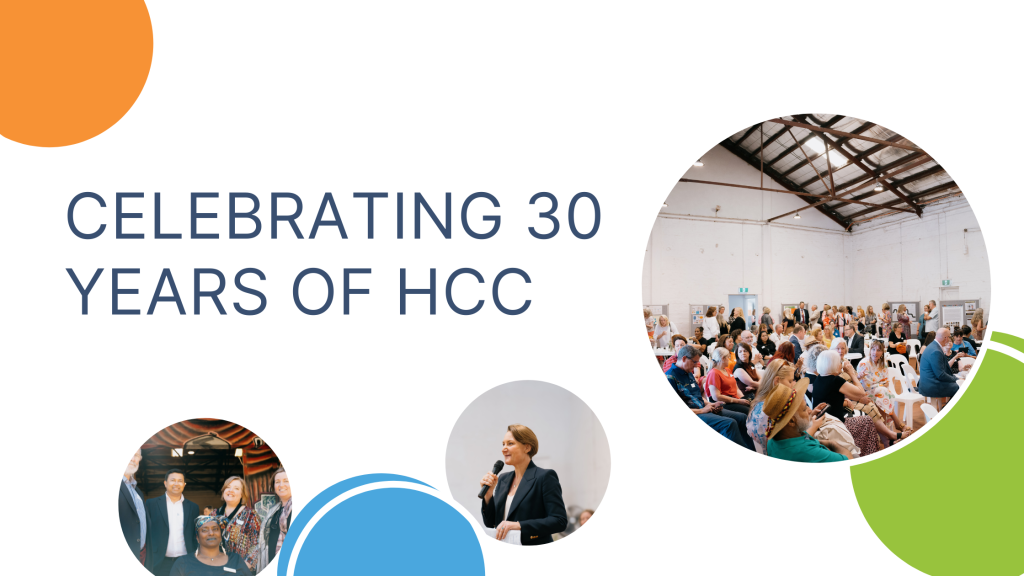
Celebrating 30 years of Health Consumers’ Council

Health Consumers’ Council was launched on World Health Day (7 April) in 1994 as the independent “voice” on health policy, planning and decision making.

The mission statement at this time stated that HCC would:

  • contribute to the health of all people of WA by providing a “voice” and recognised presence for health consumers
  • contribute to the planning, development, provision and evaluation of health services
  • facilitate an exchange of views on matters of concern affecting the health of consumers.

Since then, we have championed and supported thousands of people to assert their rights, have their say, and influence health service delivery.

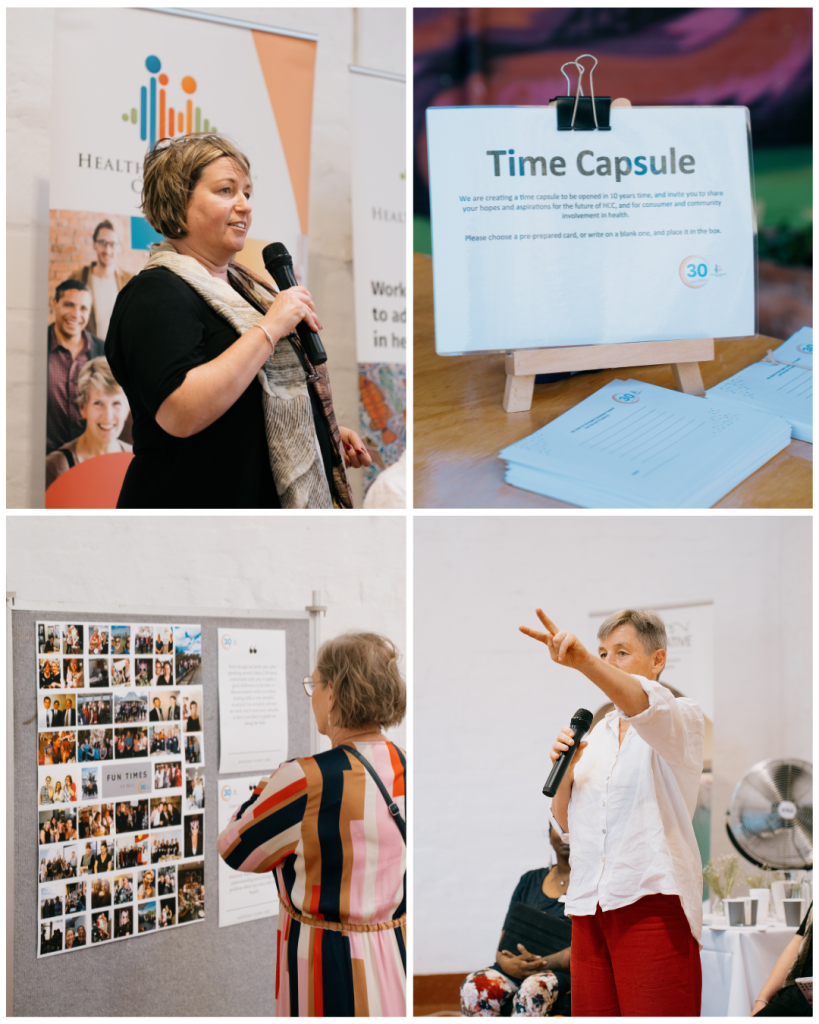
On 8 April 2024, we celebrated 30 years of the Health Consumers’ Council together with members, staff and stakeholders.

It was a beautiful day for a celebration at Perth City Farm, where guests were able to move between the indoor and outdoor displays and activities, and catch up with colleagues and old friends.

Noongar Elder Auntie Cheryl Taylor opened the event with a Welcome to Country and reflection, and then we heard from HCC’s founding Chairperson, Ann White, and founding Advocate, Maxine Drake. Our special guest for the event was the Minister for Health, Hon. Amber-Jade Sanderson. We also heard from HCC’s current Chair, Mallika Macleod, and our current Executive Director, Clare Mullen.

The speeches were followed by a video in which keys figures from HCC’s past and present shared their reflections and wishes for our anniversary. You can watch the full-length version here (approx. 25 minutes) or view the highlights reel here (approx. 7 minutes).

You can also watch a recording of the formalities and speeches from the event.

Our guests had the opportunity to take part in activities that included sharing their hopes and aspirations for consumer and community involvement in health in a time capsule to be opened in 2034. We invited people to share a pledge about their role in creating that future, which were used to create a pledge tree. There will be opportunities to contribute to these activities throughout the year as we continue our celebrations, so please keep an eye out for them.

Throughout the venue we had displays exploring HCC’s work over the years, including timelines, important moments in our history, key projects, copies of old Health Matters magazines and annual reports, and a look towards the future. We will be sharing some of these with you on our social media soon.

It was a wonderful opportunity to connect with our community and colleagues, and we look forward to continuing to celebrate you in various ways over the rest of the year.

Photos by Juno Shean

Digital Health Series – Patient Portals

By Pip Brennan, Electronic Medical Record Consumer Reference Group Convenor

The Health Consumers’ Council was funded by the WA Health Electronic Medical Record (EMR) Program to convene three consumer webinars and four Consumer Reference Group meetings between January and June 2024. The purpose of this work is to build on the EMR Consumer Charter that was co-designed developed in 2021.

In this interim period prior to developing a tender for a statewide EMR, HCC aims to upskill a group of supported, networked consumers and empower us to deliberate on key aspects of the EMR. We have also created several videos on key topics. We are sharing the learnings from this work as widely as we can, as WA continues its progress towards obtaining EMR in around three years’ time.

Patient Portals – what do consumers need to know?

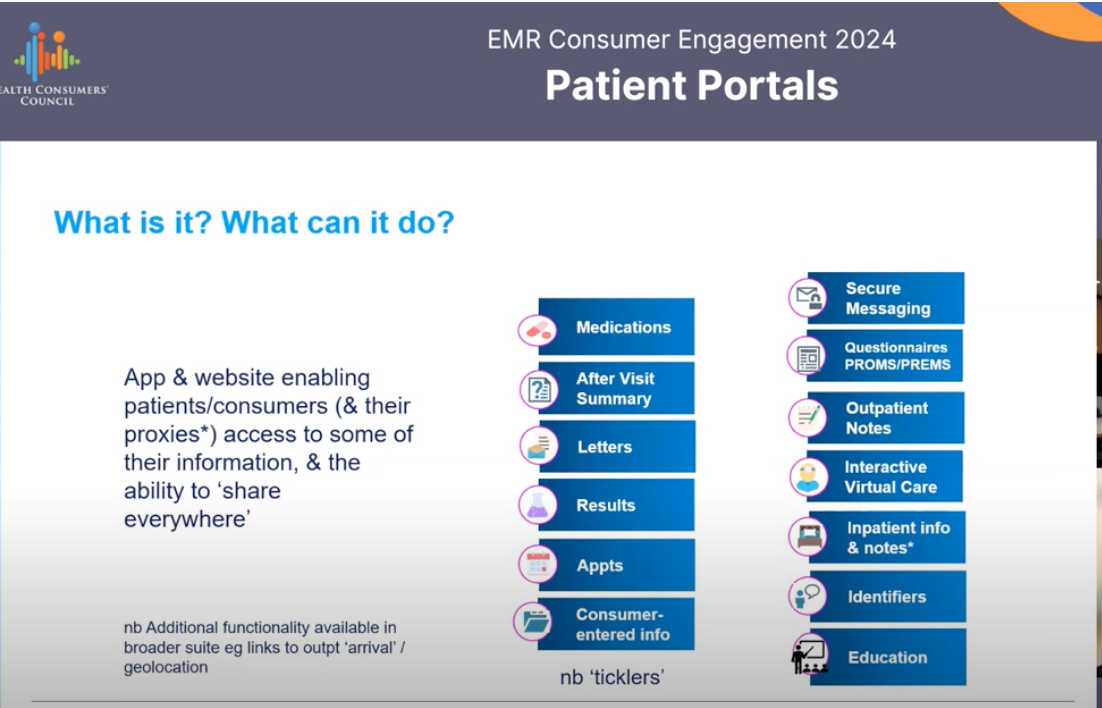
The Patient Portal is the part of an Electronic Medical Record that we can see and interact with.

It was the focus of the EMR Consumer Reference Group meeting in February 2024. Prior to the meeting, a list of patient portal resources were provided for the Group to look at:

At the meeting, we interviewed Liz Cashill and Consumer Representative Mary Oti from Royal Melbourne Hospital. They began implementing their patient portal in their EMR in 2020 and share key insights about what a patient portal is, how it works in practice, and what we need to think about as consumer representatives. You can watch the video replay below or read the transcript here.

WA’s Consumer priorities for a Patient Portal

After the presentation, the EMR Consumer Reference Group discussed our priorities for the future WA Health EMR Patient Portal. This is a summary which was provided to the WA Health EMR Program:

Consumer involvement: Consumers are partners throughout all stages of scoping, procurement, development and rollout of a patient portal.

Consumer centred: Base the design around us as consumers, as we move all across the system and want to be able to use one entry point for all our care. It must integrate and connect with adjunct and related systems; it needs to work in harmony with My Health Record. A priority for consumer centred care includes recording of preferred pronouns, name etc as part of the patient portal.

Consumer empowerment: The portal must support partnering with our health care team to achieve the best possible health outcomes. Specifically this includes two-way communication with an ability to view,  edit, download and print information about us. We need to be linked to knowledge and resources to navigate our care journey, with easy and intuitive navigation features.

Transparency, Choice and Control: this would look like there being controls for sharing of information need to be in place as they are for My Health Record, and understanding

Equity of access: we need to be supported to use the patient portal if we wish, but to receive the same standard of care if we don’t choose to use it. We would also like to see system flags to support equitable care,. e.g. when someone is travelling from the country. Other examples include a flag if there is a Disability Care Plan so staff are supported to provide safe care to someone who for example isn’t verbal. Flags to support trauma informed care are also key. A key consideration too is a patient portal available in languages other than English.

Proxy access is important with protections and permissions. For example, accessing health care for an adult child with a disability in the absence of guardianship –e.g. NDIS offer “common sense” choices – where people don’t need to get Guardianship to access their adult child’s records. We can sometimes have a bias towards the presumption of abuse e.g. in carers for people with disability, people who are frail aged.

Check the Digital Health page for the full series of webinars and information sessions on the WA Electronic Medical Record.

Reflections on the Digital Health Festival 2024

By Pip Brennan, Electronic Medical Record Consumer Reference Group Convenor

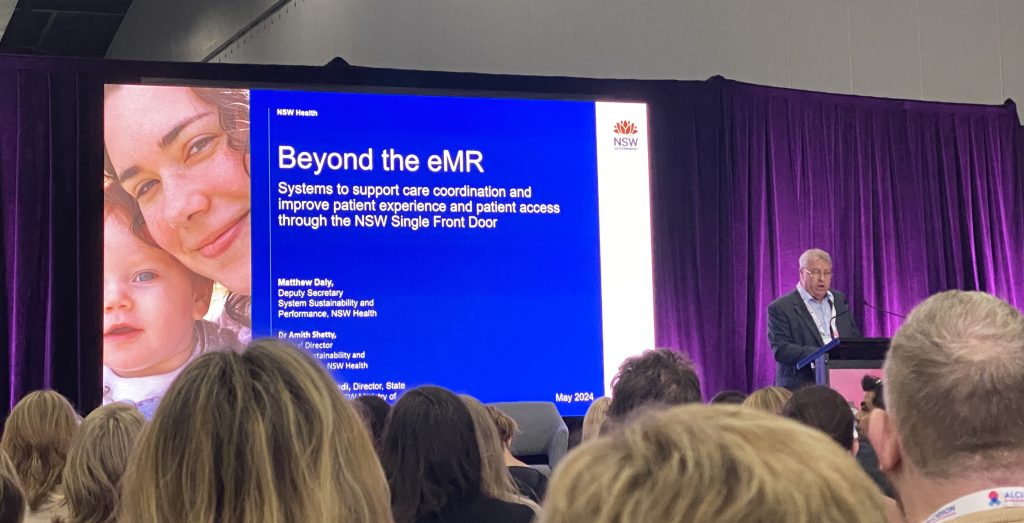
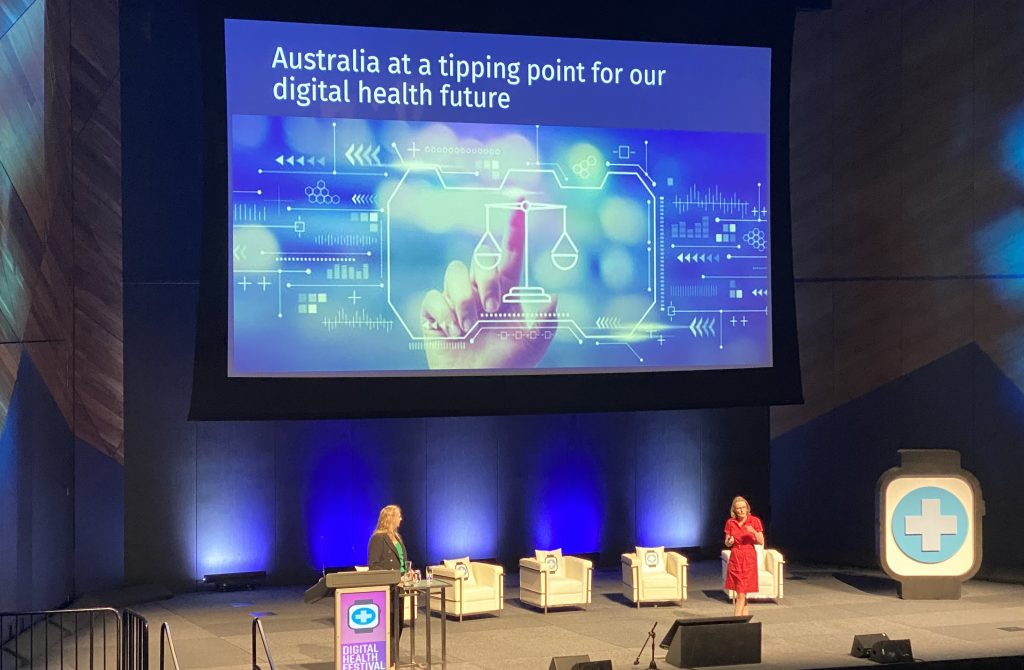
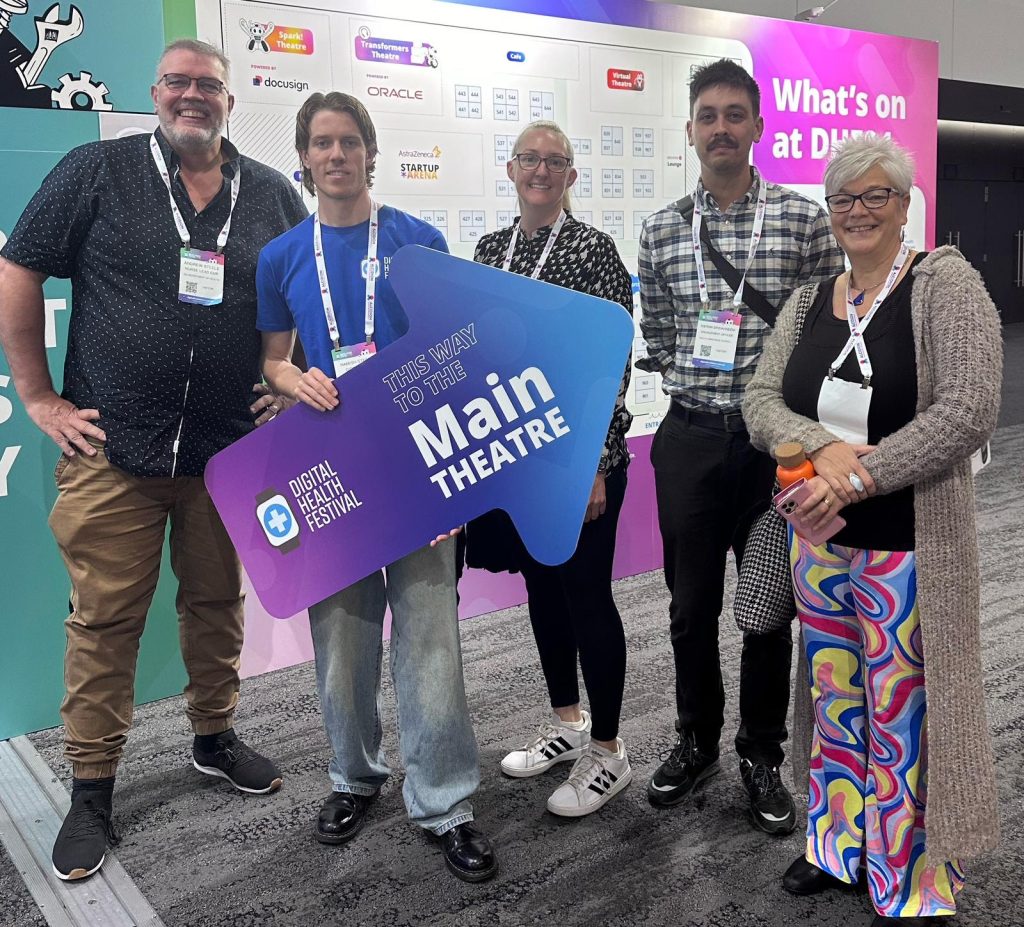
I was lucky enough to attend the Digital Health Festival 2024 in Melbourne, with WA consumer and health professional colleagues. The Health Consumers’ Council in WA negotiated to obtain three free consumer passes, and WA Health’s Electronic Medical Record (EMR) Program Team funded travel for myself and HCC Engagement Coordinator Kieran Bindahneem. We met Ricki Spencer in Melbourne, they are a member of the EMR Consumer Reference Group and split their time between WA and Victoria.

With eight concurrent streams and mostly 30-45 minute presentations, the Digital Health Festival was definitely overwhelming. Some of the concurrent presentations offered headphones, and these were by far the easiest presentations to stay focused in.

At the entrance was the stand where I took the opportunity to include a message about the importance of consumer involvement. #NothingAboutUsWithoutUs. It was not a common idea, and presentations mentioning co-design usually meant different health and government professionals collaborating. The wrap up report for the Digital Health Festival doesn’t mention the word “consumer” or “patient” anywhere – we sit somewhere in the “Other” category in the pie charts and tables. I have been approached to speak at the Digital Health Festival in 2025.

What has stayed with me

  • Dr Wonchul Cha’s keynote presentation about the Samsung Medical Centre in Korea, especially how the Patient Reported Outcomes surveys, which are integrated into their electronic medical record, achieve an 80%-90% response rate. They are a seamless part of the clinical appointment, and keep patient wellbeing right on top of the agenda.
  • Meeting up with consumer advocates including Mehmet Kavlakoglou, Harry Iles-Mann, and Ricky Spencer. Some quiet times talking outside the hub-bub of the Festival were restorative and insightful.
  • Talking to Healthcare Information and Management Systems Society (HIMSS) staff and filling in a missing piece of the PROMS puzzle in my mind – how they need to be integrated into an EMR and used as part of care to get the return rate that really tracks patient outcomes (see Samsung example above).
  • Listening to a CSIRO presentation on the work they’re doing regarding consent processes and how to have ongoing consent facilitated when our data is used for research – consumers aren’t actively involved yet, but hoping they will be soon.
  • Panel discussion on how AI is supporting clinical decision making where one speaker suggested that over time, clinical trials may not be approved unless they have already gone through AI as this will reduce potential harm to patients.
  • I don’t need to feel total despair that each state and territory is doing its own thing regarding electronic medical records. Interoperability is still going to be technically possible. It is the number one consumer priority! The key challenges we have in relation to digital health are actually cultural – but the interoperability work at the federal level mandating interoperability is helpful.


Some reflections

  • What would it be like to have a consumer-co-led digital health festival with a focus on research translation, rather than research commercialisation? Some presentations were very sales-y.
  • Most states and territories have implemented their EMRs without significant or meaningful consultation with consumers, and even in some cases clinicians. Not so in WA! And after the conference the WA Budget announcement confirmed that WA will be funded for the next three years to develop a tender and appoint a supplier for WA’s EMR.
  • We have an EMR Consumer Charter in WA and a Consumer Reference Group working with the WA Health Team. We are upskilling ourselves and reflecting on what are key consumer priorities for an EMR. See our web page for all updates.