By Tania Harris, Engagement Manager, Aboriginal and Disability Engagement Lead
The Art of Respectful Recognition
An Acknowledgement of Country is a gesture of deep respect that reflects the oldest continuous culture in the world. When crafted thoughtfully, it becomes a profound statement of recognition and respect for Aboriginal and Torres Strait Islander peoples’ connection to their land.
It is essential to acknowledge the Traditional Owners of the land and to pay respect to their Elders past and present.
While short, a meaningful Acknowledgment of Country can be powerful, reminding us of the rich cultural heritage that predates modern Australia.
Guidelines for an Authentic Acknowledgement
Crafting an Acknowledgement of Country that is both respectful and personalised will allow for a moment of reflection and connection.
Start with the basic acknowledgment of the Traditional Owners and Elders. Build upon this foundation to include recognition of the significance of the land and the ongoing cultural connection.
Creativity in Acknowledging Country
Acknowledgements can be delivered creatively while still maintaining the essence of respect and recognition. Whether recorded as a video or expressed through an art project, these gestures can be personalised and shared in various settings.
At home, record or share a photo or video expressing your Acknowledgment, perhaps with family or friends.
In the workplace, create video messages or photo displays that represent your organisation’s commitment to respecting Country.
The Pitfalls of Tokenism
A meaningful Acknowledgement of Country should be more than a checkbox exercise. It should not feel tokenistic, nor should it be used to overshadow the essential work of self-reflection, truth-telling, anti-racism, genuine partnership, and inclusion.
Ensure that the acknowledgment is given the time and space it deserves, rather than being rushed through.
Reflect on the deeper meaning behind the words and allow for a moment of consideration for the audience and yourself.
Beyond the Basics: Personalising Your Acknowledgement
There are many ways to craft an Acknowledgement of Country but personalising it to your context can make it more impactful.
Consider beginning with the traditional Acknowledgment and adding a personal reflection or commitment related to reconciliation and respect.
Tailor the language to suit your audience, whether they are healthcare professionals, community members, or corporate stakeholders.
Acknowledgment as a Commitment
An Acknowledgment of Country is a clear expression of your commitment to recognising the importance of Aboriginal and Torres Strait Islander cultures. It’s a commitment that should be carried out with deliberation and sincerity.
Embrace Cultural Protocols: Acknowledging Country Workshops
Every day we live, work, and dream on Aboriginal and Torres Strait Islander lands. Take a moment to acknowledge this connection by crafting a meaningful Acknowledgement of Country. Join one of our Acknowledging Country workshops to deepen your understanding and respect for these cultural protocols.
Think about how you can incorporate a thoughtful and respectful Acknowledgment of Country into your daily practices and events. Reflect on the cultural significance of the lands you inhabit and take the next step to honour this heritage by attending a workshop that will enrich your acknowledgment practices.
In the last 30 years, HCC has championed and supported thousands of people to assert their rights, have their say, and influence health service delivery. As we continue to celebrate our 30th anniversary this year, we’re reflecting on some of the key achievements in this space.
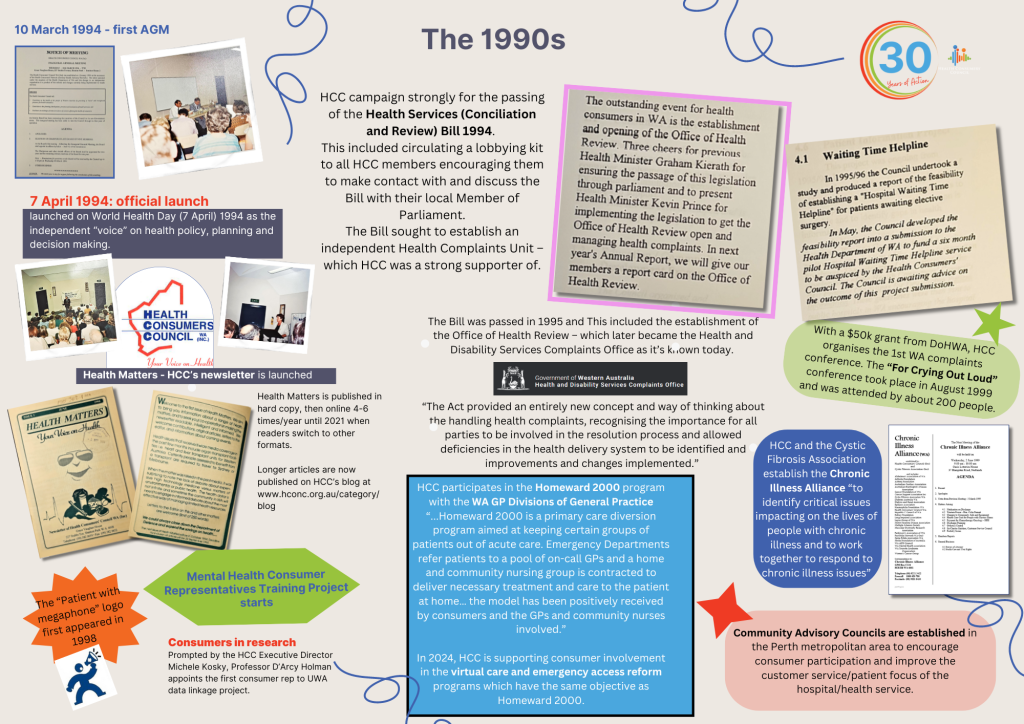
Here are some of the health consumer and health advocate highlights of the 1990s:
HCC launched on World Health Day (7 April) 1994 as the independent “voice” on health policy, planning and decision making.
HCC campaigned strongly for the passing of the Health Services (Conciliation and Review) Bill 1994. This included circulating a lobbying kit to all HCC members encouraging them to make contact with and discuss the Bill with their local Member of Parliament. The Bill sought to establish an independent Health Complaints `Unit – which HCC was a strong supporter of. The Bill was passed in 1995 and This included the establishment of the Office of Health Review – which later became the Health and Disability Services Complaints Office as it’s known today.
Community Advisory Councils are established in the Perth metropolitan area to encourage consumer participation and improve the customer service/patient focus of the hospital/health service.
Prompted by the HCC Executive Director Michele Kosky, Professor D’Arcy Holman appoints the first consumer rep to UWA data linkage project.
With a $50k grant from DoHWA, HCC organised the first WA complaints conference. The “For Crying Out Loud” conference took place in August 1999 and was attended by about 200 people.
HCC and the Cystic Fibrosis Association establish the Chronic Illness Alliance “to identify critical issues impacting on the lives of people with chronic illness and to work together to respond to chronic illness issues”.
We are now seeking Expressions of Interest for two Management Committee (Board) vacancies.
Health Consumers’ Council was launched by the Minister for Health in 1994 as an independent voice for the community on health policy, planning and decision making and to provide a recognised presence for health consumers. Since then, we have championed and supported thousands of people to assert their rights and have their say on health.
In 2024, our 30th anniversary year, we are renewing our commitment to ensuring a strong presence for consumers and community members in all decisions relating to the health of Western Australians. To do this, we will need to increase the resources available to us so that we can build more capacity in the community and extend our support to more people across WA.
We are a member-led organisation governed by a Management Committee (also known as a Board). Our members share our goals and support our purpose of:
amplifying and championing the voices of WA health consumers
to drive positive outcomes in health and healthcare
and achieve equitable, person-centred, quality healthcare and improved health outcomes and experiences for everyone in Western Australia.
HCC is a registered charity with responsibilities to the Australian Charities and Not-for-profits Commission as well as under the WA Associations Incorporation Act 2015. As such, Management Committee members play an important role in ensuring we meet these responsibilities and comply with all governance requirements. Management Committee members are also responsible for the overall strategy of HCC.
This year we have two Management Committee vacancies. These are voluntary positions – with any expenses reimbursed – and require attendance at bi-monthly meetings (usually online), along with representation on one sub-committee (usually monthly meetings).
We are interested to hear from people who bring any of the following perspectives or experience:
Aboriginal people
People with disability
People from the LGBTIQA+ community
People aged 18-24
People with lived experience and/or networks and connections to people managing health and other related challenges
People with experience of managing or working in a growth-stage organisation
People with connections in philanthropy and/or community foundation networks
People with connections/involvement in health/medical or other human research
People with regional experience and/or connections
People with skills and experience in social enterprise/fee for service work
People with experience in IT strategy planning and development in the non-profit sector
Previous NFP Board experience highly desirable but not essential
To be eligible to be a Management Committee member, you need to be a HCC member already, or be willing to become a member (free for individuals).
Want to know more?
On 29 August HCC will be hosting an online information session for people interested to learn more about the role of Management Committee members. In session you’ll have the chance to meet with three current members of the Management Committee, hear more about the role and HCC’s strategy, and find out why nominating to join the HCC Management Committee might be the right option for you.
Shortlisting by the Nominations and Governance Committee will take place on 1 October. We may invite potential nominees to meet with Board members and the final list of nominees will be approved by the Management Committee by the end of October. If there are more than two nominees, a vote by members will occur at the Annual General Meeting in early December.
At the time of this post, WA Health has been funded for the next three years to write the specifications and choose a vendor to develop an Electronic Medical Record, or EMR. This will be a statewide EMR for WA Health’s public hospitals and health services. From January to June 2024 HCC has been working with our EMR Consumer Reference Group to up-skill ourselves on all things digital, so we are able to provide the consumer voice into this part of the process. In March 2024 we convened a webinar entitled Can the EMR stitch up our health system? This blog has links to the replay, transcripts and summary and provides insights into what consumers need to think about. Consumer involvement in WA’s EMR is being funded by WA Health to ensure a strong consumer voice. WA has been leading the nation in the level of consumer involvement in this important initiative.
This blog series has been written by Pip Brennan who is working for HCC on the project, co-located in the Health Department.
Interoperability is just a fancy word for your health information following you, from GP to hospital, allied provider to pharmacist to specialist and back again. In 2021, HCC co-designed an Electronic Medical Record Consumer Charter which has this to say about interoperability:
Accuracy: My health records are complete, accurate and up to date.
Equitable care: My health records are available to my treating clinicians regardless of where I am being treated.
Transparency, Choice and Control: I have access to my real-time health information at no cost to me or my family.
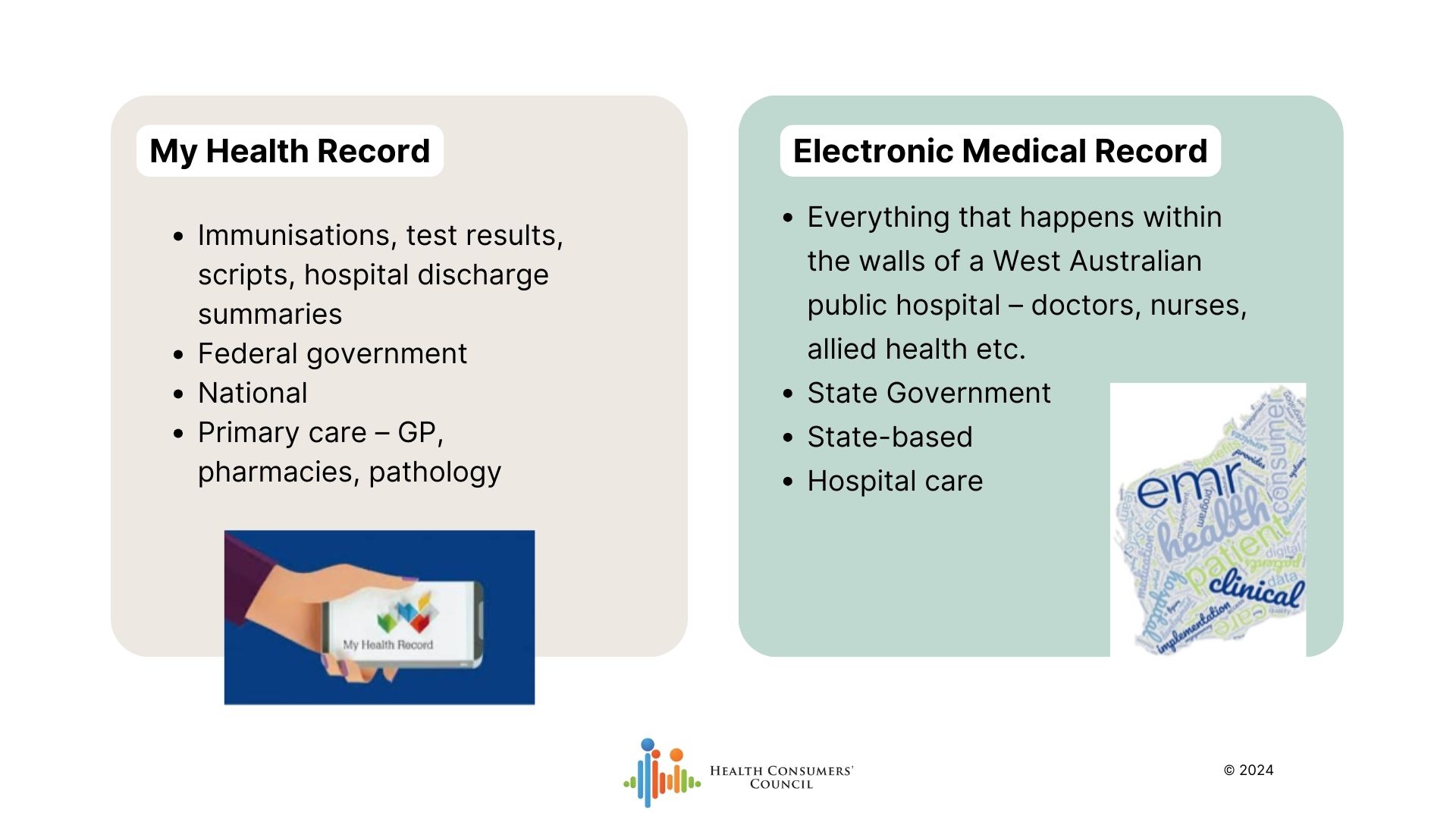
I’m just pausing for a moment to remind people of the difference between an Electronic Medical Record and My Health Record. The dot points from the Charter above refer to WA’s future Electronic Medical Record. The Electronic Medical Record and My Health Record are different as per the image below. An Electronic Medical Record is based within a hospital or health service. My Health Record contains federally based information such as GP care and immunisation records. We want the two to talk to each other. That is interoperability.
Australia is doing a significant amount of work on interoperability at a national level. We now have a National Healthcare Interoperability Plan, and this potentially offers WA an opportunity to have a more joined-up EMR than other states and territories who developed their EMRs prior to this policy coming into being.
There’s a change in the air that as if to say everyone recognises that we have an opportunity, probably a once in not just a single generation, but multi generation opportunity to fundamentally transform the way our health system works
Harry Iles Mann
Webinar – Can an EMR stitch up our health system?
Because of all the work happening nationally, we invited National Consumer Leader and Digital Health Expert Harry Iles Mann to talk with WA’s Chief Clinical Information Officer Dr Peter Sprivulis about WA’s Electronic Medical Record and how that could connect up our health care.
It’s all about culture. The technology is the easy bit. It’s the culture that is the difficult aspect to digital health transformation.
Get workflows right. Ensure that the words mean the same on each side of the transaction – that GPs and hospital staff mean the same thing. e.g. allergies.
Legal and regulatory levels. There is potential for the My Health Record Act to be broadened to become My Health Information Act. This will provide a safety for health consumers, and puts very clear obligations on health services to share data appropriately. This is a long term reform.
Financial and cultural piece – we need to deal with perverse incentives to make the right thing the easy thing for clinicians. For example, currently if a GP speaks to a specialist about a patient, neither is compensated, even though this could expedite care for a patient and avoid unnecessary, inconvenient, costly consultations. There needs to be a joined-up conversation with private, public, state and federal health to sort this out.
My Health Record is still key – There is ongoing investment in the My Health Record as a platform to facilitate interoperability and consumer access to their information. Yes, My Health Record has its issues – but a key reason for the ongoing investment is that regardless of what states and territories or different vendors do in developing EMRs, there will be something that is sitting within the custodianship of government that is a point of access for you and your health information.
We’ve made a start – WA has digitised parts of the Electronic Medical Records in WA’s hospitals, but this will see us take a bit leap forward. An EMR is all about the bedside workflows – this is where all the risk sits.
Patient portals can really assist with ensuring you have access to your EMR health information and can participate more actively in your own care.
The OpenNotes approach might be possible through WA’s EMR Project. (Google it. It’s very exciting!) This is quite aspirational though and may not be on the table, depending which vendor is chosen. OpenNotes will help clinicians think carefully about what they write about people, and will support the accuracy of information.
Importance of EMR Consumer Involvement
There are three levels of consumer input into training clinicians, and driving culture change:
1. Telling stories about what’s working, and what isn’t – this is effective with policy makers. Consumer stories are much more effective than clinicians providing feedback about what isn’t working for them as clinicians. Consumer stories can drive digital investment.
2. Co-designing solutions – so that the workflows centre around the patient, not the clinician. Information isn’t captured and shared for free. It always takes time and resources to share data.
3. Change management initiatives need consumers present, to make sure the tools are used in the way that helps consumers. Harry’s example of the test results not being available in the ED – it’s likely there is a portal that would allow the clinician access, but they don’t know how to use it. Consumers need to provide motivation for busy clinical staff to learn how to use the packages effectively.
Being a Digital Health Consumer/ Carer Rep:
You know more about digital health than you think you know.
You don’t need to understand every last technical detail – it’s important to ask naïve questions. This can prompt important critical thinking in digital health project.
There are no stupid questions – sharing your experience is more valuable than learning “geek language” “Insist on answers in plain English. If the geeks can’t explain to you what they’re trying to do in plain English, then then you’ve probably got a program that’s not really set up for success anyway.”
We need to think of ourselves as allies with clinicians for change, working collaboratively together. “we’re not two different actors, trying to find common ground from across the chasm, we’re actually allies working towards a common goal.”
Feeling the need to geek out? All the federal initiatives for you to google are listed below:
Council for Connected Care provided strategic advice on interoperability and supporting the implementation of the National Healthcare Interoperability Plan.
There’s a change in the air that as if to say everyone recognises that we have an opportunity, probably a once in not just a single generation, but multi generation opportunity to fundamentally transform the way our health system works