
Category: Media

When healthcare gets hard, we stand with you

Your Christmas donation helps West Australians get the support they need when things go wrong or get too hard to manage alone

Every year, thousands of people across Western Australia find themselves stuck in a healthcare system that’s complex, overwhelming and often deeply distressing. Some struggle for months to get answers. Others can’t access the care they need. Many feel unheard, powerless and alone.

That’s where Health Consumers’ Council WA steps in.

We’re the only organisation in Australia that provides individual advocacy across the entire healthcare sector, from GPs and hospitals, mental health to allied health, across both the public and private systems.

For more than 30 years, we’ve been helping West Australians navigate healthcare when things get complicated.

We hear you. We’re independent. We’re free.

How we help

We help patients, carers and their families to:

  • Understand their rights as a patient
  • Get the care they need
  • Speak up confidentially with an advocate by their side
  • Be treated with respect and cultural understanding
  • Fix problems so others don’t face the same issues

Beyond individual cases, we drive system-wide change

We identify patterns experienced by health consumers and provide evidence-based input to government decision-makers, helping to remove barriers in WA’s healthcare system. By resolving issues early and advocating for continuous improvement, we aim to strengthen healthcare accessibility, equity and quality for all Western Australians.

How your donation helps

Accessing personal medical records

Peter spent more than a year trying to access his medical records. When he approached our advocate Jenni at Health Consumers Council, a conciliation request was already in progress but moving slowly. Jenni contacted the practitioner directly, reminded them of their obligations and the issue was resolved quickly. Peter finally received his records and was able to move forward with is healthcare journey.

Informed choice in mental health care

Jamie believed she had no choice over her medication due to a Community Treatment Order. Advocate Chrissy checked with the Mental Health Tribunal and found an administrative error. Learning she was actually a voluntary patient empowered Jamie to attend her appointment feeling informed, respected and able to contribute to her own treatment.

Support during a difficult time

With her husband gravely ill, Janice, whose first language is not English, worried she would be pressured into decisions she didn’t fully understand. Advocate Helen explained the hospital process, clarified her rights and helped her prepare. Janice attended the meeting feeling calm, informed and ready to speak up on her husband’s behalf during an emotional and complex time.

Compassion in complex situations

Alex felt anxious about an upcoming hospital admission and uncertain how to explain their needs. Kerrie worked with them on a clear care plan and Sensitive Practice Request, then shared it with hospital staff. This preparation helped everyone understand Alex’s condition and needs, creating a calmer, more respectful experience.

What people say

“The Gold Standard”

“Jenni  is very approachable, she is a sincere and caring person, very professional and thorough. She was wonderful and if I need help anywhere again, she is the Gold Standard in which I will compare them to. Thank you.”

“Chrissy was fantastic”

“She honestly went above and beyond to help me and make sure I understood everything. Also beautiful and caring as well. Thank you Chrissy, you are a super star.”

“Thank you for going above and beyond to help me with my learning disability”

“Thank you so much for all your help and support in this matter Kerrie. You truly are amazing and very helpful. It is not often these days you find people that go above and beyond to help you and you truly have so thank you so very much from the bottom of my heart.”

A small team with a big impact 

In 2025, we:

  • Supported 1,249 people with individual advocacy
  • Took 4,560 advocacy actions on behalf of patients
  • Made 23 submissions to shape fairer healthcare policies
  • Met with 96 senior healthcare decision-makers to drive change

Your donation helps us reach more people and create lasting change in WA’s healthcare system.

Your tax-deductible donation helps us be there for those that need us 

We’ll be there for you and your loved ones too when you need us

We’re a registered charity and all donations over $2 are tax-deductible.

HCCWA welcomes hospital investment, continues call for action to keep WA healthier for longer

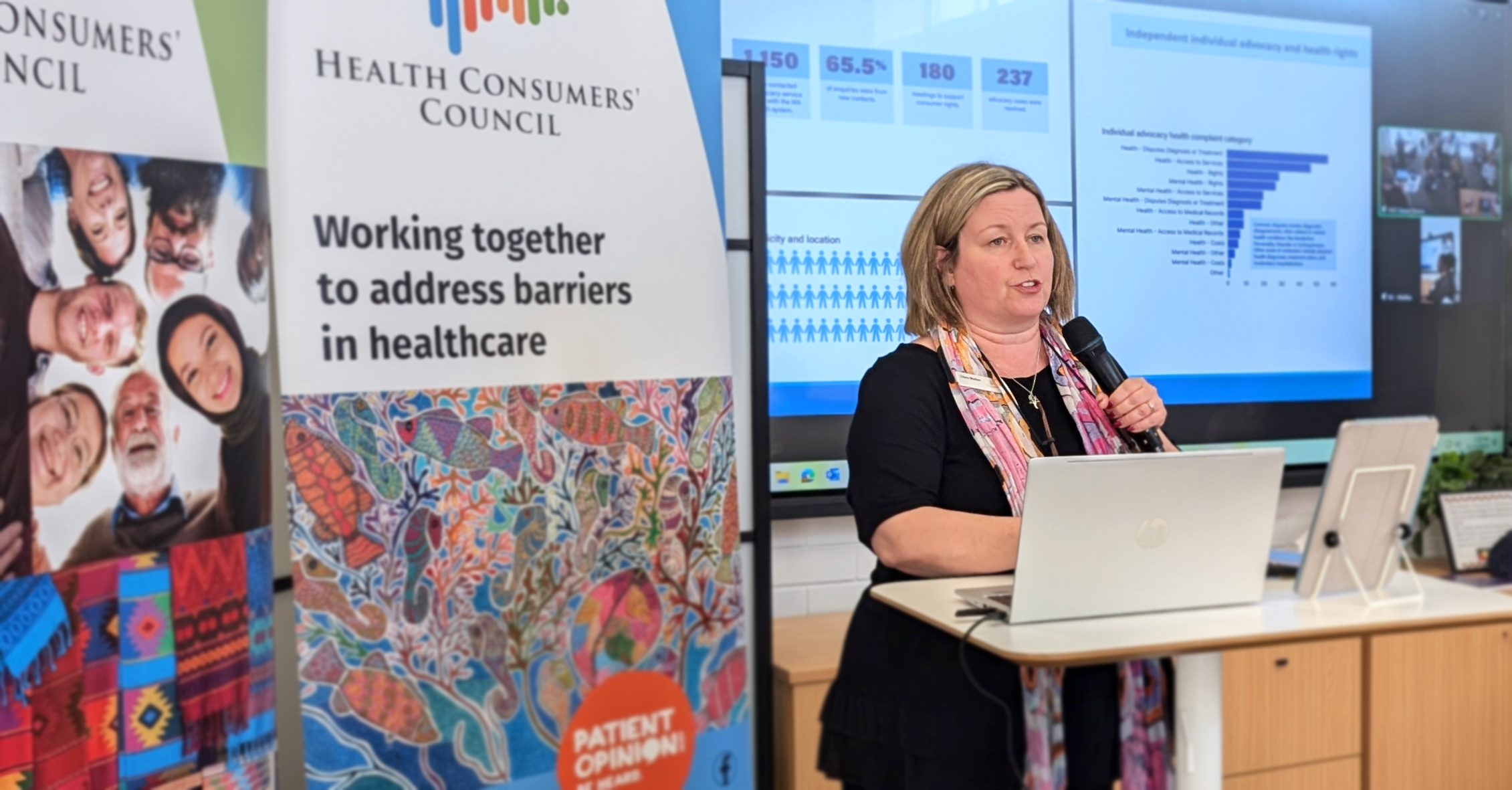
Clare Mullen speaks about the Healthcare Consumers' Council

Health Consumers’ Council WA (HCCWA) welcomes today’s announcement by the WA Government of increased investment in hospital capacity, recognising it as an important step in responding to the current demand for hospital care.

HCCWA Executive Director Clare Mullen said the investment would be reassuring for people struggling to access timely care, and emphasised that the ultimate goal must be a healthier population that requires less hospital care in the first place.

“Every Western Australian deserves access to high-quality hospital care when they need it —but a truly sustainable health system keeps people healthy and supported before they reach crisis point,” Ms Mullen said.

“No one wants to need hospital care. Ill-health need not be inevitable. To reduce pressure on hospitals, we need to invest just as strongly in prevention, early intervention, and the social conditions that keep people well.”

Ms Mullen said consumers consistently raise concerns about the difficulty of accessing affordable and timely primary and community care and early intervention with health issues —particularly for people living with or at risk of chronic conditions, or in regional and remote areas.

“When there is a lack of early intervention programs, or people can’t access the right care at the right time, health problems escalate and hospital admissions become inevitable,” she said.

“It’s a relief to see hospital expansion to ease the current pressure on services. But without strong community-based options, as well as targeted investment in preventative health activities, the demand for acute care will keep rising.”

“Western Australians want to see a system that supports health, as well as one that treats illness — one that helps people to stay well, connected and supported in their communities.”

HCCWA is calling for a balanced approach that includes:

  • Long-term investment in early intervention and preventive health programs,
  • Better funding for community-based and multidisciplinary care, and
  • policies that address the social and economic drivers of poor health.

“This is a welcome and necessary investment in hospital capacity. And we look forward to partnering with WA Health to ensure consumers and community members are actively involved in shaping these important infrastructure projects,” Ms Mullen said. “And if we want fewer people needing hospital care, we must also invest in prevention.”

Perth, Western Australia — 06/11/25

For further information or media requests:

Clare Mullen  |  Executive Director
0488 701839
clare.mullen@hconc.org.au

Consumer Voices Drive Change: A Win Against Predatory Dental Practices in WA

Joint AHPRA and ATO Statement Targets Predatory Dental Payment Practices

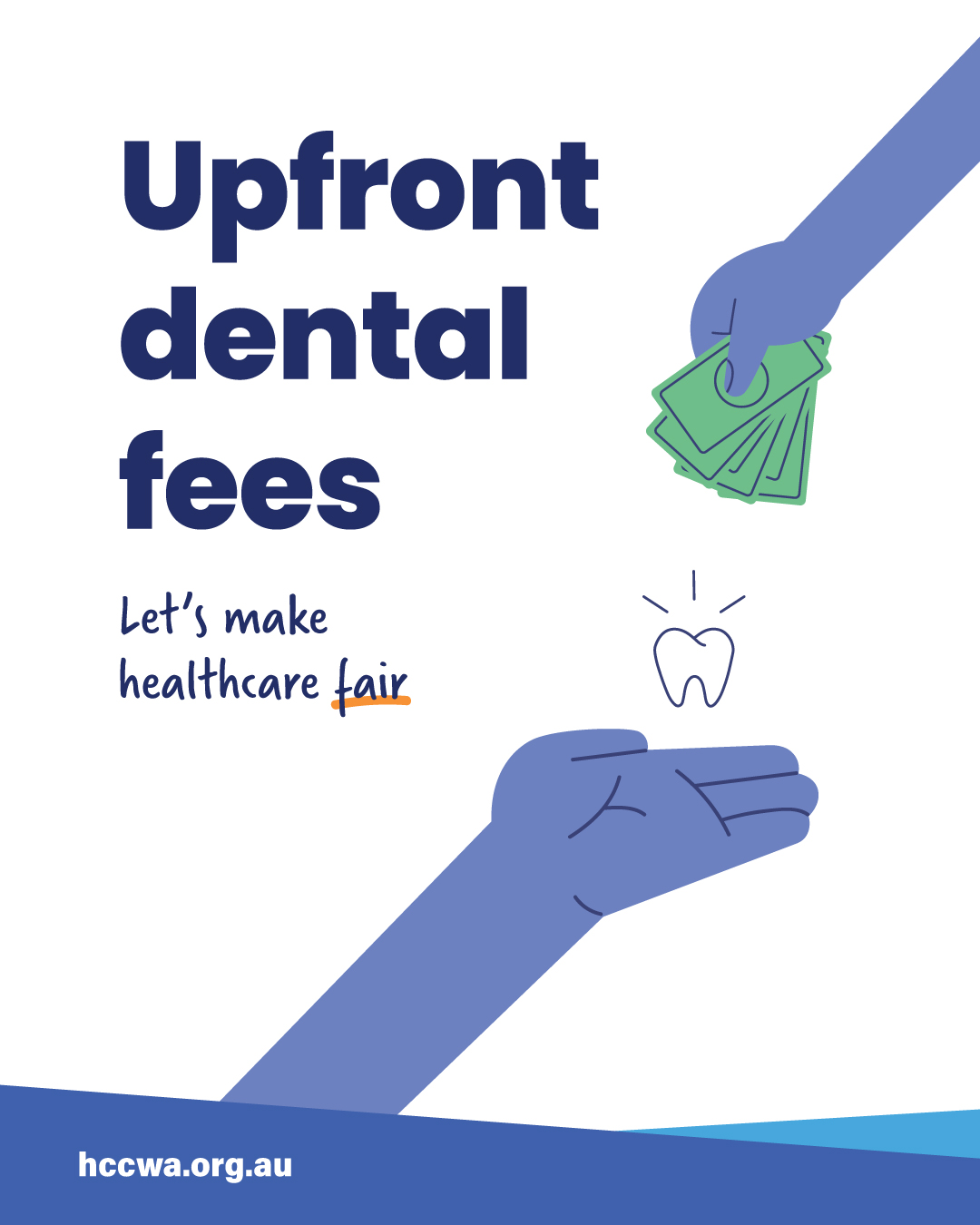
We’ve seen time and again that consumers speaking up can drive change, and last week was no exception. Consumers who have been impacted by poor practices by WA dentists have collaborated with HCC and together we are we are making changes.  

We celebrated a victory last week when APHRA and the ATO issued a very strong joint statement on the worrying misuse and overuse of the compassionate release of superannuation to pay for dental treatment. The agencies gave strong guidance to practitioners on the limited circumstances in which it is appropriate to use such payment methods and also undertook to investigate practitioners who they believe are using this system inappropriately. 

Unlike previous statements on this topic, which were framed as partly a caution to patients, this statement places the responsibility squarely with practitioners and with third party agents who may assist in completing applications for early release of super. We welcome this change in approach, and we are really pleased that these regulators have listened to consumers and to our advocacy in framing this message. 

We heard about this issue earlier this year, following the death of a dental practitioner who had taken substantial advance payments from patients for expensive dental treatment, but had passed away before delivering the treatment.  

In our research, we found a worrying number of practitioners who include in their advertising materials information that encourages people to withdraw their superannuation to pay for treatment. Some of this advertising appeared predatory and was often included incorrect information.  

After advocacy from us, in partnership with consumers and pressure from the media, there was a press release from AHPRA in late May which expressed concern about the increase in using superannuation to pay for treatment, and a great checklist of red flags for consumers. This was a pleasing start, but we continued our advocacy, as we were concerned that the messaging from regulatory bodies around this practice was not strong enough.  

The statement issued on 16 October is strong. It speaks of inaccurate statements being made by practitioners on forms supporting the release of superannuation, and of the penalties that people will face for making such statements. The consumers who have been left stranded are continuing their fight for justice through legal avenues, the media, and complaints processes. We are continuing to work with Consumer Protection, AHPRA and Choice Australia to explore avenues to protect consumers in future.   


Bronwyn Ife  |  Systemic Advocacy and Engagement Lead

Media enquiries: 0488 701 839 | info@hconc.org.au

Dental issues, quality and cost – update on advocacy Oct 2025

This year many of us have been shocked by news reports of consumers having paid up front for extensive and costly dental treatment (often implants) and then before the work is completed their practitioner has stopped practicing, died or been deregistered, leaving consumers out of pocket, in pain and with nowhere to turn.

Making this more devastating, a number of consumers have withdrawn a substantial sum of money from their superannuation to afford the up-front cost for treatment. With the treatment being left unfinished they are left high and dry, and out of pocket.

What we heard

When these issues came to our attention – raised by consumers directly to our individual advocacy service, and through the media coverage in The Sunday Times – we looked into what had gone wrong and we found:

  • High costs of dental treatment meaning people need to request access to their Super to help cover the cost
  • Practitioners requiring payment upfront but those payments not always being protected or returned to consumers if practitioners are unable to complete the work
  • The system that’s supposed to protect consumers having a number of gaps:
    • Predatory advertising of costly dental treatment and encouragement to access Super without financial advice being promoted via social media with highly emotive imagery
    • Limitations of information being provided to consumers to enable them to make truly informed consent and being clear about the future impact of accessing Super to pay for treatment
    • The request for Compassionate Release of Super being signed off by the same health practitioner who will be benefit financially from that request. In many cases, this may not be a cause for concern. However, it allows for unscrupulous practitioners to encourage the transfer of funds from  someone’s future financial security, to their own income with little/few checks and balances to ensure fully informed consent.
  • Quality issues – people paying for expensive treatment and then learning their treatment was not of the expected standard
  • Practitioners with a history of concerning practice being able to continue to practice – and information not being available to consumers about past history

What we’ve done so far

It’s clear that the regulation and protection of consumer rights in the area of dental treatment is ripe for reform. Some of the gaps in protection for consumers will take a long time to resolve.

Having collected information about people’s experiences and identified the gaps in consumer protection, we’ve reached out to a number of the agencies that can play a role in addressing these. These include:

  • The Australian Health Practitioner Regulation Agency (AHPRA) and the Australian Dental Board
  • The WA Chief Dental Officer
  • The WA branch of the Australian Dental Association
  • The WA Commissioner for Consumer Protection
  • CHOICE, the national consumer advocacy group

We also reached out through our networks to find out about other consumer concerns on this area. Using that feedback, we’ve contributed to a number of media articles and raised consumer concerns regularly and consistently, as well as speaking up on consumer perspectives at this year’s Dental Board conference. We are making these points:

  • people making the decision to access Super to pay for dental treatment need to be provided with clear information about what they are paying – $10,000 today may actually be worth a lot more if it had been left to accumulate interest in your Super fund
  • if someone is paying up front for treatment, those funds should be held in a trust account – similar to when you pay a deposit for a rental property – that can’t be accessed by the health professional until the work has been completed
  • that regulators – like Ahpra – need to put the interests of consumers front and centre when designing and applying systems of regulation. And acknowledge that financial harm is a risk to consumers, and that regulation systems need to protect against that alongside health harm.

About compassionate release of super

The early release of superannuation – known as Compassionate Release of Super – is meant to only be used if other funding options such as savings or a loan are not available. It’s a last resort mechanism that’s in place to enable people to pay for  essential treatment that cannot be paid for any other way to:

  • treat a life-threatening illness or injury
  • alleviate acute or chronic pain
  • alleviate acute or chronic mental illness.

We are not arguing that the ability to access superannuation for compassionate reasons should cease. We are calling for some tighter checks and scrutiny to ensure that the release is only available when the treatment does meet the above criteria. And that consumers understand the full implications of accessing their funds this way.

The data that the Australian Tax Office provides is alarming.  A majority of superannuation released for compassionate grounds is being spent on medical care, with $1 billion released for medical treatment in 2023-24.

The largest category for medical release of superannuation is dentistry, with $526 million of the above $1 billion being released to pay for dental treatment. This has increased from $66 million in 2018-19, a nearly 700% increase in six years.

Many practices include references to accessing superannuation on their websites when they are referring to payment options. Some others mention accessing superannuation on the front page of their website and some even include it in their online advertising that is pushed as sponsored posts on social media and other websites. We have also seen the emergence of businesses who can complete your superannuation paperwork for you and help you access your super. These are not medical practices but rather an agency who charges patients to help them complete a fairly simple form, and can refer people to their “partner” practitioners if they are having a hard time getting a dentist to sign off on the release of superannuation.

We hope that the ATO can use their data to identify and track practitioners who are the recipients of a larger than usual proportion of superannuation releases and take appropriate actions to ensure that any unusual charging practices are closely scrutinised.

If you have concerns about the financial practices of a health practitioner, you can submit a notification to Ahpra at https://www.ahpra.gov.au/Notifications/Concerned-about-a-health-practitioner.aspx

Registration of practitioners who have a history of disciplinary issues

It became clear that one of the practitioners who had attracted media attention had previously been deregistered in another country. We have raised this with AHPRA as it was unclear to us how this practitioner came to be registered in Australia. While we were unable to obtain specific detail about an individual dentist we did have extensive discussions on this topic and are hopeful that AHPRA will in the future be approaching such registrations in a different way.

Where to next?

Sadly, many of the patients who have been left out of pocket with unfinished work by David Hurst are still stranded. We are aware that a class action has commenced and we hope that this process is helpful for those consumers.

We will be continuing our advocacy with the agencies outlined above to advocate for long-term systemic change. We will continue to share updates through our e-news.

If you have any comments on any of this, please reach out to us at info@hconc.org.au


Dental costs in WA. Consumer FAQ

Updated October 2025. Health Consumers’ Council WA.

Why are we talking about dental costs

Some people in WA paid large sums upfront for dental work. When a dentist stopped practising or was deregistered, the work was left unfinished. Patients lost money and often had health impacts.

Why do people use their superannuation for dental

Dental care is expensive. Many cannot afford it. Some dentists and third party services promote using superannuation as a payment option.

What is the risk

  • If treatment is not finished, your money may be lost.
  • Upfront payments are rarely protected.
  • Some dentists continue working despite past problems.
  • Advertising can be misleading about cost and outcomes.

How much superannuation is being used

In 2023 to 2024 Australians accessed 1 billion dollars through compassionate release of superannuation. Dentistry accounted for 526 million dollars, up from 66 million dollars in 2018 to 2019.

What should I do if I am considering dental work

  • Ask for a written cost estimate with item codes and timeframes.
  • Avoid paying the full cost upfront. Request staged payments.
  • Check the dentist’s registration on AHPRA and the Dental Board.
  • Be cautious of advertising that pushes superannuation access.
  • Contact HCCWA if you are unsure of your rights.

What is HCCWA doing

  • Collecting consumer stories and evidence.
  • Raising issues with AHPRA, the Dental Board, WA Chief Dental Officer, ADA WA, and Consumer Protection WA.
  • Partnering with consumer groups.
  • Pushing for protection of upfront payments and clearer disclosures.

Need advice

Contact Health Consumers’ Council WA. Visit hconc.org.au or call 08 9221 3422.

We reiterate our unflinching support for everyone in our community

It can be hard to find the right words to acknowledge the events of last weekend. The images of some people in our community expressing hatred and violence towards others based on race or immigration status, have been deeply distressing.

We know that racism has a big impact on people’s health and wellbeing — not only through the direct mental health harm of experiencing or witnessing it, but also due to systemic racism within our healthcare system and structures that make it more difficult to access care.

At Health Consumers’ Council WA, we reiterate our unflinching support for everyone in our community — including refugees, migrants, and the traditional and ongoing custodians of this land: Aboriginal and Torres Strait Islander peoples. We stand alongside you as allies in the fight against prejudice and discrimination.

One way we contribute to breaking down barriers in health and healthcare is by championing the voices of people from a wide range of backgrounds — ensuring their perspectives are included in how health services are designed, delivered, and evaluated. Another way is offering the opportunity to people to learn to craft your own meaningful Acknowledgment of Country. We regularly host workshops as part of our contribution to reconciliation, supporting people to grow their confidence to play their part through this important ritual.

Alongside these broader reflections, the health system itself remains under intense pressure. Recently, staff from the Department of Health presented their plans for expanding access to the Hospital in the Home program. This ambitious plan will create capacity equivalent to a medium-sized hospital by July next year. Consumer feedback was positive, while noting the importance of ensuring that the role and needs of carers were considered. But everyone could see the benefits of receiving hospital-level care at home, supported 24/7 by clinical teams. If you or a loved one need hospital care, don’t forget to ask your treating team whether Hospital in the Home might be an option.

As you know, at HCC we regularly speak up about the community’s calls for greater investment in preventative health. This past fortnight, I had the opportunity to join the Australian Dental Board Conference for a panel on Profit-driven vs patient-centred dental care. I highlighted the urgent need for better access to affordable dental care, reminding participants that preventable dental conditions are the leading cause of hospitalisations for children requiring a general anaesthetic, and account for nearly a quarter of all potentially preventable hospitalisations in Australia. Serious investment in preventative health must include dental care. I also called for better regulation to protect the health and financial interests of health consumers when accessing dental care. We continue to advocate on this issue – and will provide further updates in coming weeks and months.


Finally, we recently hosted a forum last week bringing together consumer leaders and health system staff to explore how we can strengthen and expand consumer leadership in WA. It was a warm, constructive conversation that left me hopeful we will continue to build on the excellent work already underway.

Thank you, as always, for the many ways you each contribute to advocating for and shaping a stronger, fairer, more people-centred healthcare system.

Until next time,
Clare Mullen
Executive Director, Health Consumers’ Council WA

Housing as a health issue: Homelessness Week

As we head into Homelessness Week, we are all acutely aware of the housing crisis in Western Australia.

Recent research from Curtin University shows the depths of this crisis, with increasing numbers of people finding it hard to afford a home and over 40% of people who live in unaffordable housing experiencing poor physical or mental health. The report also tells us that homelessness in WA has risen 8% since 2016 and that the waiting list for social housing has grown to over 20 000. There are 6300 people who are considered to be of the highest priority of needs waiting for a home.

Sometimes we assume that all people experiencing homelessness are street present or “rough sleepers”. In fact, this is often not the case with many people (particularly women) who experience homelessness choosing to stay with family or friends, sleeping in their cars or staying in short term accommodation, which means they are often not visible and also underrepresented in data.

There is no debate that homelessness causes poor health with people who experience homeless experiencing much higher rates of mental health issues, stress and suicide. In addition to this, people who do not have a home tend not to access preventative health care, so their health needs are not addressed early and rapidly become more serious health concerns.

What often happens is that people who experience homelessness seek care at emergency departments of tertiary hospitals and their stay is often longer at these hospitals because there is no safe place for them to go upon discharge. The cost to the health system in treating and accommodating people who experience homelessness is considerable. In a recent study in Western Australia it was identified that over $400 000 was saved in the health system in 12 months by just three patients being placed in appropriate, safe, permanent accommodation. Hospital attendance and hospital admissions reduce significantly once housing needs are met, particularly if those housing needs include wrap around services such as integrated primary health care providers.

Of course we believe that safe, secure and permanent housing should be provided to everyone simply because it’s the right thing to do, for their physical and emotional wellbeing. However, we are aware that often times there needs to be an economic argument as well as a compassionate one, and well-designed social housing using Housing First principles seems to us to tick both boxes.

Photo by Gary Steadman of a reported bag

Photo by Gary Steadman of a reported bag from his LinkedIn post: “Thank you for bringing my living room to my attention.”

Housing First projects argue that housing should be provided first, rather than requiring people to meet a set of criteria before being provided with accommodation. This is a key change in the way homelessness is understood and managed, as it recognises that once someone has a home and appropriate support services nearby, it is much easier to transition into a situation where people may be able to seek work or otherwise make changes that allow less social isolation. Housing First principles make provision of housing a priority, while allowing the clients to access support services without conditions attached. The principles also eliminate the complexity of deciding who is more “worthy” of public housing, and rather just understands that housing is a human right and a health issue.

We are pleased to see some Housing First project progressing in the inner city of Perth and in Mandurah and some funding in the budget for further projects. While these projects are being built, however, we still see many street present people in our neighbourhoods, and this cold, wet weather makes us all acutely aware of how challenging and distressing this must be. We welcome initiatives like the Orange Sky mobile laundry and the Brollie Brigade who provide free mobile hot showers, haircuts and hygiene services, along with Street doctor services. These organisations work tirelessly on the front line of service provision for street present people.

We are still heartbroken though to hear stories of local government rangers removing or threatening to remove the possessions of street present people, as was highlighted recently on LinkedIn or the callous approach some local governments take to move on people who are sleeping in their vehicles or on the streets.

We consider homelessness to be a health issue, as well as a social one, and we welcome the appointment of a Minister for Preventative Health. We hope this preventative health lens takes a wide look at the social determinants of health, including housing, to ensure that housing programs continue to be a high priority for this government.

Bronwyn Ife  |  Systemic Advocacy and Engagement Lead

Media enquiries: 0488 701 839 | info@hconc.org.au

Your voice at the table: HCCWA’s recent ministerial meetings

Clare Mullen speaks about the Healthcare Consumers' Council

Building strong partnerships with WA’s new Ministerial team

Over the past few weeks, we have been busy meeting with the new ministerial team and their advisers. These meetings have been a great opportunity to share the experiences and priorities of health consumers across Western Australia. We’re pleased to report that the response from ministers and their teams has been very positive and encouraging.

Why these conversations matter
In all our discussions, Ministers and their advisers were genuinely interested in hearing about the diverse experiences of health consumers — the people who use health services every day. It’s clear that while many lobby groups approach government, our unique focus on the lived experiences of health consumers stands out as vital and valued.

Key highlights from our meetings

  • Making healthcare fair
    In our discussions with all the ministers and their teams, we discussed how consumers deserve healthcare that is fair for all. This includes

    • access to independent advocacy support to reduce harm and level the playing field if things go wrong
    • particular efforts to ensure that the concerns and interests of Aboriginal people, people from multicultural backgrounds, and people with intellectual disability are heard and not dismissed in healthcare settings
    • addressing the financial barriers to healthcare like expensive hospital parking fees.


  • Preventative health and system sustainability
    In our discussions with Minister Hammat – Minister for Health and Mental Health – and with Minister Winton’s team (Minister for Preventative Health) we talked about how health consumers and community members would like to see the commitment to increased investment in preventative health delivered on, noting it is a priority highlighted in the Sustainable Health Review. We also shared how critical it is for consumers to be involved at every level of decision-making, particularly as our health system evolves and faces workforce challenges. We recognised the strong work happening in some parts of WA health services to ensure consumer perspectives are understood from Board to bedside – and that there are more opportunities to build on these strong foundations.
  • Addressing the social determinants of health and weight stigma
    Our meeting with Minister Winton’s team reaffirmed their strong understanding of the social determinants of health and their commitment to preventive strategies.  We also commended Minister Carey for his action on increasing access to social housing. We shared updates from the WELL Collaborative (Weight Education, Lifestyle Leadership) — a partnership focused on improving health outcomes and experiences for people impacted by overweight and obesity that HCC has been involved in since 2018.
  • Consumer leadership in major projects
    With Minister Carey – Minister for Health Infrastructure, a new portfolio – we discussed the success of having consumer leadership embedded in the Women and Babies Hospital project. This approach ensures that consumer perspectives are integrated early and meaningfully in major developments. We encouraged that this approach be considered for all major infrastructure activities. We heard that work is underway to streamline and standardise consultation processes on these activities and we will continue to advocate for consumer representatives at every stage – including before ideas are generated, as well as being consulted on outcomes.
  • Health Research and Consumer Involvement
    With Minister Dawson’s office, we advocated for continued consumer involvement in medical research planning, decision-making, and the communication of research outcomes. We discussed how bringing researchers, practitioners, and consumers together can accelerate the translation of research into the real-world applications that consumers are keen see.
  • Aged Care and Community Models
    In our conversation with Minister McGurk – Minister for Aged Care and Women – we emphasised the need for strong support for older people — whether staying well at home or transitioning to aged care. We also discussed the value of community connector models, which help people navigate complex systems. The Minister had a good knowledge of these as she’d been involved in helping to establish a similar model aimed at supporting children in out of home care access essential healthcare.

Looking ahead
These meetings were a great opportunity for us to ensure that the new ministerial team and their advisers understand the importance of health consumer perspectives and how they can help to cut through the vested interests that exist in healthcare. It’s clear that WA’s new ministerial team values the voices of health consumers and is keen to hear about the real-world experiences of those accessing – or trying to access – care.

We look forward to building on these strong foundations to ensure that consumer perspectives remain central in shaping health policies and services.

Clare Mullen, Executive Director

High Specialist Fees: The Grattan Institute Report has identified some interesting solutions.

HCCWA welcomes the recent report “Special Treatment: Improving Australians’ access to specialist care” from the Grattan Institute into the cost of specialist appointments.

“The cost of specialist care is a problem for many people, across all areas of health.” according to Clare Mullen, the Health Consumers’ Council WA’s Executive Director in regards to the Grattan Institute‘s report about expensive specialist doctor fees.

“It’s really tough for people to have to make the choice between going on to a public wait list and with no information about how long they might be on that wait list, or trying to find the money to pay for care privately if they do have private health,” she stated in her interview with Nadia Mitsopoulos on ABC News Perth Mornings.

Our Health Advocate Team, who are on the front line of our specialised one-on-one advocacy service, know this all too well; we hear regularly about the prohibitive cost of specialists from people across WA. As Clare Mullen points out in this interview; the emotional and vulnerable nature of healthcare decisions make it crucial for consumers to have trustworthy information. “It’s important that consumers are given access to the information that they can trust to make informed decisions and let’s make healthcare a bit fairer for everyone.”

Health Consumers’ Council WA offer the ONLY free individual health advocacy service in Australia.

Listen to the interview starting at 51:45 here.

Our hybrid health system means that consumers can find themselves caught between choosing to attend an appointment with a private practitioner or waiting for an outpatient appointment in the public system. The lack of transparency around waiting times for public appointments does see people choose to see a private practitioner, but as this report highlights, the cost of these appointments can be well outside the reach of many consumers with one extreme example of an appointment that left a consumer with an out of pocket cost of over $600.

Ideally the health system would have sufficient staff and funding to mean that the toss up between high costs and long waits would not occur .  We are encouraged by the recommendations of the report to identify and train specialists in the fields that are most in need, and also to invest in public clinics in areas where they are most needed.

It is also interesting to note that the report has identified that the current system makes it challenging for GPs to receive advice from specialists about managing specific patients, which therefore leads to a larger than required number of referrals being made to those specialists. The report recommends a secondary consultation system which would reduce referrals to specialists and reduce patient expense and stress at navigating the complexities of the health system. It also has the undeniable benefit of reducing pressure on the specialist system, freeing up time for more patients to be seen. It is these kinds of radically different approaches to the provision of health services that we need to ensure our health system can evolve to manage a growing and aging . Before the state election in March this year the WA Labor government promised a pilot program called “GP Ask” to trial a secondary consultation model, and we look forward to the results of this pilot.

The report refers to the Commonwealth Government’s Medical Costs Finder website which provides some helpful information about how much people can expect to pay for certain procedures. Sadly, very few doctors have voluntarily provided their fees for this website, but the Government has committed to using Medicare data to upgrade the website to give a more accurate picture of the costs a patient can anticipate if undertaking their care in the private system.

The Grattan Institute goes further though and suggests that the government legislate to claw back some extreme fees charged by practitioners. We would be interested to see how this might look and we continue to monitor this situation with great interest.

Bronwyn Ife  |  Systemic Advocacy and Engagement Lead
For media enquiries: 0488 701 839

2025-26 Budget “The No Surprises Budget”

The State Budget was handed down on 19 June and HCCWA was pleased to be invited to the industry budget briefing and lock in.

Reading the budget documents, it was great to see all health-related election commitments being funded, as these included some important infrastructure promises and some interesting and innovative programs. We are looking forward to the implementation of the GP ASK program, which should reduce unnecessary referrals to specialists, which in turn reduces waiting times for patients. We are also interested to see the WA Virtual Emergency Department expanded and serving more community members. Great preventative programs such as funding for Ngala and the Australian Breastfeeding Association are also welcomed.

Other health items included:

  • Improvements to nurse to patient ratios
  • Expanding the pharmacist scope of practice to allow greater choice for consumers for access to care for some uncomplicated health conditions
  • Additional beds in the Time to Think program, accommodating hospital patients who are waiting for an aged care placement
  • Funding to develop the Perth Biomedical manufacturing hub to help grow the local medical research industry
  • Funding for the first Dementia Action Plan
  • Funding for a Medical Respite Centre for continuing care people experiencing homelessness who need access to the hospital system.

Spending on healthcare for people in regional areas is vital and we welcome the increases to the Patient Assisted Travel Scheme, as well as infrastructure investment in health services in Bunbury, Albany, Geraldton, Kalbarri and Kalgoorlie. Expansion of renal dialysis in Halls Creek and Fitzroy Crossing is also a great step in providing crucial health care close to where people live.

While spending on infrastructure is crucial, there is a wider picture in the health system that needs to be examined. We were hoping to see investment in radically different models of care, as recommended by the Sustainable Health Review. Community Connector and Social Prescribing models are proving to be hugely important at providing services to community members where they live and in keeping people well, connected, and out of hospital. While Silver Chain programs are funded in this budget, there is nothing for new and innovative community connector programs that will be essential in the future of our health system.

While we welcome many cost of living initiatives, such as free public transport to school, we were disappointed that there was nothing in the budget to help WA health consumers and their carers with the high cost of parking at hospitals. Our hospitals are free, but accessing them is not free, we’ve heard from people who have had to take out pay day loans to cover the cost of hospital parking. Subsidising hospital parking would be an excellent initiative to assist people with the escalating cost of living and provide relief for people who are experiencing the acute stress of a sick, hospitalised family member.


Bronwyn Ife  |  Systemic Advocacy and Engagement Lead
For media enquiries: 0488 701 839

Consumers in the media

As WA’s peak body for health consumers, we are often approached for comment by news outlets. Here’s a snapshot of some recent coverage: