Category: News

State election – let’s look through a health lens

** UPDATED 24/02/2025**

With a state election looming, we have been keeping an eye on the announcements from both major parties to see what they are saying about health. 

At Health Consumers’ Council we are keen to see new policies and programs within the health system to help improve the experience of consumers and patient outcomes. While big spending on infrastructure is always welcome and necessary, we are also really interested in ideas that will change and improve the way people interact with the health system every day. 

We want to see increased investment in primary care, increased investment in preventative health measures, a continued focus on improving the efficiency and capacity of  the hospital system and improved access to health care in the community. 

We’ve had a look at what the major parties have said about each of our priority areas and we’ve summarised them for you, so you can decide what is important for you in health when you are going to vote. 

Our Priorities WA Labor Party WA Liberal Party 
Increased investment in primary care 
  • $8.2 million “GP Ask” program allowing GPs to communicate directly with WA Health Specialists on behalf of patients reducing the need for ED visits and referrals  
  • $14 million for women’s health centres 
  • GPs to be able to diagnose and prescribe medicines for ADHD 


  • $26.4 million for GP training incentives 
  • $1 million for GP community residency program 
  • $5 million GP upskilling for ADHD co prescribing 


Increased investment in preventative measures 
  • $39.5 million for public access to treatment at Ngala’s residential parents service 
  • $6 million to help develop more community housing 
  • $3.1 million housing first program in Bunbury 
  • $10.4 million expand Homeless Engagement Assessment Response Team 
  • $38.6 million family and domestic violence package includes increasing capacity of refuges in Geraldton, reforms to restraining orders act 
  • $850 000 for Australian Breatfeeding Association breastfeeding education classes, training and local parent groups 
  • $4 million to support development, implementation of mental health and suicide prevention programs in the workplace 


  • $36.3 million universal access to residential parents service at Ngala 
  • $40 million suicide prevention programs  
  • $40 million mental health prevention strategies 
  • $6 million to kids help line 


Improved efficiency and capacity of hospital system 
  • $3.3 billion to improve health infrastructure – redevelopments at Bunbury, Geraldton and Peel 
  • $104 million in improvements to Royal Perth Hospital  
  • $100 million for Midland Health campus ED  
  • $36.3 million for WA Virtual Emergency Department 
  • $2.5 million Womens’ reproductive health day procedure centre  
  • Build Womens and Babies hospital in Murdoch 
  • $50 million to expand Ronald McDonald House, $25 million for Cancer Council WA Lodge Accommodation services  
  • $5 million for adult eating disorder services  
  • $60 for improvements to Albany Hospital 


  • $275 million to provide 500 additional transitional care beds 
  • $13 million for high residential rehab beds for compulsory drug rehabilitation 
  • $100 million in four years Elective surgery guarantee  – everyone will get surgery within clinical timeframes – by getting it at no cost in the private system if cannot be accommodated in public system  
  • $20 000 payment to study and work as a nurse in WA – adding 2000 nurses to the workforce 
  • $33.5 million for eating disorder services  
  • $73.2 million to expand St John Urgent Care clinics 
  • $18 million for 60 000 episodes of care at St John Urgent Care  
  • $10 million training for high demand specialists 
  • Build Womens and Babies hospital in Nedlands 
  • $80 million to rebuild Royal Perth Hospital 
  • Two new wards at Joondalup Health Campus 
Improved access to health care in the community  
  • $26 million for youth mental health in the regions including $13.8 million for an Acute Care and Response team in Bunbury and $12.2 million to access virtual infant and child mental health services  
  • $9.9 million to transition a Kalgoorlie mental health program into a public subacute mental health facility 
  • $30.4 million health outcomes in Kimberley, including new clinic at Broome Regional Aboriginal Medical Service, a Derby Wellness centre with focus on drug and alcohol services, mental health support FDV services and aged care, detox facility in Broome and double renal dialysis capacity at Fitzroy Crossing. 
  • $12.4 million for a rebab centre in the Great Southern 
  • $16.3 million regional paramedics in Peel and South West 
  • PATS fuel rebate increase from 26c per km to 40c per km and expanded number of eligible services for PATS  – physio, speech, OT and dental  
  • $140 million aged care including loans for providers to deliver more beds and a program of Integrated Older Adult Care Hubs, Dementia Action Plan and an Aged Care Facility for Aboriginal people in Queens Park.  
  • $7.5 million for improved RFDS Services in the Mid West  
  • $21 million radiation oncology services in Geraldton  
  • $2 million renal dialysis unit in Geraldton  
  • $10.4 million for improved diabetes care 


  • $24 million Chemo in the Home program  
  • $19 million for five regional mobile dental units 
  • PATS increase to .40c per km (same) nightly allowance $150 per night 
  • $10 million on career paramedics in regions  
  • $25 million radiation oncology in Geraldton 
  • Build Tom Price Hospital  
  • $5.5 million for outpatient and ambulatory care services at Kalamunda hospital  
  • $3 million to expand dispensing of hospital only medications to community pharmacies  
  • $60 million for free post discharge GP visits 


Find out more:
WA Labour
WA Liberals
WA Greens
WA Nationals

They vote for you

Bronwyn Ife  |  Systemic Advocacy and Engagement Lead
Published on Feb 17, 2025  |  For media enquiries: 0488 701 839

Health consumers and two elections…

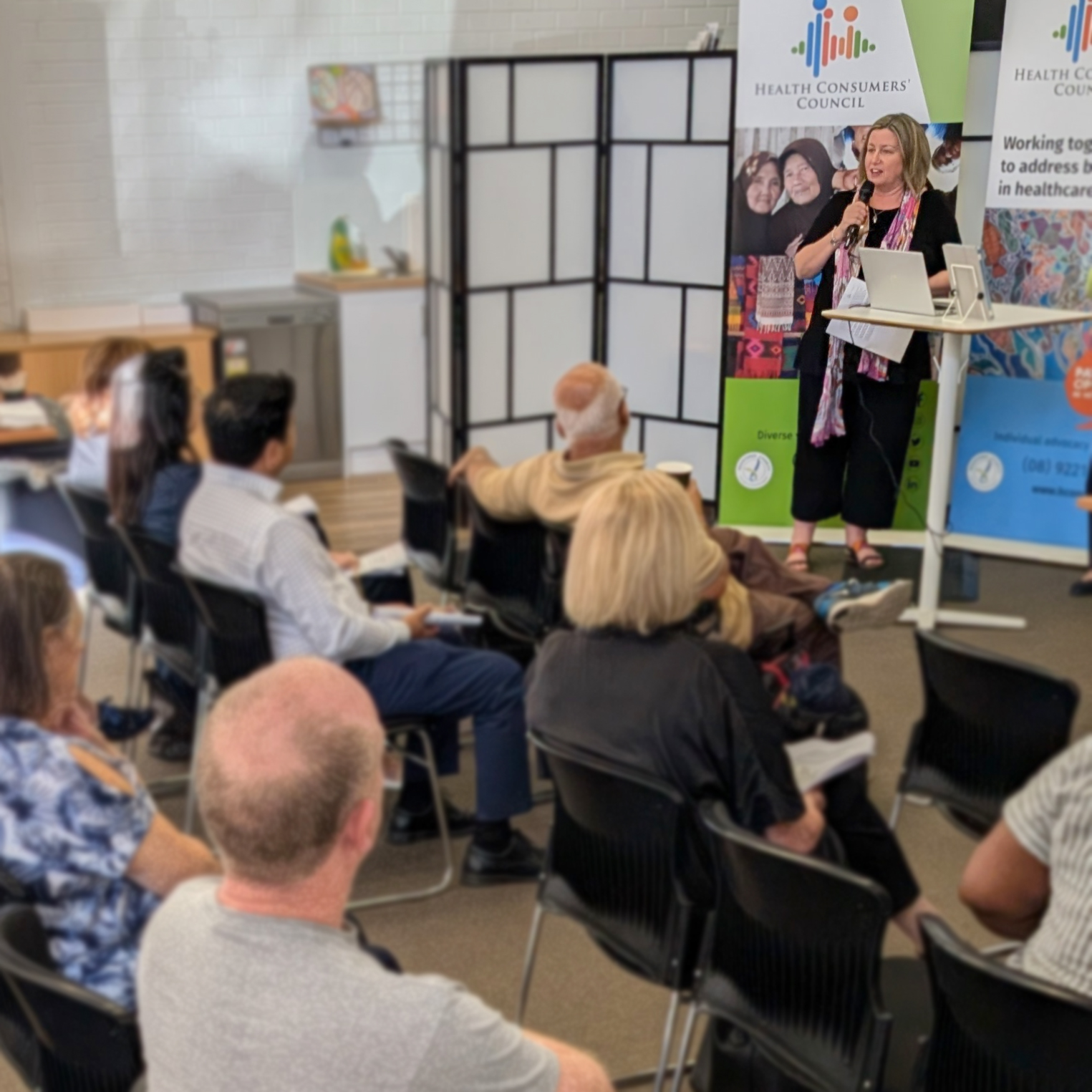
Clare Mullen speaking with HCCWA members

Why the 2025 elections matter for healthcare policy, and how patients and consumers can influence change.

The Impact of the WA State Election 2025 and Federal Election on Healthcare

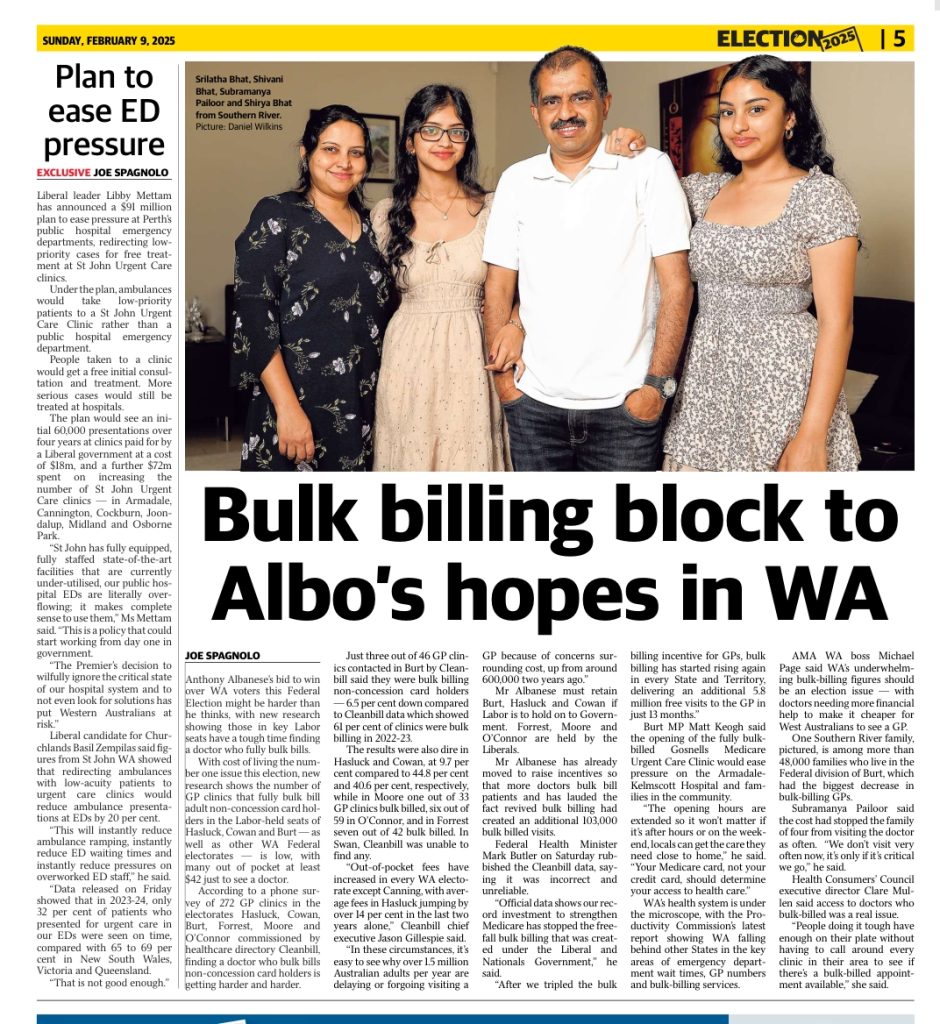
You might have noticed we’re in the run up to two elections. The WA State election on Saturday 8 March 2025, and the Federal election at some point in the next few months. Not only that, but the Productivity Commission and Cleanbill both published reports this month about healthcare in Australia pointing out what is very clear to anyone trying to access healthcare – there’s a lot of pressure on the hospital system and good luck trying to find a bulk billed GP appointment. And so the airwaves are alive with announcements and soundbites calling for action. And many of these will talk about the need for more hospital beds and hospital infrastructure.

Policy Priorities for Better Healthcare in WA and Australia

Here’s what we’d like to see from a patient and health consumer point of view:

  • increased investment in primary care across the state
    • the Cleanbill report found there are fewer than 40 GP clinics in WA where someone who’s not on a concession card can be bulk-billed – with the cost of living pressures being experienced by many people we know this means people are thinking twice about accessing care
    • the increase in urgent cares is great, but it’s not the same as good primary care
  • urgently increase the investment in preventative health measures
  • a continued focus on improving the efficiency and capacity of the hospital system
    • while retaining a focus on delivering compassionate person-centred care
  • improving access to healthcare in the community
    • one of the reasons for long waits in the Emergency Department is because there are people in hospital who are well enough to leave hospital, but not well enough to return home – we need more access to more community-based options, for example people looking for residential aged care
    • one study into a Compassionate Communities Community Connector model in WA’s South West found that the model led to a 63% reduction in hospital admissions – imagine if we were able to roll this kind of approach out across the state?

You can hear me talking about some of these points with Nadia Mitsopoulis on ABC Perth Mornings this month at this link. The whole item is from 4m45s and our comment is from 16m25s until 20m45s.

Long-term solutions: addressing the root causes of healthcare challenges

Change is not a quick fix

Despite what you’ll read in the coming weeks, there are no quick fixes to the current pressures. WA is not alone in facing these pressures on our healthcare system. And these pressures haven’t come out of nowhere.

The very powerful commercial interests of the food, alcohol and entertainment sectors have created a world over the last five decades where we are increasingly and strongly nudged towards unhealthy behaviours such as eating high levels of ultra-processed foods; spending increased time on electronic devices, including social media; and prioritising paid work over social and community connections.

Add to this the recovery from the turbulence of the COVID pandemic, and healthcare systems around the world are facing similar challenges.

The role of vested interests in shaping healthcare policies

Patient and consumer voices can cut through vested interests

There are many vested interests in the healthcare space. Powerful clinical groups and commercial interests are able to spend significant sums of money putting forward the interests of their members and stakeholders.

And in Australia, we have three levels of government who all have a role in health and healthcare. And unfortunately, getting different parts of government to work well together has never been easy.

Why consumer advocacy is essential for better healthcare policies

Only consumer advocates have the interests of patients, consumers and the community as their sole focus

It has never been more important that there are strong, informed, and connected patient, consumer and community voices in every discussion informing decisions about health and healthcare.

By Clare Mullen, Executive Director

Why we choose to keep our office open on the Australia Day public holiday

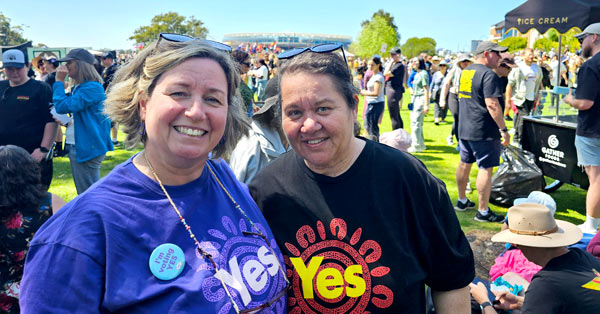
Clare and Tania at a the Perth march for a voice to parliment

A simple act of empathy, support, and perspective

Australia Day holds varied meanings for Australians. However, for many Aboriginal and Torres Strait Islander peoples, it symbolises colonisation, loss, and intergenerational trauma. At Health Consumers’ Council (HCC), we believe it is vital to acknowledge this history, understand its impact, and support First Nations peoples not just on January 26 but every day.

Standing in solidarity with Aboriginal communities

As advocates for all healthcare consumers in Western Australia, we recognise the importance of listening to, and amplifying, the voices of Aboriginal peoples. For many, January 26 is a day of mourning and reflection, highlighting ongoing challenges such as significant health disparities.

On the Australia day public holiday (27 January) our office will be open

At HCC, choosing to give staff the opportunity to work on the Australia Day public holiday is an act of solidarity. This is something we have done for a couple of years now and it has been welcomed by staff. We believe there is much to celebrate about Australia, but we recognise the colonial history of the current date, and so don’t see it as a day for celebration. Our team members have the option to work on this day and take another day off instead, or to take the day off if that’s their preference.

Encouraging dialogue, empathy, and micro-activism

By sharing our decision to work on Australia Day we hope to spark reflection and conversation within organisations and communities. By reconsidering the significance of January 26, we aim to promote inclusion, equity, and a deeper understanding of its impact on Aboriginal and Torres Strait Islander peoples.

This is one of the steps we take to acknowledge the truth of our nation’s history and to play our part in fostering a more inclusive future.

This reflects our broader commitment to addressing health inequities and standing with Aboriginal communities as they continue their work to address the harm of colonisation that is still experienced by many people today.

We also work throughout the year to address health inequities experienced by other groups and you can find out more about that work on our website.

Acknowledging some key dates in Australia’s history

  • 65,000+ years ago: First peoples from Southeast Asia arrived in Australia, forming the world’s oldest continuous civilization.
  • 1606: Dutch explorers became the first Europeans to land in Australia.
  • 1788: Captain Arthur Phillip raised the British flag at what he named as Sydney Cove on January 26.
  • 1818: NSW celebrated January 26 as a public holiday to mark the 30th anniversary of the Sydney Cove landing.
  • 1901: The six colonies united to form the Commonwealth of Australia.
  • 1938: Aboriginal protests on January 26 highlighted the trauma of colonisation, calling it “A Day of Mourning.”
  • 1988: Protests during the Bicentenary included 40,000 people marching for land rights and against dispossession.
  • 1994: January 26 was officially declared a public holiday across all states and territories.

Consider joining us for our workshop Acknowledging Country.

Acknowledging Country

An Acknowledgement of Country is an important start to most meetings and professional gatherings and is an opportunity to express your and your organisations respect for Aboriginal people, Country and Culture.

This workshop is designed to help you start to think about what an Acknowledgement of Country means, the difference between and Acknowledgement and a Welcome to Country, when you should be doing an Acknowledgement and how to personalise and make your own Acknowledgement meaningful and respectful.

You will leave the workshop with some tangible tools to develop your Acknowledgement, have the opportunity to ask questions, to develop your own personalised Acknowledgement and some tips for delivering it with confidence and respect.

All profits from these workshops go directly to supporting Aboriginal health consumers in WA in various ways including but not limited to, funding training opportunities for Aboriginal health consumers and occasionally Aboriginal workers, funding Aboriginal consumer payments to ensure Aboriginal perspectives are heard where they may not be. Please contact Tania to discuss this further.

See more workshops we offer below, or register for our next Acknowledging Country workshop now.


Addressing inequities in WA Healthcare: building a fairer system for all

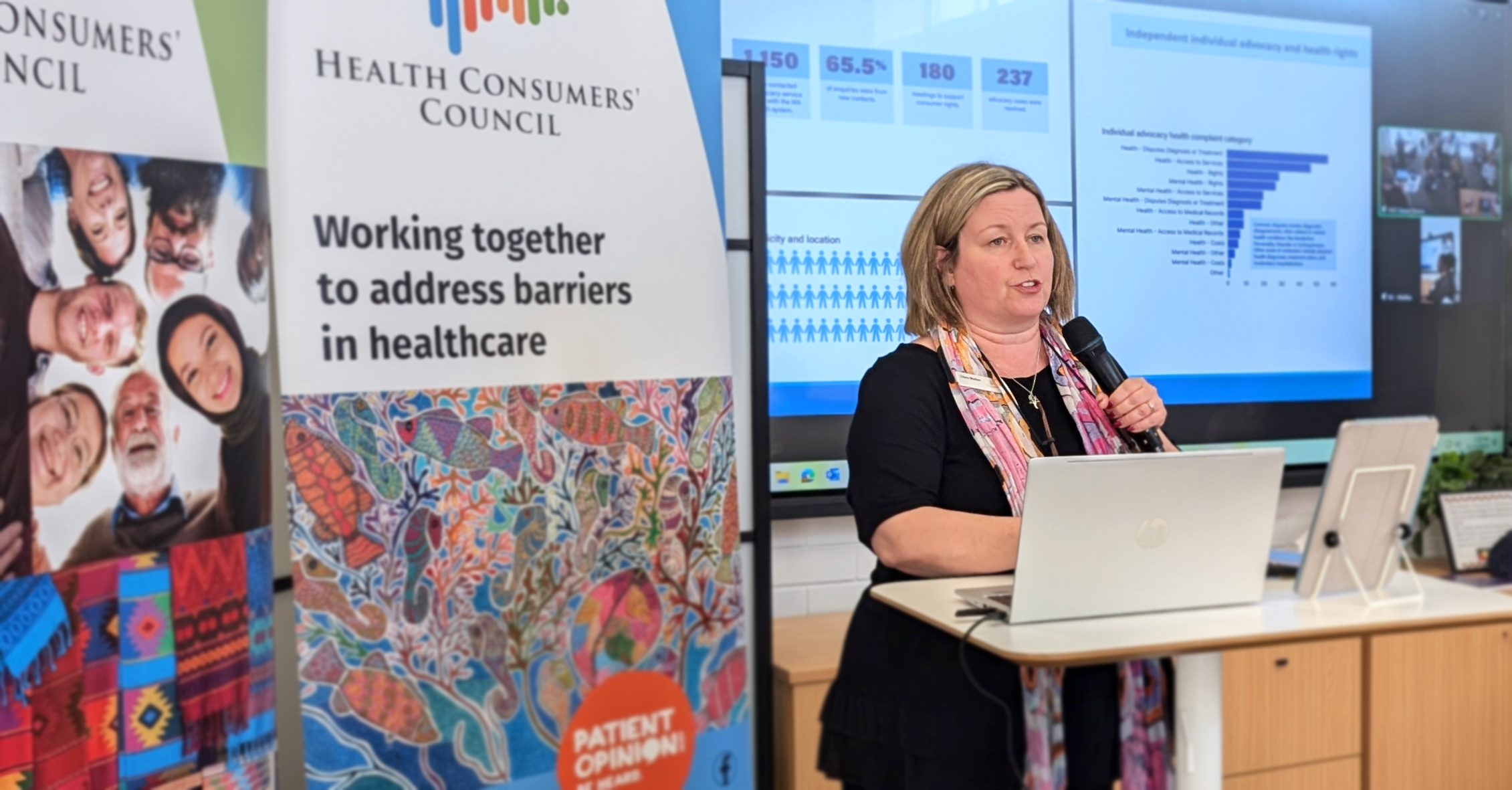
Clare Mullen speaks about the Healthcare Consumers' Council

Addressing inequities in WA Healthcare: building a fairer system for all

Adjusting the picture

The issue of public hospital TV fees in WA has sparked widespread debate, with discussions featured on ABC, 6PR, and SkyNews. On Wednesday, I was invited on to 6PR’s Perth Live with Oliver Peterson to share the Health Consumers’ Council of WA’s (HCCWA) perspective on healthcare equity in Western Australia, and the cost of watching free-to-air TV in public hospitals around WA.

The strong public response to the issue of free TV services reveals that many West Australians believe that everyone should be able to access basic amenities, such as free-to-air TV, in public hospitals. HCCWA works to amplify the voices of people who use healthcare providers in WA, or those caring for someone else who does. And let’s face it, that’s pretty much all Western Australians.

Changing the channel – it’s more than a call for free TV in our hospitals

Healthcare equity is a complex issue, and community feedback reflects a range of perspectives. Patients can pay up to $14 per day or $54 weekly for access to basic television services which are outsourced by hospitals to external providers. These costs can disproportionately affect long-term patients especially elderly people, and people on low-incomes.

Some argue against taxpayer funding of ‘patient entertainment’, while others share heartbreaking stories of loved ones unable to afford basic comforts during their recovery. As I shared with the ABC earlier this week:

Being in hospital can be overwhelming. Patients face the stress of medical procedures, waiting for results, and being away from home—all while feeling unwell. Mental health is critical to physical recovery, and free access to TV provides a soothing escape. In a state as wealthy as WA, we can surely find ways to ensure everyone can enjoy small comforts like summer sport while they heal.”

At HCCWA, we believe everyone should have the same access to the seemingly small things which can have a big impact on someone’s wellbeing.

Turning up the volume on fairness

This debate highlights deeper systemic challenges in our healthcare system. When basic amenities like television become a financial burden for those already struggling, and other out-of-pocket healthcare costs, it raises important questions about equity in healthcare. As financial pressures on West Australians increase, should a person’s ability to have a good experience in hospital depend on their bank balance? We don’t think so. So we’re adding this to the list of things we’re looking at to see what can be done about it.

Broader advocacy for healthcare equity

While TV access for people on low incomes might seem like an insignificant issue, it’s just one aspect of healthcare equity and access to healthcare in Western Australia. As we approach both state and federal elections, we’ll be putting forward a patient and health consumer lens on critical issues like access to bulk billing GPs, mental health treatment affordability, affordability of ambulance services, and community-based care options. We’ll also be commenting on maternity care, women’s health, suicide prevention, and the health impacts of racism on First Nations peoples and other communities and other health disparities in Western Australia.

A great health system – for all

We know many West Aussies have a great experience in WA health services. We’re here to speak up for the people who don’t and advocate for health policy reforms. We’ll continue to advocate for fair access for all by amplifying people’s experiences where they are struggling with our healthcare system. Whether we’re talking about keeping your mind occupied in hospital or broader systemic issues, our commitment remains the same: championing fairness, equity, safety, and empowered consumers in healthcare.

Join the conversation

We’re about building a healthcare system that treats everyone with dignity, regardless of their financial situation. We believe that no one should face additional barriers to access, comfort and wellbeing simply because they’re doing it tough financially.

Join us in our community-led mission to shape our healthcare system so that it meets the needs of all Western Australians. Sign up for our newsletter, follow us on Facebook, Instagram or LinkedIn or check out the resources on our website. Together, we can create a healthcare system that’s fair for all.


COVID health protections in hospitals – return to masks

Health Consumers’ Council welcomes today’s announcement by the WA Department of Health that WA public hospitals will be strengthening health protections in light of an increase in COVID-19 infections.

We know that COVID has remained a concern for medically vulnerable people and the community at large. And with regular media reports of rising infection numbers, and evidence about the impact of Long COVID still emerging, many in the community may be concerned about whether we’re doing enough to manage the risk of serious illness or widespread infection.

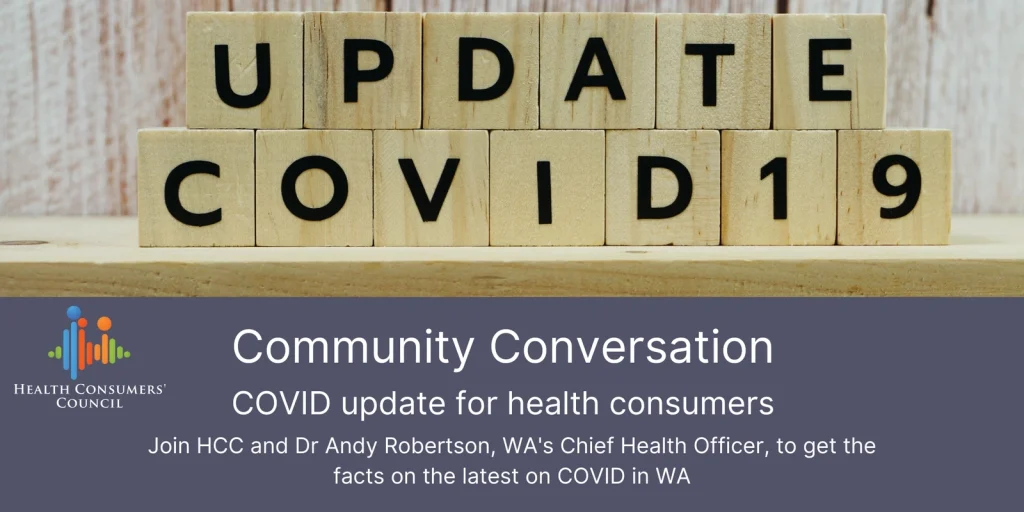
HCC will be hosting a Community Conversation for health consumers where attendees will hear directly from Dr Andy Robertson, WA Health’s Chief Health Officer, and get the facts on the latest wave on Tuesday 12 December at 1pm.

Children's building blocks with UPDATE COVID19 spelled out - and title of the event

It shouldn’t be this hard to be heard…

By Clare Mullen, Executive Director

It was heartbreaking to hear about the experiences of the the family of baby Ashlee, who died in 2019. We were asked to speak about this on the ABC Drive show this week after the Coroner found that Ashlee’s death was preventable.

Ashlee’s dad spoke about how difficult it was to have their voice heard in the health system. He described how they had to resort to getting lawyers involved just to get answers, and to get an acknowledgement that something had gone wrong.

Sadly, the experience of trying to get answers from the health system, or an acknowledgement or an apology from health services after something has gone wrong, can often be a distressing experience – adding more pain to an already terrible situation.

Let’s be clear – this experience, and other incidents like it, should not happen. 

We want no family to go through this situation.

That’s why we advocate for a patient safety culture in our hospitals. A big part of that is listening to families and patients when they raise concerns.

We know people believe that safe care is care where they feel heard by the treating team.

We believe that part of that safety culture would see consumer perspectives being taken on board at every level of decision making that impacts on patient – from bed level to Board level. We believe this is critical to making sure that decisions that affect safety and quality – such as resourcing and staffing levels – in hospitals are made with consumer perspectives front and centre.

Use Aishwarya’s CARE Call to speak to a senior staff member

Thanks to the advocacy of another family who also experienced a tragic death in a hospital, people in WA public hospitals have another way to have their voice heard in the health system.

If you are concerned about a loved one’s condition when they’re in hospital, and you feel you’re not being heard when you speak to staff, you can An image of a heart with wings, next to the title Aishwarya's CARE Call. A speech bubble with "Are you worried?". We need to know.use Aishwarya’s CARE Call.

This is a number in the hospital where you can speak to a senior staff member who will listen and action your concerns there and then.

If things go wrong

Where something has gone wrong in health in WA, and if you’re having trouble getting answers, Health Consumers’ Council can help by walking alongside you. We can help you to get information about what happened so you can decide what action you might want to take. That could be asking to meet with the hospital team, submitting a complaint, accessing your health records, etc. Our team can advise on writing letters, or accompany you to appointments if you would like.

We also have information on our website to help you navigate the process of making a complaint if that’s what you want to do.

Health Consumers’ Council is an independent charity that was set up to provide a way for consumer, patient, carer, and family voices to be heard at every level of the health system. We were set up almost 30 years ago by people who wanted there to be an independent body that speaks up for consumers in health. We offer an independent advocacy service that can walk alongside consumers, patients, and families who are seeking answers and redress when things go wrong in health.

Unfortunately, limited resources mean we’re not able to be available to everyone that could benefit from our support.

WA needs more “in the moment” advocacy

Ideally, people would be able to access individual advocacy support where and when it’s needed. We’d like to see independent advocates available on site in our hospitals. We would rather be able to help people assert their rights in the moment, to avoid things going wrong.

As Ashlee’s family commented – you should haven’t to resort to lawyers to get your voice heard in health.

Health consumers’ feedback on digital health “Future for healthcare in Australia…” workshop


HCC’s Consumer representatives give feedback on ACHSM pre-congress workshop

Over 100 ppl — mostly health service providers — but certainly including at least 12 HCC consumer representatives, attended a pre-ACHSM* congress workshop, “The future of healthcare in Australia: designed for consumers, enabled by digital, and accessible for all” held at Perth Convention and Exhibition Centre 21-23 September 2022. Following the event, we asked our HCC consumer representatives who attend the pre-congress workshop for feedback. Read further to find out what they said.

* 2022 Australasian College of Health Service Management – ACHSM, held at Perth Convention and Exhibition Centre 21-23 September 2022.

The session was entitled “Future for healthcare in Australia: designed for consumers enabled by digital access for all’. The main presentation gave an overview of the Deloitte, Curtin Uni and CHF white paper entitled ‘Australia’s health reimagined. The journey to a connected and confident consumer.” 

Noted by one consumer: the very title of the session …designed FOR, not designed WITH!

In this white paper it shows where the opinions of stakeholders lie about where the health system currently sits, as well as priorities for change.

The three “horizons” – ‘connected’, ‘empowered’ and ‘confident’ consumers – are envisaged to exist as a progressive step approach to a reimagined health system which ‘supports all Australians to live their best, healthiest lives.’ The white paper describes a number of transitions that will reorientate the health system to focus on the needs of individuals.

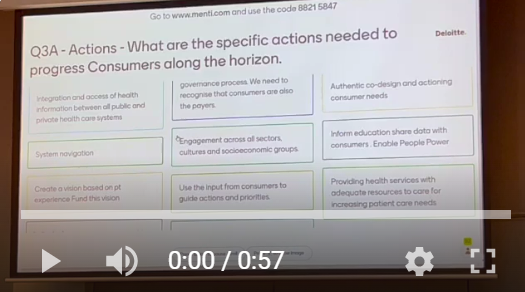
Following the review of this report’s findings, the audience was asked to participate in a series of Menti polls (Mentimeter is an online, interactive, live polling tool used to ask questions at events, and provides the audience’s responses on screen). Polling activities looked at views on the current state of healthcare and its use of digital health in terms of three horizons, connected, empowered and confident consumers.

Overall, many of our consumers suspected that that the room was not very consumer focused in its perspective.

One consumer said that when voting on priority focusses, the important dimensions to focus on that will accelerate the health system toward achieving its visions (e.g., consumers moving along the “horizon” from “connected” through to “empowered”), the dimensions relating to consumers came in as priorities 5, 8, 12 and 13. Priorities 1-4 were system funding, system integration, enabler workforce, and enabler data interoperability.

The priority responses from the room were all about the providers and the system doing things to reform itself – not starting from where consumers are and what they need.

There was a lot of academic and high-level commercial ‘report’ jargon thrown around the room, said another consumer, which is not very consumer-friendly regarding simple language or a ‘give it to me straight, doc’ approach.

One of our consumer representatives said he was “very surprised that the title suggested workshop for consumers but [that consumers] were very outnumbered by others [e.g., health service providers]”.

However, more than a couple HCC consumer representatives found the workshop to be positive and most worthwhile with a good spread of consumers in the room and plenty of opportunity to get the consumer perspective heard and captured, especially using Menti. A couple consumers mentioned Menti being useful:

“…the electronic way [using Menti] of gathering comments, opinions and insights (via phones) is an efficient way of conducting the workshop, especially when only 1.5 hours is allocated.”

The strong consumer feedback will help shape the next phase of the work.

Of interest, the point was made that health providers and clinicians are also service users and so they should look at what they would want to receive for themselves and their loved ones.

Another consumer seconded that point of view, saying “A moot point was that we are all consumers at one time or other.”

It is worth highlighting concerns of another health consumer in attendance:

“… about the comments made [regarding] ‘we are all consumers of health services’ by the group. I think it is really important for not only health service providers but also health workers and those in leadership positions across the system, to understand that being a consumer of health services means different things for different people. While I agree that we all should receive the same access to digital health tools, there needs to be a recognition of the complexity of need for consumers with complex health issues compared to those who perhaps step in and out of the health system periodically throughout their lives – and digital solutions need to address this and respond to it. People with chronic health conditions…often have contact with the health system on a weekly basis and require a more intensive, complex, and sophisticated relationship with the system, to meet their needs. I don’t believe this level of complexity is necessarily understood or appreciated by people who don’t have lived experience of chronic disease and multiple comorbidities. I think to say, ‘we are all consumers of health services’ is being blind to the varied complexities of consumer experiences and it is essential to have people living with complex chronic disease who are reliant on the health system constantly, in leadership positions in health, to ensure this is understood and provided for in digital health strategy.”

Some pointed out that if the health system did not hurry up and adopt more digital health resources then digital disruption would mean consumers met their needs elsewhere as private companies enter the field and websites such as https://www.patientslikeme.com/ are set up.

(This was echoed by another consumer who attended an event in August 2022 – read the blog here: “A wild reflection from digital health summit”.)

More quotes, and feedback:

There have been many similar strategies in the past and many of our consumers remain unconvinced that we need another one at this point. For example, many of our people specifically mentioned the National Australian Digital Health Strategy and that it involved “extensive community consultation across the country”.

…it is frustrating to see a restart, rather than building on what has been done previously.

I fear that there are many efforts to improve the health provision in the community but is it still being addressed in silos.

I would love to see a co-design committee developed to move ahead with what priorities can be worked on in this space.

There is no “one size fits all” and there are many things that need to be improved within WA Health. How can we move forward with realistic and achievable outcomes is my question?

As an aside – one health consumer recommends the 2017 Documentary “Daughters of Destiny” on Netflix and is convinced that starting health literacy awareness in early education is absolutely necessary.

[Noteworthy: October is Health Literacy Month.]

One consumer noted that “we [the attending workshop participants] were not told how the survey of approximately 1,800 people was administered nor the characteristics of the respondents.” She said, “This raises concerns about representativeness and possible bias if it was largely administered digitally as this may result in an overstatement of willingness and desire to adopt digital health resources.”
(~ Since the session she discovered it was indeed an online survey)

“A central focus on health outcomes was not explicit and evident in the presentation, and that is always a concern,” one consumer shared. “It must be the starting and end point, with the strategy articulating a pathway for delivering improvement.

Digital health is not a silver bullet and cannot be considered in isolation of the “health” ecosystem – it is an enabler along with other interdependent components that must be represented as part of a holistic solution that brings in a stronger community role and emphasis on consumer responsibility.”

“We all need the reassurance that there will be benefits of an integrated system that it is sustainable, workable, and where all [are] included [with] no one left behind…

Our regional services need aligning around Australia. Our Indigenous communities need appropriate consultation. Multicultural people need accessible info. Gender diverse, neuro divergent, and multiplicity of broad users need to be recognised and accepted as service users with their own often co existing diversity and needs. We know mental health concerns have also risen throughout Australia over past three years, not to mention our ageing population with continuing and varying need.

[Noteworthy: October is World Mental Health Month.]

If we are not delivering appropriate health care now to those in need, how do we expect anything new to be accepted, or are we going to have to supplement upcoming changes with the loss of something already existing?”

Overall, although with mixed levels, HCC consumer representatives thought the white paper is a useful contribution. However, there are several concerns that “not enough attention is paid to the digital divide either in the report or the workshop and there is a real danger it will gloss over the difficulties of access for some and rather than delivering something that is person-focused. It will assume that all consumers want and are able to access digital health and therefore replicate existing inequalities rather than break them down.”


***

Follow our social media platforms for ongoing commentary and contributions from our consumer representatives and the HCC team.


Connecting and communicating consumer perspectives on cancer care in WA


Has cancer affected your life – currently or in the past? A desire to connect with others who have similar lived experiences is the drive behind the upcoming community conversation welcoming consumers affected by cancer in WA. Health consumers’, carers, family, and community are invited to join “Connecting and communicating consumer perspectives on cancer care in WA“.

Be part of the conversation to discuss progress on the 2020-25 WA Cancer Plan. Discuss opportunities for future consumer and community connections.

Date and time

About this event

The WA Cancer Plan guides cancer care in WA: find out about progress on the 2020-25 plan and discuss opportunities for future consumer and community connections

Health Consumers’ Council (HCC) WA and the Consumer and Community Involvement Program (CCIP) are hosting this community conversation for people with experience of cancer – either for themselves, or for a loved one.

In this session, consumer representative Susannah Morris, the HCC WA consumer representative in cancer involved in work relating to the development and now implementation of the WA State Cancer Plan, will give an update on work so far as background for the conversation. Cancer care is delivered in the states and so state plans provide important context that guides care and affects consumer experiences and outcomes. Unlike some other jurisdictions, WA does not have a readily identifiable network of cancer consumers: we are fragmented between our cancer types and our treating locations and so this community conversation provides a space for us to come together.

This will be an opportunity for attendees to discuss their interest in people with experience of cancer in WA connecting with each other in order to influence the scope, design and delivery of health services and health research in relation to cancer and survivorship.

(NB This information session is being hosted independently by HCC and the CCIP to provide an opportunity for people with experience of cancer to connect with each other and learn about work relating to cancer care and services in WA. This is not a Department of Health event.)

This conversation will be held online, via Zoom – details will be sent out in the week before the session.


About the organisers

We are (Health Consumers’ Council WA) an independent charity that exists to support and promote consumer, carer and community perspectives in the WA health system.

The Consumer and Community Involvement Program (CCI Program) is an activity of the Western Australian Health Translation Network (WAHTN). The CCI Program (CCIP) supports consumers, community members and researchers to work in partnership to make decisions about health research priorities, policy and practice with the aim of improving health outcomes and ensuring community involvement becomes standard practice.

BACKGROUND: Cancer Care and the WA Cancer Plan, launched 2020

The WA Cancer Plan was released in February 2020 setting out the next five years of strategy in relation to cancer services. This work was undertaken by the WA Department of Health, and the Health Consumers’ Council supported the project through running a community survey and developing consumer videos reflecting consumer patient journey experiences. A summary of survey results is available here. The launch event featured a moving and articulate presentation from Advisory Group member Susannah Morris, who ensured the consumer voice was at the heart of the plan as much as possible.

(An abridged version of Susannah’s speech is in Health Matters (pages 10-11: March 2020 issue) on the Health Consumers’ Council (WA) website, titled “A new plan for cancer
care in WA“)

REGISTER FOR THE COMMUNITY CONVERSATION HERE:

https://bit.ly/WA-Cancer-Plan-Community-Conversation-Consumer-Perspectives

(LinkedIn: for Dr Susannah Morris)

My Health Record Opt Out Period

You have from 16th July until 16th October to opt out…


Did you know that by the end of 2018, an online summary of your health information “My Health Record” will be created for every Australian?

If you don’t want to have a My Health Record, you need to take action by 15th October and opt out.

There are a range of ways to support you to opt out, and these will come on line by 16th July. You can sign up on this web page for updates as they are released.

Why have a My Health Record?

In simple terms, a My Health Record connects the dots between, for example, your GP and your hospital care. Over the last several years, WA Health services have been working on linking your hospital discharge summary to a My Health Record. So when your discharge summary is created, it looks for a match with a My Health Record and if there one, it will connect the two. Your GP will then be able to see the discharge summary, and so will you. Getting a My Health Record will mean important information like this will be at your fingertips 24/7. This will result in faster and safer care for you and your family.

Do you have any allergies???

Patients often wonder why they have to keep repeating tests and explaining allergies over and over again. but currently, we have on way of easily sharing that information across our systems. A My Health Record will help with this.

Across Australia

Having a My Health Record will mean your important patient information follows you no matter where you travel in Australia.

Advanced Care Plan

You can also upload your Advanced Care Plan if you have one, on your My Health Record.

Whose records?

In our Advocacy service we often encounter people needing assistance in accessing their medical records. This will, over time, be a thing of the past, where people can maintain control over their own health information via the My Health Record. This is vital when seeking follow-up treatment, understanding our own health care and knowing what has happened to us.

What about privacy?

This is a huge consideration, and many will know that the My Health Record, which used to be called the Personally Controlled Electronic Health Record, has been in the planning stages for many years, in part because of the important considerations of protecting privacy. If you are really concerned, you can opt out.

Extra privacy protections

One of the new features of the My Health Record will be the ability to set it up so that you get a text if someone accesses your health record. This is not something our current paper based medical records provide. You will also be able to control certain aspects of it yourself.

To find out more please ensure you, your family and friends go to the government website for information and updates.

How you can help support quality healthcare for all

For some time, I have been thinking about people across the globe that access healthcare (health consumers). Unfortunately, most are not able to access the same quality of healthcare available in Australia. I wondered how we in the ‘Lucky Country’ could share our good fortune with others and help support quality healthcare for all.


Help support quality healthcare for all

To help support quality healthcare for all health consumers, Health Consumers’ Council will nominate each year a selected healthcare charity organisation located in Australia and overseas. We will provide those who attend our functions the opportunity to donate a gold coin go towards the nominated ‘good cause’. We hope you will support us in this endeavour to help improve healthcare for those less fortunate than ourselves.


Hamlin Fistula Ethiopia

In 2017 we are collecting donations for ‘Hamlin Fistula Ethiopia’. ‘Hamlin Fistula Ethiopia’ was founded in 1974 by husband and wife, Dr Reg Hamlin OBE and Dr Catherine Hamlin AC. I first came across the ‘Hamlin Fistula Ethiopia’ in the 1990s and have since read more about it, including in the book, ‘The Hospital by the River’, by Dr Catherine Hamlin. (Pictured: Catherine Hamlin Co-founder of Hamlin Fistula Ethiopia)


Catherine and her late husband Reg initially travelled to Ethiopia (as doctors) with the intent of staying for three years. Originally from Australia they dedicated their lives to the women of Ethiopia. Dr Catherine Hamlin turned 97 in January and she still lives in her home in the grounds of the Adis Ababa Fistula Hospital.


Catherine and Reg are part of my collection of heroes, people I admire for the contribution they have made to the lives of others and therefore the world. Today we constantly look at life through the media lens, making the world seem almost devoid of genuine acts of kindness. So, it is even more important to recognise genuine heroes like Catherine and Reg.


The Hamelin Clinic also has an office in New South Wales and I encourage you to visit their website here to learn more about this wonderful couple, their staff and women the Clinic heals.


Louise Ford | Consumer & Community Engagement Manager