Category: Blog

National Health Reform Agreement – how health is funded by the Federal and State governments

By Clare Mullen, Executive Director

The National Health Reform Agreement (NHRA) is an agreement between the Commonwealth government and the state government on a range of health issues.

The Federal Government has commissioned an independent review of this Agreement as it is the mid-way point of the Agreement’s term. The review team is due to report in August 2023.

I had the chance to speak with the Review team when they were in Perth this week.

Below are some of the points we plan to include in Health Consumers’ Council’s submission which we will submit by the end of June 2023. If you have further points you’d like to see included in that response, please email them to Jasmina Brankovich, HCC’s Systemic Advocacy and Policy Lead, jasmina.brankovich@hconc.org.au

  • A key focus of the Agreement relates to how hospitals are funded – this is called Activity Based Funding (ABF) and it means that hospitals are funded based on the volume of services they provide (rather than receiving a block of funding as was the case previously). From our discussions with people across health, it seems this has led to some activities which would benefit consumers being understood by hospitals as not to be included – i.e. activities which might lead to services being provided in primary care/community care settings rather than in a hospital setting
  • Funding based on fee for service inevitably leads to health services need to drive activity – when less activity in the hospital, and more in primary care would be best for the consumer
    • We note that NSW Health opted to initiate collaborative commissioning, using state funds to commission primary care services so as to reduce demand on hospital services – we’re not aware that this has been replicated in other states yet, including WA
  • The role of “system manager” as it’s currently recognised – i.e. only of public hospitals – limits the value of a system manager role.
    • Given that managing hospitals relies heavily on the provision and functioning of primary/community care services – often commissioned and/or funded by the Commonwealth, there may be an advantage in exploring the role of “system manager” being expanded to all publicly funded health services in the state – including those in primary care.
    • Consumer input into commissioning and funding decisions should be mandated for all publicly funded health services – both at a hospital and primary care level. This may require investment in building the capacity and structures to support informed consumer input to these decisions.
  • In response to the goals of the NHRA:
    • deliver safe, high-quality care in the right place at the right time
      • there is significant opportunity to improve funding flows across hospital/primary and community services – all too often consumer reps hear, that’s a function of “the other part of the system”.
    • prioritise prevention, and help people manage their health across their lifetime
      • there is little evidence that this goal is being achieved through any of the activities in the current agreement
    • drive best-practice and performance using data and research
      • this is difficult for consumers to comment on given the limited transparency of data about best practice and performance that is in the public domain
    • improve efficiency and ensure financial sustainability
      • the geographic and demographic characteristics of WA mean that “efficiency” and “financial sustainability” comparisons with other states is unlikely to be an effective way of measuring success for the WA community
      • We advocate for a recognition of the inherent “inefficiencies” in a health system that is delivering care across a vast geographic area, with very limited Federally-funded primary care provision in the regions – a national efficient price is unlikely to be sufficient to deliver safe high quality care in many parts of WA

With regards to the 6 reforms outlined in Schedule C of the NHRA:

  • empowering people through health literacy – person-centred health information and support will empower people to manage their own health well and engage effectively with health services
    • from our position in the system, there is very limited evidence of any activity happening in this area
    • we would like to see a stronger role for community-led initiatives – including bi-cultural workers – to shift the dial on health literacy
  • prevention and wellbeing – to reduce the burden of long-term chronic conditions and improve people’s quality of life
    • we note the publication of both state and national strategies relating to preventive health and obesity prevention, but see limited evidence of any investment in the implementation of these strategies at any level
    • we believe grassroots investment in building and maintain social capital is critical to this priority
  • paying for value and outcomes – enabling new and flexible ways for governments to pay for health services
    • we believe there’s an opportunity for more consumer involvement in discussions to determine the framework for paying for value and outcomes
  • joint planning and funding at a local level – improving the way health services are planned and delivered at the local level
    • in WA, we have limited evidence of this happening in practice. We acknowledge the benefit of having the three WA Primary Health Networks (PHNs) managed by the same organisation – the WA Primary Health Alliance.
    • We note the fact that in WA, the geographical areas covered by our PHNs don’t match the geographical areas covered by WA’s Health Service Providers and the challenge this creates for joint funding and planning
      • (In the metro area we have Perth North PHN and Perth South PHN, but South Metro, North Metro and East Metro Health Services)
  • enhanced health data – integrating data to support better health outcomes and save lives
    • we would advocate for more local involvement and upskilling of WA consumers to inform the collection, publication and use of health data for the WA community
  • nationally cohesive health technology assessment – improving health technology decisions will deliver safe, effective and affordable care
    • we are looking into this to inform our response.

We will also be considering our position on how Patient Reported Outcome Measures (PROMS) and Patient Reported Experience Measures (PREMS) could be used to inform how funding flows to different parts of the health system in future.

Overall, we will be calling for more local involvement and control of public funds that are allocated for the benefit of the WA community. For example, regional commissioning groups that agree funding priorities, planned outcomes, and performance measurement frameworks – to include multiple and diverse consumer and carer leaders working alongside local health system staff and policy makers who are well-placed to make decisions affecting the WA community.

Interested in integrated care? Time to get interested in interoperability…

By Clare Mullen, Executive Director, Health Consumers’ Council WA

Last week I was in Canberra to take part in the Wild Health* Canberra Australian health leaders’ summit. Wild Health are a publishing company who publish online content for people in the health system.

I took away lots of reflections which I’ll be mulling over in the next few weeks – but a major one for me is that

It’s time for consumer leaders and advocates to become knowledgeable and vocal about interoperability.

According to this article from the UK King’s Fund, “interoperability is the technical term used to describe the flow of information – about decisions made and care that has been or is being provided – across care settings. Good interoperability facilitates the best care in the best place with decisions made using all available information.

While I’m still developing my understanding of digital health (to get to the recommended 30% of literacy – see below), from what I can tell, the issue with interoperability and why we don’t have more of it, is not just a technical issue.

You can’t always get what you want – especially if you don’t ask for it

One of the speakers asked conference attendees how many of them had asked for interoperability when they were scoping a digital health project – and the number was low. It seems one of the main reasons it’s not being baked in to systems is because it’s not being asked for.

As we know, health consumers have been calling for more integrated care for years. And we have the most to gain from integrated care.

Interoperability of systems – so our information can flow to the right people at the right time in our health journey – is critical to integrated care.

It’s also critical to remember that the “data” flowing around the system is our information – both about us as individuals, but also about us as a community. It’s critical that systems are designed in a way that means we can access our own information, and that as a community our collective information is understood to be a community asset – able to be used to inform decisions about where and how we need care.

As consumer representatives, advocates and leaders it can be easy to disengage from discussions like this – because they can seem too technical. But the next wave of transformation in health is going to be digital and not only do we need to understand it, we need to be able to lead the discussions to ensure that community and consumer interests remain at the forefront of these discussions.

You can read more of the discussions at the Wild Health summits live blog from the event https://wildhealth.net.au/whats-happening-in-health-reform-join-our-live-blog/

Developing a digital mindset

I heard about this book on Brene Brown’s podcast. One of the main points they make is that we all need to get to a basic level of literacy to be able to be part of discussions in relation to “going digital”. Based on the fact that we can converse with people who speak another language once we’ve reached 30% of that new language’s vocabulary, they suggest we all need to get to 30% literacy in regards to “digital”.

And they take the reader through some of the basics that we need to understand to reach that level.

It’s an easy accessible read and one I’ll be coming back to again and again.

At HCC we’re looking into how we can develop some training content for consumer reps and leaders to help us reach this level of understanding, and develop our digital mindsets. Watch this space.

Book cover: The Digital Mindset - What it really takes to thrive in the age of data, algorighms and AI

* Wild Health invited me to speak at this event and covered the costs of my flights and accommodation to enable me to participate.

Rapid review – Federal budget health announcements

By Clare Mullen, Executive Director, Health Consumers’ Council

Just by chance, I happen to be in Canberra the week before the Federal budget, and the week I take up my new role at HCC – an interesting time to be in the nation’s capital. I had time to read the transcript of Minister Mark Butler’s speech and Q&A session at the Press Club on 2 May. Below are some things I’m taking away.

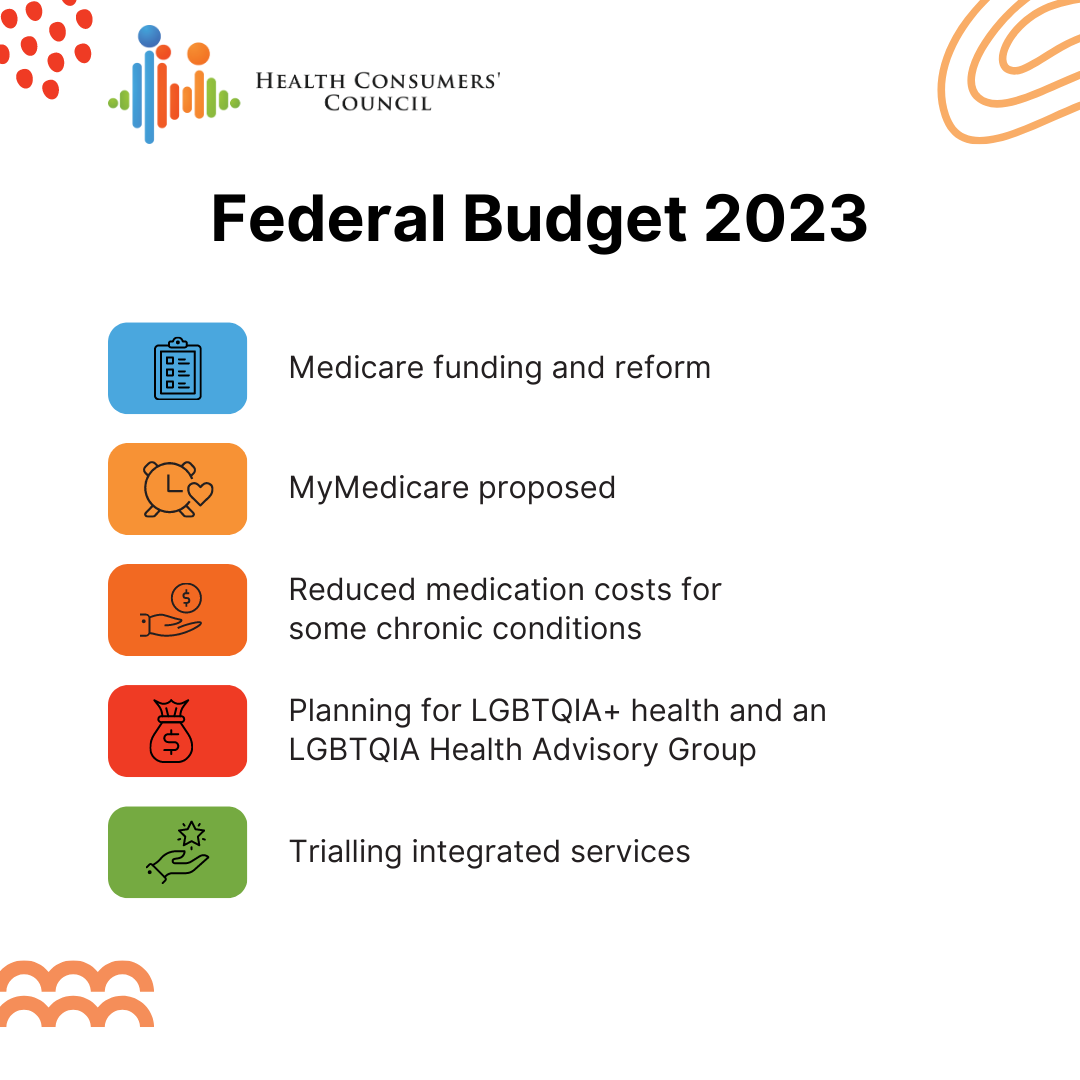
The TL;DR* version? Different roles for nurses, midwives and pharmacists are coming; new approach to Medicare funding for primary care – including My Medicare coming; restrictions on vaping. No mention of the need for much more consumer involvement in these reforms.

  • we’ll see the introduction of My Medicare
    • there are no details yet, but it says patients will be able to register on the platform, with their preferred clinician
    • practices/GPs can also register
    • the aim is to enable more on-going care, less “transactional” care
    • over time, it will enable easier identification of patients who are going to hospitals upwards of 10 times a year and allow better targetting of resources to enable them to receive better care in primary or community care
  • we’ll see funding for longer telehealth consultations
  • there will be changes to workforce roles, with an emphasis on a more multidisciplinary approach to care freeing doctors up to provide the care that only they can provide
    • greater role for nurses and midwives – including a Review of Scope of Practice
    • greater role for pharmacists/pharmacies – including
      • free vaccines under the national Immunisation Program
      • access to opioid dependency treatment
  • The Minister describes these changes as “persistent evolution, not overnight revolution” and reiterated several times how these changes will take time.
  • He noted that there have been modest increase in spending on Medicare Benefits Schedule and the Pharmaceuticals Benefits Scheme – but a significant increase in hospital spending.

The Minister also announced well-publicised changes to vaping accessibility, including banning non-prescription vapes, and an increase in tax on cigarettes. He also noted the need to increase the number of doctors who can prescribe vapes to support smoking cessation. Funding from the tax increases will go towards programs to reduce smoking/vaping dependency. He commented that “our focus is not on the people buying, our focus is on the people selling”. He also said there are more announcements to come in next week’s budget.

#WhereAreTheConsumers

Many of these reforms sound very positive for consumers. Consumers have long been calling for more time with their GP, more affordable/free access to primary care, and are ready to access care from other members of the primary care clinical team.

It’s clear that the design and implementation of these reforms are going to need a high level of involvement from a diverse range of consumers, carers and community members.

Local consumers influencing national reforms

Being in Canberra, I also took the opportunity to meet with local and national consumer leaders: Darlene Cox and her team at Health Care Consumers Association, ACT’s equivalent of HCC, and Elizabeth Deveny at Consumers Health Forum, the national consumer peak body. It was great to discuss our shared interests and challenges.

What is clear is that there is much more opportunity for WA consumers to be more involved in national health reform discussions. Elizabeth commented that there are often WA nominations for national working groups – but we can always do with more. We also discussed the challenges of very limited funding for consumer organisations, and the importance of continuing to make the case for more investment in building capacity and diversity in consumer leadership right across Australia.

I know that there are currently relatively limited opportunities for local consumer involvement in primary care – both through the Primary Health Networks (managed in WA by the WA Primary Health Alliance) and within local practices.

I will be writing to Mark Butler to highlight this and enquire about how this might be addressed in a way that ensures grassroots community perspectives are well understood as these reforms take shape.

Join us

If you’re interested in how consumers, carers and community members can shape health and healthcare, you can join Health Consumers’ Council WA and become part of a social movement in health. It’s free to join and you’ll receive invitations and updates about our work and other items of interest.

A white canvas with multi-coloured splashes of paint. The word together is across the canvas in capital letters.

[* TL;DR is internet shorthand for “Too Long; Didn’t Read”]

Executive Director Announcement

[Image: L-R Mallika Macleod, HCC Chair and Clare Mullen, HCC Executive Director]


After carrying out an external recruitment process the Health Consumers’ Council (HCC) WA Management Committee is pleased to announce the appointment of a new Executive Director – Clare Mullen.

Clare has worked with Health Consumers’ Council since 2018, most recently in the role of Deputy Director. She has extensive understanding of health and social care systems with over 20 years’ experience in the UK and Australia. In the last 10 years she has held leadership roles in the WA Department of Health, the WA Primary Health Alliance and Health Consumers’ Council, giving her a deep understanding both of the complex issues facing our health and social care systems, as well as the lived experience of diverse consumers, carers and community members as they navigate these systems.

She is passionate and skilled at seeking innovative solutions to these challenges by bringing people who use these services together with people who work in these services in engaging ways that enable the strengths of each of these groups to be applied to the issue at hand. She also has considerable experience in advocating for consumer, carer, lived experience and community perspectives in a range of settings.

The Management Committee is looking forward to working with Clare in her new role.

The Management Committee would also like to take this opportunity to thank outgoing Interim Executive Director Rebecca Smith for leading HCC into 2023, and her willingness and ability to step in and support the team during the recruitment process. Rebecca will continue as a member of the HCC Leadership Team on an interim basis to support the transition.

Congratulations Clare!

Encouraging a Strong WA Consumer Voice in Medicare Taskforce Report


There is a lot of reform taking place at the moment in the area of primary health care and how this interacts with hospital and community care.

As the needs of Western Australian communities may differ from those of other regions, it is essential that the voice of WA is heard in this reform work. There are several opportunities for WA consumers to participate in this important work, including watching a replay of a recent community briefing by the Consumers Health Forum (CHF) on the Medicare Taskforce report or registering for the upcoming session to inform their feedback on the report, which will be held on March 22.

Background

In early February 2023, the Federal Government released the “Strengthening Medicare Taskforce” report – Elizabeth Deveny, CEO of the national Consumers Health Forum (CHF) was the consumer voice at that table. Learne Durrington, CEO of the WA Primary Health Alliance was also at the table, representing Primary Health Networks.

Last week, 3 February, CHF held a community briefing session on the report. You can watch the recording of that webinar here.

CHF will also be holding another session on 22 March (2:30 pm AEDT) to inform their input to the next stage of this process. If this is an area of interest to you, we encourage you to register here: a pre budget follow up webinar to talk about the key messages for consumers that CHF want to promote to decision-makers and the wider community.

Upcoming HCC consumer representative networking session

On 31 March (10 am – 12 pm AWST), HCC will be hosting the first of our consumer representative networking sessions for 2023. We’re delighted to advise you that Elizabeth Deveny from Consumers Health Forum in Canberra will be joining us virtually at that session so we’ll have a chance to explore the implications for WA with her directly. Register here.

~ Clare Mullen, Deputy Director, HCC

Stepping forward with confidence into 2023

Suzanna Robertson, executivedirector of Health Consumers' Council, head and shoulders pictured to the left of a branded banner with logo and tagline that reads "Health Consumers' Council, working together to address barriers in healthcare".

December 6, 2022


HCC Executive Director – 2022 Annual General Meeting (AGM) Address

delivered 6 December 2022

It’s a privilege to have joined HCC in April this year (2022).  HCC is an organisation with a strong voice built on experience, knowledge, and a proven commitment to really listening.

We are expert at creating space and conditions for people to be share experience and perspectives.  We identify and act on opportunities to emphasise what we hear and learn, to influence decisions by government and health services, and create conditions for positive change.

We gained 14 new members in 2021/22, growing the HCC community of people involved in creating positive change to nearly 250, with more individuals and organisations joining each month.

In the coming year, we want to do more of what we know makes a difference to people’s lives. However, we operate in an environment where government funding to the community services sector has not kept up with wages growth and cost of operation increases.  This is a hard ask. As such, we are making concerted efforts to grow and diversify our funding sources:

  • Providing consumer engagement expertise through projects and consultancy paid on a for-service basis.
  • Application to government proposing funding for expanded advocacy to reach more people who have prover health outcomes – we’re hopeful but competing with many other challenges for a finite bucket of money.
  • Expanding our consulting to new markets like aged care and disability services that are seeking to engage with consumers effectively and authentically.
  • Continuing to refine the information we collect and report to demonstrate our value and impact, which is challenging when our value is so clearly linked to relationships more than transactions and therefore much harder to measure and count. But we’re committed to keep trying.

When I started here, a statement in HCC’s strategic plan struck a chord – “learning as we go.”

Such simple words, yet so frequently they strike fear into the hearts of policymakers and funders.  So, then nothing is implemented until it’s fully proven, and with governance frameworks and project schedules clearly aligned and articulated.  Creativity, innovation, and consumer voice stifled by bureaucratic process, leading to “faux design” rather than co- design.

I feel like there’s a change afoot. The commitments of key reforms like SHR, of which my predecessor Pip Brennan was a driving force of consumer voice, recognise that what’s gone before isn’t working and it’s time for something new.

Doing new and different things requires a commitment to trying, learning, refining, doing, and learning, trying, and doing some more.  At HCC we are small enough to be agile, responsive, and innovative while robust enough to be credible, reliable, and respected.  These are the qualities that will see HCC step forward with confidence into 2023.


Suzanna Robertson | Executive Director, December 2022


Sustainable Health Review – focus on delivery

In November 2022, Health Consumers’ Council staff attended a WA Health Leadership breakfast with the Minister for Health and Mental Health, Amber-Jade Sanderson, for an update on the Sustainable Health Review (SHR).

After a slow start to implementation, and the disruptions caused by COVID, it was great to hear the Minister reiterate the Government’s commitment to the SHR and its implementation. The Minister was firm in her view that the SHR is about:

  • an equitable patient-centred system
  • a health system, not a hospital system
  • giving a voice to consumers.

She reminded attendees that the SHR outlined the need for courage, collaboration and systems-thinking.

We heard that while WA’s COVID response demonstrated the robustness of the WA health system, it also highlighted its fragility in some areas. The Minister was clear that as we now live with COVID, it’s not about snapping back to how things were before – but that it’s time to make sure that the health system’s actions match community needs.

She outlined that a key priority is addressing emergency access to care – which is a focus for a Ministerial Task Force that was established earlier this year.

Tim Marney, Chief Economist at Nous Consulting, and Chair of the Independent Oversight Committee (IOC) for the SHR then spoke about how the focus for the IOC is very much on delivery. There will be a new focus on implementation.

As part of that, it has been agreed to provide focused support to a smaller number of recommendations (there are 30 in total in the SHR) to enable implementation to be accelerated in these critical areas:

  • Recommendation 11: Improve timely access to outpatient services through:
    a) Moving routine, non-urgent and less complex specialist outpatient services out of hospital settings in partnership with primary care.
    b) Requiring all metropolitan Health Service Providers to progressively provide telehealth consultations for 65 per cent of outpatient services for country patients by July 2022.
  • Recommendation 13: Implement models of care in the community for groups of people with complex conditions who are frequent presenters to hospital.
  • Recommendation 17: Implement a new funding and commissioning model for the WA health system from July 2021 focused on quality and value for the patient and community, supporting new models of care and joint commissioning
  • Recommendation 22: Invest in a phased 10-year digitisation of theWA health system to empower citizens withgreater health information, to enable access
    to innovative, safe and efficient services; and
    to improve, promote and protect the health of Western Australians.
  • Recommendation 23: Build a systemwide culture of courage, innovation
    and accountability that builds on the existing
    pride, compassion and professionalism of staff to support collaboration for change
  • Recommendation 26: Build capability in workforce planning and formally partner with universities, vocational training institutes and professional colleges to shape the skills and curriculum to develop the health and social care workforce of the future

Tim was clear to point out that this did not signal that the other recommendations were less important and reiterated that work on these would continue.

He also highlighted that a number of the recommendations including Recommendation 3 with a focus on health equity and Recommendation 4 with a focus on citizen and community partnership – and for which Suzanna Robertson, HCC’s Executive Director is a co-lead – should be seen as underpinning all the other recommendations.

Health Consumers’ Council continue to advocate for targeted consumer and lived experience partnership and involvement in all the SHR work and look forward to learning more about how this will work for the six prioritised recommendations.

(By Clare Mullen, Deputy Director, Health Consumers’ Council)

Consumer participation payment – HCC process change

Starting in 2023, Health Consumers’ Council will be changing our process when we ask for a consumer’s information to make a consumer participation payment. This change is to ensure that appropriate records are being kept and is due to Australian rule changes.

We will require people to complete a “Statement by supplier” form (for the Australian Tax Office).  The form may be necessary to receive payment from us without an ABN. If you receive this form from us, we will detail why it is required – please reach out to us if you need this further clarified before completing the form. Additionally, if you require any assistance in completing the form we have provided, please do not hesitate to contact us for assistance.  

Kieran,
Health Consumers’ Council, WA

Supermarkets like casinos?

(by Clare Mullen, 10/11/22)

I’m really enjoying Magda Szubanski’s ABC series – Australia’s Big Health Check. She’s looking at how easy – or not – it is to be healthy in Australia.

She highlights that poor nutrition and obesity are taking over from tobacco and smoking as the leading cause of ill health and death in Australia. One of the doctors on the show comments that when it comes to our health

genes are what load the gun, but then it’s our lifestyle that pulls the trigger… the important thing here is, that you can do something about this…

What Magda goes on to show, is how determined we have to be in order to do what we can to avoid harmful foods when we’re out shopping! Dr Sandro Demaio, Chief Executive of VicHealth comments that

With the lack of natural light and no clocks, supermarkets are more like casinos than traditional markets

And shares that the prime “real estate” of the ends of aisles are sold to food companies by the supermarkets. As one of the community members in the show says

When you’re going in for a quick shop, it’s hard not to buy that end of aisle stuff…

And of course, that “end of aisle stuff” is often the low nutrition, high calorie, high sugar option.

But as Magda shows in the program – there are people fighting back. And we think WA health consumers, carers and community members can be involved in that work too.

Come along to our events this month and be part of the discussion – share your thoughts on how we can all play a part in a healthier WA!

A picture of Magda Szubanski with a blue rubber glove on one hand and a blue bandage on her forehead. The wording says Let's Fight For a Healthier Us

Rapid review of the Independent Governance Review with a consumer/lived experience/community lens 

The report of the Independent Governance Review Panel has been noted by Cabinet and was presented to Parliament on 25 October 2022. You can read the report and the public submissions online at https://ww2.health.wa.gov.au/About-us/Department-of-Health/Independent-Governance-Review-of-the-Health-Services-Act-2016

At Health Consumers’ Council we were proactive at promoting this Review as an opportunity to address some of the high-level issues experienced by consumers, people with lived experience, carers and family members. 

The report is the result of months of detailed work and will take us some time to go through in detail. We understand there will be much work required for the proposals contained in the report to be actioned. We’re sharing our rapid reflections on the report at this stage in the spirit of collaboration and shared purpose. 

Overview 

From HCC’s initial reading, we see that there is much to be welcomed in the report – and some things to question further before they progress to implementation. 

 Great to see proposed: 

  • Act to be changed to require involvement of consumers on Health Service Provider (HSP) Boards, including Aboriginal people and people with mental health experience 
  • The Minister for Health is to develop a long-term health strategy 
  • A proposal that governance should evolve so that collaboration, information sharing and networking are the norm 
  • Consumers should be recognised as partners in systemwide health strategies and development of local services 
  • Establishment of collective leadership forums (consumers involved in the “advisory” forum) 
  • That the Minister for Health will develop a legislated code for consumer engagement and partnership 
  • A stronger focus on Aboriginal health and the inclusion of the Aboriginal Health Council of WA in the collaborative leadership structures of the system 
  • Refreshed role for Clinical Senate and clinical networks 
  • Creation of three commissioning authorities (north, south and east) at arms-length from HSPs – in collaboration with other commissioning bodies, including Commonwealth, National Disability Insurance Agency and local aged care authorities 
  • All data to be shared openly and transparently across DoH and HSPs unless there is a reason not to do so 
  • Public reporting of performance dashboards but… 
  • More transparent public reporting was also proposed in the Sustainable Health Review but so far hasn’t been fully implemented from that program of work 
  • Under workforce proposals it includes the development of patient-oriented roles to work alongside clinical roles and support consumer engagement and system navigation 
  • The inclusion of consumers and Aboriginal health services in the design of emergency responses including any rapid design and mobilisation of new service models. 

 More information needed/questions to be asked 

  • It is proposed that the Department of Health (DoH) provide more clear guardrails to HSPs about where HSPs do and don’t have local discretion in regard to systemwide policies. We hope this won’t mean that policy officers in DoH – many of whom have no or little experience of working in frontline clinical settings – will develop policy that HSPs will then be required to implement. 
  • Change in role for the Mental Health Commission – from commissioning to oversight. 
  • While the report signals a shift in culture from competitive to collaborative, it is silent on the mechanisms for this to be achieved. As this isn’t something that will “just happen”, we believe it needs some focused attention and resources on how this shift will occur. 
  • The report refers to building the DoH’s capability to develop major health projects – we’d like to know that this will include senior consumer involvement. We see value in a consumer lens being applied before anything progresses to procurement and being locked into contracts. 
  • It refers to an ICT Executive Board and a Digital Health Reference Group – it refers to a range of stakeholders, but no mention of consumers yet. We’d advocate for someone with a consumer lens in these discussions, noting that they would also have to have strong technical understanding. 
  • On p23, it’s noted that more training is needed on how to engage with consumers. We note that this was also a recommendation (Rec 12) for Boards in the Hugo Mascie Taylor report into the safety and quality of the system published in July 2017, but we’re not aware of any such training having taken place. What will be different to ensure these recommendations are fully progressed, and publicly reported on? 

 Opportunity missed? 

  • The report does not seem to require that DoH involve consumers/carers at the highest level of DoH governance. This is very disappointing and at odds with references elsewhere to the importance of consumer/carer/community involvement in systemwide strategic planning and discussions. For example, the MHC has had consumers and carers involved at their highest levels of governance for some time – including sitting alongside Health Service Provider Chief Executives at the Mental Health Executive Committee – but there is no sign of this being suggested for DoH. 

We will continue to review this document in detail and will be holding a rapid consumer/carer/lived experience leader briefing session on the report on Tuesday 1 November, 12pm – 1.30pm. You can register to attend this session at https://www.eventbrite.com.au/e/independent-governance-review-report-hcc-info-session-tickets-451041014817  

We will also reach out to the Review team to see if they will be organising any targeted briefing sessions. 

Clare Mullen, 31 October 2022